
ITB - Intelligent Transient Bioelectronics
This project addresses a fascinating emerging field of research: electronic devices that can be deployed within the human body offer a wide range of possibilities for monitoring and controlling vital functions, for example, in postoperative care. Of particular interest are electronic components made from materials that can be completely resorbed by the body without leaving residues, allowing the devices to disappear entirely after fulfilling their function. Such transient electronics would open up an entirely new field of applications: devices that perform temporary tasks, such as postoperative monitoring, and subsequently do not require surgical removal.
Carbon-based organic electronics are particularly well suited for this purpose. They enable biocompatible and resorbable components with a broad spectrum of electronic and optoelectronic functionalities. Furthermore, they are especially suitable for neuromorphic functions and allow the integration of local data processing and artificial intelligence. To realize this vision, extensive research on materials, devices, and systems is required. We therefore propose the establishment of a Center for Intelligent Transient Bioelectronics at TU Dresden, where this exciting research topic can be explored comprehensively.
The Hector Foundation supports the establishment of a Center for Intelligent Transient Bioelectronics within the framework of the Dresden Integrated Center for Applied Physics and Photonics (IAPP). Through the integration of several research groups and the provision of base funding, a powerful research center will be created. Within this structure, close collaboration between different professorships from physics, electrical engineering, chemistry, and medicine is planned.
Previous work from the IAP with relevance here includes-
Implantable resorbable bioimpedance sensors for early detection of postoperative complications:
Here we successfully developed an implantable, bioresorbable organic sensor platform for real-time monitoring of tissue conditions directly at surgical sites. The device, integrated into intestinal anastomoses, enables continuous bioimpedance measurements to detect ischemia-related changes at an early stage—prior to the onset of clinical symptoms. By combining biocompatible materials with organic electronic functionality, the system allows localized, high-resolution monitoring during the critical postoperative phase. The results demonstrate the feasibility of transient, implantable sensors as early warning systems for surgical complications, with the long-term goal of fully resorbable devices that eliminate the need for removal and enable intelligent, data-driven postoperative care.
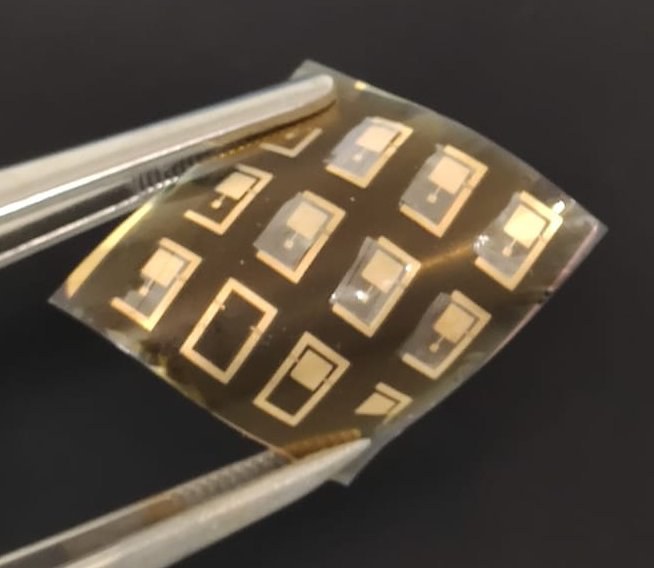
Biocompatible pressure sensors: In collaboration with the ERCD (UKD), we are developing biocompatible pressure sensors for directly measuring middle ear pressure. Currently, such measurements are either only possible indirectly or involve additional surgical procedures, which the new method will eliminate in the future. The use of an elastic polymer allows for capacitive pressure measurement in the range of +/- 70 mbar. We integrate tiny coils into our components to enable wireless communication via RFID.
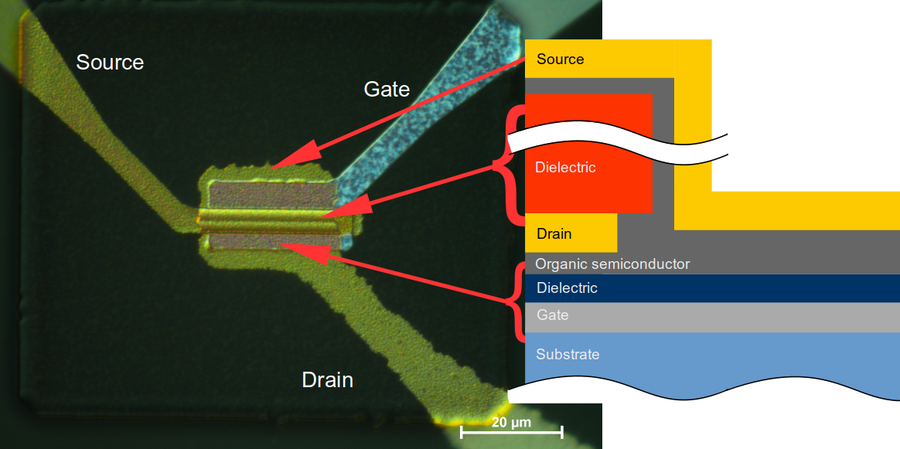
A integrated vertical organic thin-film transistor device in a configuration for high-frequency measurements.
Vertical organic transistors: In conventional horizontal organic thin-film transistors, the charge carrier transport is too low to produce transistors for major high-power electronic applications, such as display control or wireless communication.
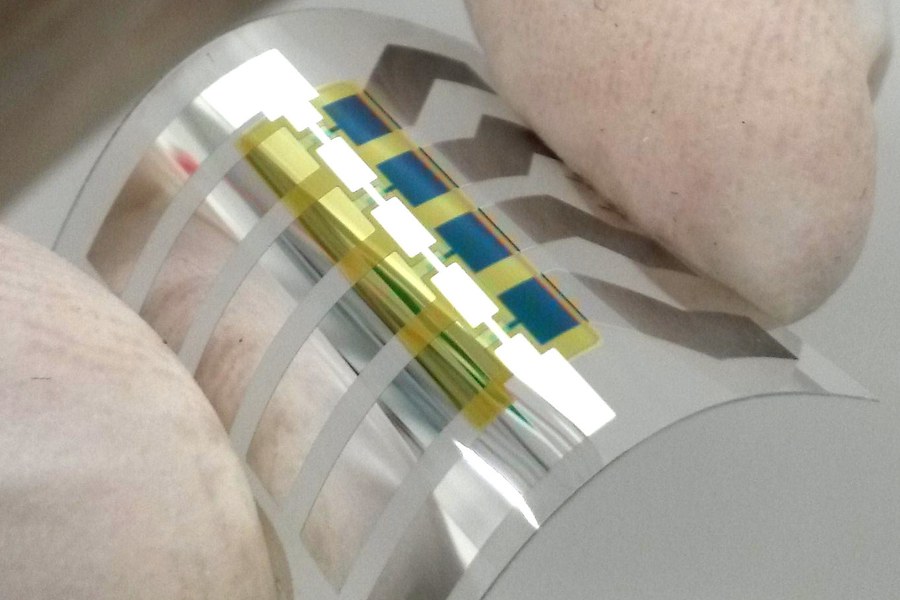
set of vertical organic triodes on a flexible PEN substrate.
Within the IAP, we developed novel vertical thin-film transistors and thin-film triodes that, due to their vertical architecture, can operate at up to 100 MHz. This significantly surpasses other organic transistors and allows them to even compete with inorganic components. The revolutionary component structure enables entirely new applications, such as single devices with integrated logic functions through a dual gate electrode.
 © Kai Schmidt
Prof. Dr. Karl Leo
Send encrypted email via the SecureMail portal (for TUD external users only).