
Relating trap states to the dark current of organic photodetectors
12/2020
Light sensing is a growing field. Nowadays, we are able to interact with technology due to many smart devices, all of which rely on some sort of signal detection. The current semiconductor technology used in such devices performs well, but many potential applications cannot be covered by inorganic semiconductors. In contrast, organic photodetectors (OPDs) are lightweight and can be fabricated in a formless, flexible and even stretchable fashion, besides being much cheaper and easier to produce, promoting them as good candidates for light detection in new applications [C. Fuentes-Hernandez et al. Science 370 (2020)]. However, the performance of these devices still has room for improvement. One of their main problems is the relatively large signal produced in the absence of stimulus, which arises from mid-gap trap states, the so-called dark current.
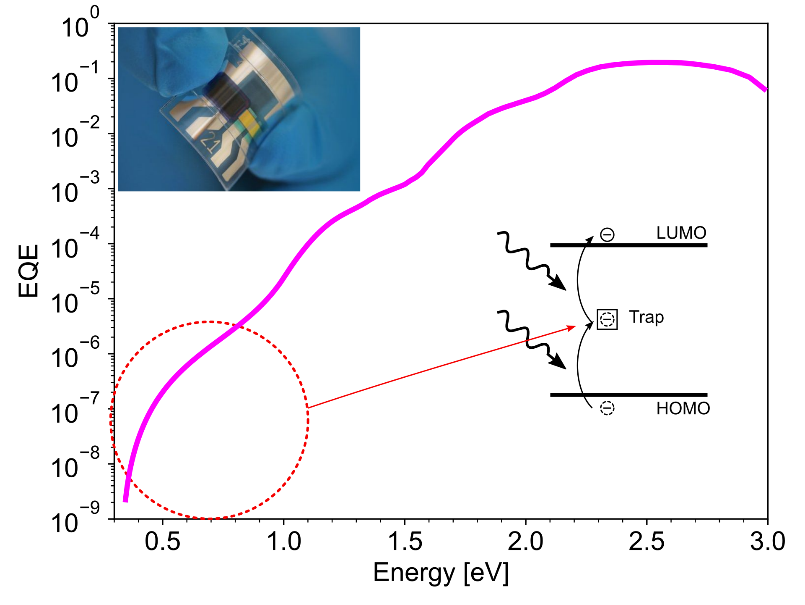
Schematic sub-gap absorption of a typical organic photodetector
In this project, we will fabricate devices using different organic molecules and relate device properties to structural characteristics of organic thin films. Trap states will be investigated with optical techniques, from which we expect to draw correlations between trap characteristics and dark current / device performance. The capability of trap states to generate charges will be analyzed by ultra-sensitive EQE measurements, as shown in the figure above. Moreover, standard OPD characterization will be performed, including current-voltage characteristics, responsivity and noise currents. Based on these measurements, a deeper understanding of the origin of the dark current will be achieved, which is the basis for substantial improvements of such photodetectors.
Contact:
 © Johannes Benduhn
Dr. Johannes Benduhn
Organic Sensors Group (OSens)
Send encrypted email via the SecureMail portal (for TUD external users only).