
Sascha Weber
 © Sascha Weber
Dr. rer. nat. Sascha Weber
Send encrypted email via the SecureMail portal (for TUD external users only).
Professur für Ingenieurpsychologie und angewandte Kognitionsforschung
Professur für Ingenieurpsychologie und angewandte Kognitionsforschung
Visiting address:
Bürogebäude Zellescher Weg, A222 Zellescher Weg 17
01069 Dresden
Office hours:
- Monday:
- 09:00 - 12:00
Termine außerhalb der Sprechzeiten können vereinbart werden.
Profile
Sascha Weber designs, develops and evaluates AI-based assistance systems for safety-critical work — from fault diagnosis in production plants and the safety assessment of computer vision systems in rail operations to supporting surgeons in the operating theatre. His central question is how the decisions of an AI system can be presented so that domain experts are able to examine them, judge them and reject them on good grounds.
Trained as a computer scientist and holding a doctorate in psychology, he combines the technical implementation with the empirical study of its effects: the systems examined in the user studies are built in the same projects.
Research Interests
- Explainable artificial intelligence (XAI) in practice — presenting reasoning chains, uncertainties and sources so that domain experts can interpret them; empirical assessment of comprehensibility, trust and overtrust
- Design and implementation of interactive assistance systems — from method development through prototypes in simulated and real environments to integration into existing workflows
- Human-centred design in safety-critical settings — user control with a clear division of roles and tasks, transparent system feedback and meaningful human oversight
- Knowledge elicitation and requirements analysis — expert interviews, qualitative content analysis and user stories as a bridge between real work practices and system design
- Knowledge-based expert assistants — locally deployable language models, retrieval-augmented generation and knowledge graphs for traceable answers drawn from organisational knowledge
- Eye movement research — measuring attention in real and virtual environments, including the comparison of human and machine attention distribution
Systems Developed
XAIminer
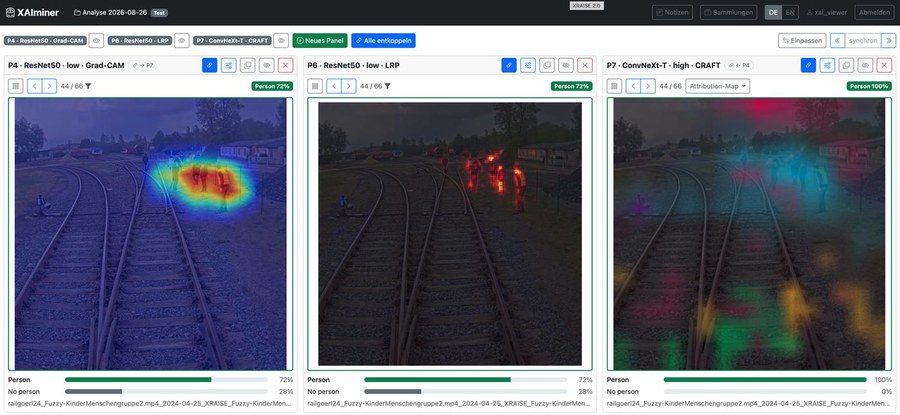
XAIminer is a browser-based system for comparing explanation methods for AI models side by side — several panels, each with its own model, method (Grad-CAM, LRP, CRAFT, CRP) and image, linked on request. It was built in the XRAISE project because no explanation method works universally: which one reveals anything depends on the task, the model and the image.
Project page XAIminer
Further systems
- Drilling noise monitoring assistant (INAK) — captures the noise generated while milling the skull bone, both at each moment and cumulatively over the course of the operation, and displays it to the surgeon; implemented in a simulation environment for cochlear implant surgery
- Dialogue-based diagnostic assistant (KoMMDia) — middleware and front end for AI-supported monitoring of packaging machines via OPC UA, using case-based reasoning for cooperative fault diagnosis
- Field study application (DESIGNATE) — recording user behaviour during social media consumption via a background service with data transfer to the cloud
Projects
Current projects
XRAISE — Explainable AI for Railway Safety Evaluations (2024–2026, German Federal Railway Authority). In automated train operation at grades GoA3 and GoA4, a technical system has to monitor the track ahead and detect obstacles — today the train driver's task. That cannot be done without machine learning. Yet the safety case under EN 50716 does not apply to deep neural networks, because their components are not interpretable the way conventional software is. XRAISE examines whether explainable AI can narrow this gap, and what risks arise when people interpret XAI results. Own contribution: design and development of XAIminer. Consortium: TU Dresden (Chair of Fundamentals of Electrical Engineering; Chair of Engineering Psychology and Applied Cognitive Research), EYYES Deutschland GmbH, PECS-WORK GmbH.
INAK — Interactive user-centred assistance system for cranial bone surgery (2024–2026, SAB). Milling the skull bone generates noise. In cochlear implant surgery this noise cannot be avoided, but it can be reduced enough to preserve the patient's residual hearing — which leaves surgeons with the demanding task of adjusting process parameters as the situation requires. The project first determines what information surgeons need during the operation, then builds process models of noise generation and develops an AI-based assistance system. Own contribution: development of combined assistance methods, their design and implementation in the simulation environment, and the study of their usefulness and applicability.
DESIGNATE — Sovereignty in the face of deceptive technologies (since 2022, TUDisc). Digital interfaces increasingly employ choice architectures intended to steer users' decisions — so-called dark patterns. Bringing together computer science, psychology and law, the project examines how effective they are and what countermeasures are available. Own contribution: development of the field study application.
Completed projects
XAI-Dia (2022–2025, DFG). Possibilities and consequences of explainable AI in fault diagnosis in industrial plants, with quality control in food production as the application case. In cooperation with the Chair of Fundamentals of Electrical Engineering and JR Die Schokoladenfabrik GmbH.
KoMMDia — Cooperative human-machine dialogue (2019–2022, funded by the BMBF programme "Technology-based service systems"). Development of an adaptive, dialogue-based assistance system using case-based reasoning for the cooperative diagnosis and elimination of faults in processing plants. With Fraunhofer IVV, Theegarten-Pactec GmbH & Co. KG and JR Die Schokoladenfabrik GmbH. Video feature on the project: zukunft-der-wertschoepfung.de/mediathek/…
FAIR (2012–2015). Bidirectional optical microdisplays integrating driver electronics, display, camera and evaluation electronics monolithically; combining augmented reality with gaze tracking for analysis, information enrichment and interaction.
FSGazeTrack (2010–2011). Attention distribution in a virtual driving environment. Based on real survey data, future construction projects were simulated and the visual attention of train drivers under adverse conditions was analysed.
3D Eye (2008–2009). Prototype for software-based strabismus treatment with coupled audiovisual 3D models and adaptive adjustment during recovery, in particular for children with amblyopia.
COGAIN — Communication by Gaze Interaction (2004–2007, EU IST 6th Framework Programme). Network of excellence aiming to make gaze tracking affordable and available to patients with ALS.
Publications
Human-AI Interaction and Attention
Müller, R., Dürschmidt, M., Ullrich, J., Knoll, C., Weber, S., & Seitz, S. (2024). Do humans and convolutional neural networks attend to similar areas during scene classification: Effects of task and image type. Applied Sciences, 14(6), 2648. https://doi.org/10.3390/app14062648
Eye-Tracking Research and Methodology Development
Weber, S., Schubert, R. S., Vogt, S., Velichkovsky, B. M., & Pannasch, S. (2017). Gaze3DFix: Detecting 3D fixations with an ellipsoidal bounding volume. Behavior Research Methods, 1-12. doi: https://doi.org/10.3758/s13428-017-0969-4
Weber, S., Helmert, J. R., Velichkovsky, B. M., & Pannasch, S. (2013). Eye tracking in real world and virtual environments: Algorithms for determining gaze position in 3D space. Proceedings of the17th European Conference on Eye Movements. Lund. Download
Weber, S., Pannasch, S., Helmert, J. R., & Velichkovsky, B. M. (2011). Eye tracking in virtual 3D environments: Challenges and directions of future research. Proceedings of the16th European Conference on Eye Movements. Marseille. Download