
Oct 26, 2026
New Collaborative Research: How Childhood Maltreatment Relates to Emotion Recognition
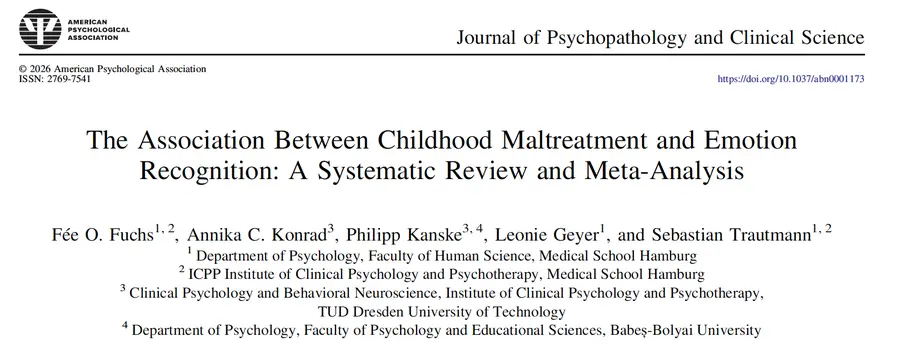
In a collaborative study, Fée O. Fuchs, Leonie Geyer, Sebastian Trautmann, together with Annika C. Konrad and Philipp Kanske in our group brought together research on childhood adversity and social cognition to investigate how childhood maltreatment relates to emotion recognition in adulthood. Through a systematic review and meta-analysis of 40 studies involving 6,369 adults, the team examined whether childhood maltreatment is associated with differences in recognizing facial emotions, including recognition accuracy and reaction times.
The results showed a small but significant difference in emotion recognition accuracy between individuals with high and low childhood maltreatment exposure, particularly for neutral and disgusted facial expressions. However, no significant association was found between maltreatment severity and recognition accuracy in dimensional analyses, and reaction times showed no significant effects. These findings suggest that early adverse experiences may be associated with subtle differences in social perception, particularly when interpreting certain emotional expressions. The study highlights the importance of understanding how early experiences may shape social functioning, while underscoring the need for further research into the mechanisms underlying these associations.
Publication: Fuchs, F. O., Konrad, A. C., Kanske, P., Geyer, L., & Trautmann, S. (2026). The association between childhood maltreatment and emotion recognition: A systematic review and meta-analysis. Journal of Psychopathology and Clinical Science.