
Oct 26, 2026
New Collaborative Research: Understanding Emotion Regulation in Bipolar I Disorder
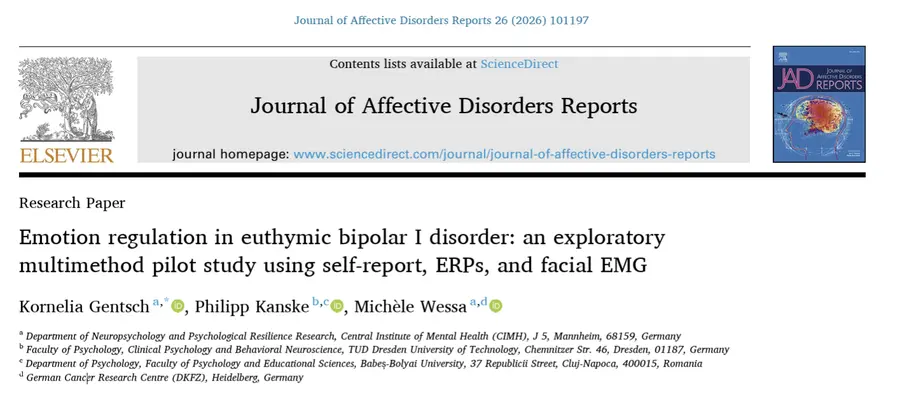
In a collaborative study, Kornelia Gentsch, Philipp Kanske, and Michèle Wessa investigated how people with bipolar I disorder (BD-I) regulate their emotions during periods of remission. Combining expertise in emotion research and clinical neuroscience, the team used a multimethod approach, integrating self-reported emotional experiences, brain activity (event-related potentials; ERPs), and facial muscle responses (EMG) to compare 22 participants with euthymic BD-I and 22 healthy controls.
The findings revealed interesting differences in the regulation of positive emotions: while healthy controls showed reduced brain responses during distraction and reappraisal, participants with BD-I did not show reliable attenuation of the late positive potential (LPP). Both groups reported reduced emotional responses when regulating emotions, but participants with BD-I reported more rumination and catastrophizing, and less habitual positive reappraisal. These preliminary findings suggest that positive emotion regulation may be a particularly relevant area for understanding bipolar disorder, highlighting the importance of further research into emotional processes and illness vulnerability.
Publication: Gentsch, K., Kanske, P., & Wessa, M. (2026). Emotion Regulation in Euthymic Bipolar I Disorder: An Exploratory Multimethod Pilot Study Using Self-Report, ERPs, and Facial EMG. Journal of Affective Disorders Reports, 101197.