
Sep 08, 2026
Air-Take-Off: Research Findings on the Safe Integration of Drones into Airspace Demonstrated
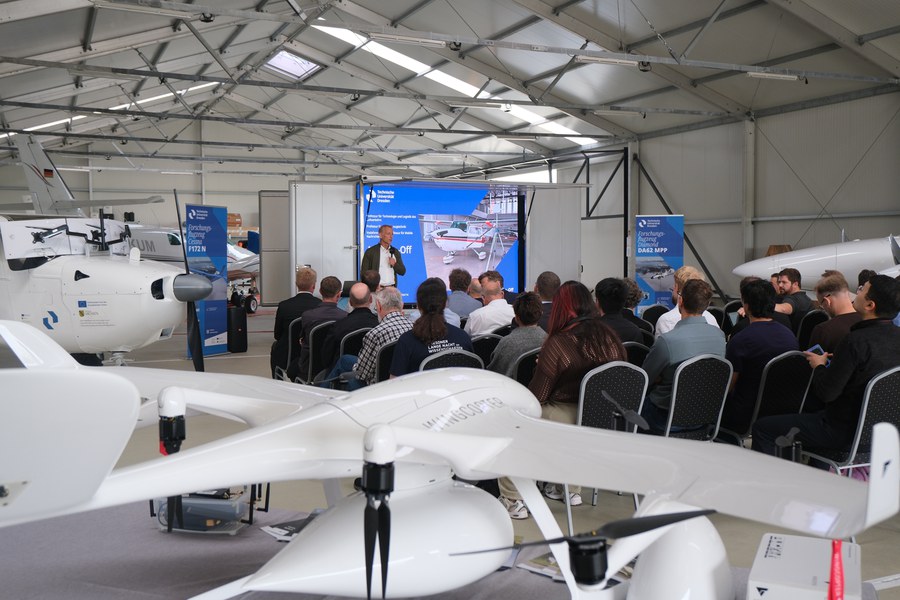
Final demonstration of the Air-Take-Off research project at the Kamenz airfield. Among other things, the demonstration featured methods for aircraft detection, conflict detection, and communication between manned and unmanned aircraft.
Detection and Conflict Avoidance
One of Air-Take-Off’s key focuses was the safe integration of UAVs into manned airspace. To achieve this, cooperative procedures based on transmitted position data were combined with camera-based methods of computer vision and artificial intelligence. The goal is to achieve as complete a situational awareness as possible in order to detect and locate other airspace users and identify critical encounters at an early stage. Building on this, methods for automated conflict avoidance were investigated.
“With Air-Take-Off, various building blocks for the safe interaction of manned and unmanned aviation were developed and tested under real-world conditions. The results provide a foundation for safely integrating more complex automated UAS operations into existing air traffic in the future,” explains Prof. Hartmut Fricke, holder of the Chair of Air Transport Technology and Logistics and project leader of Air-Take-Off.
UAV Deployment from Manned Aircraft
Another focus of the project examined the airborne deployment of fixed-wing UAVs from a manned aircraft. Using aerodynamic simulations, the conditions for a safe release procedure, among other factors, were analyzed. One possible application scenario involves time-critical shipments in which a UAV takes over the final leg to the destination—for example, for relief supplies or medical transports to hard-to-reach regions. This concept gave the project its name: Air-Take-Off.
Communication via 5G
Various wireless communication technologies were also investigated to enable coordinated interaction between the manned aircraft and the UAV. During the final demonstration, it was shown how the manned research aircraft can serve as a communication node for a UAV via the mobile 5G campus network. This is particularly relevant for operational scenarios in which terrestrial communication infrastructure is only available to a limited extent.
Continuation at the Smart Mobility Lab
The methods and research platforms developed in the project will continue to be used in the Smart Mobility Lab. The VTOL research drone procured as part of Air-Take-Off will serve as a flexible sensor platform for further work on detection, sensor fusion, conflict detection and avoidance, automated flight control, and BVLOS operations.
The Air-Take-Off research project is funded under the EFRE/JTF – Research and Development – Project Funding 2021 to 2027. The project is scheduled to conclude in October 2026.
A detailed report on the final demonstration and the research results is available in Mobility Magazine:
Read the detailed report in Mobility Magazine