
Sep 08, 2026
New Research Drone Expands the Experimental Capabilities of the Smart Mobility Lab
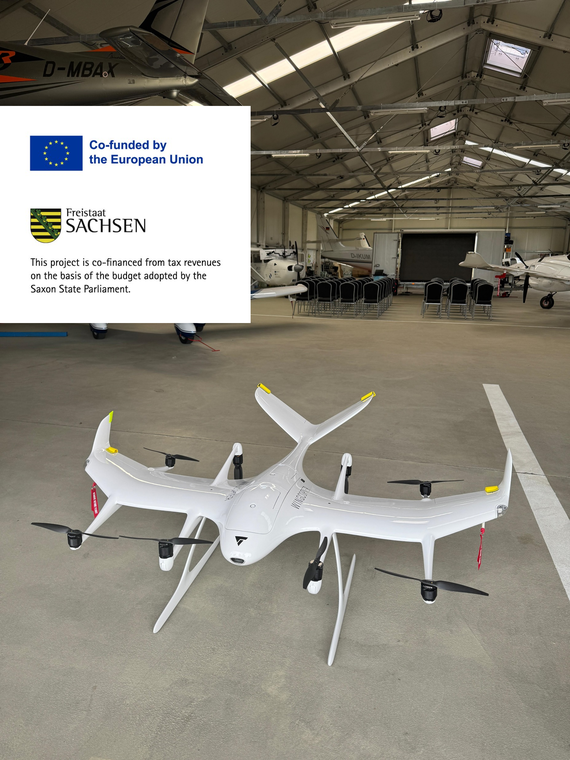
A new VTOL research drone expands the experimental capabilities of the Smart Mobility Lab. As a flexible sensor platform, it will initially be used in the Air-Take-Off project to study aircraft detection as well as conflict detection and avoidance—and will support numerous other research projects in the future, ranging from large-scale data collection to BVLOS operations.
The Smart Mobility Lab is receiving a new VTOL research drone, which will serve as a versatile sensor and test platform for research in the field of automated and unmanned aviation. The combination of vertical takeoff and landing with efficient winged flight enables, in particular, longer measurement, reconnaissance, and research missions over larger areas.
The drone was procured as part of the Air-Take-Off research project at TU Dresden. The project is part of the EFRE/JTF – Research and Development – Project Funding 2021 to 2027. Air-Take-Off focuses in particular on the safe interaction between unmanned and manned aircraft and is developing methods for detecting and localizing air traffic participants as well as for automated conflict detection and collision avoidance.
In the project, the new drone serves as a mobile sensor platform. It allows various sensors and algorithms to be tested under real-world flight conditions and enables the recording of measurement data for the development and validation of new methods. A key focus is on methods for detecting and localizing other air traffic participants and assessing their movement or flight intent. Building on this, critical encounter situations are identified, and methods for conflict avoidance are investigated. This work complements the manned research platform already in use in the project, a Cessna 172.
The additional unmanned platform enables, in particular, more frequent and flexibly configurable tests without having to rely on the manned research aircraft for every sensor or algorithm investigation. The Cessna remains particularly relevant for experiments in which the perspective or interaction of manned aviation itself is the subject of investigation or a higher payload is required. Sensor development, preliminary flight tests, data collection, and the step-by-step validation of algorithms, on the other hand, can already be carried out using the new research drone.
Beyond Air-Take-Off, the platform will be used in the future for numerous research projects at the Smart Mobility Lab. Possible applications include, among other things , large-scale survey and data collection missions, the testing of various sensor systems and sensor fusion methods, AI-based object recognition, detect-and-avoid procedures, automated flight control, and investigations into BVLOS operations. The drone thus complements the SML’s emerging research infrastructure with a mobile platform that allows new methods to be tested in a targeted manner initially and then transferred to more complex test scenarios. The SML’s outdoor test site is intended, among other things, for BVLOS tests and large-scale mission scenarios.