
Oct 15, 2026
Shaping Change in Lusatia: Smart Mobility Lab Receives Multi-Million-Euro STARK Grant from the Federal Government
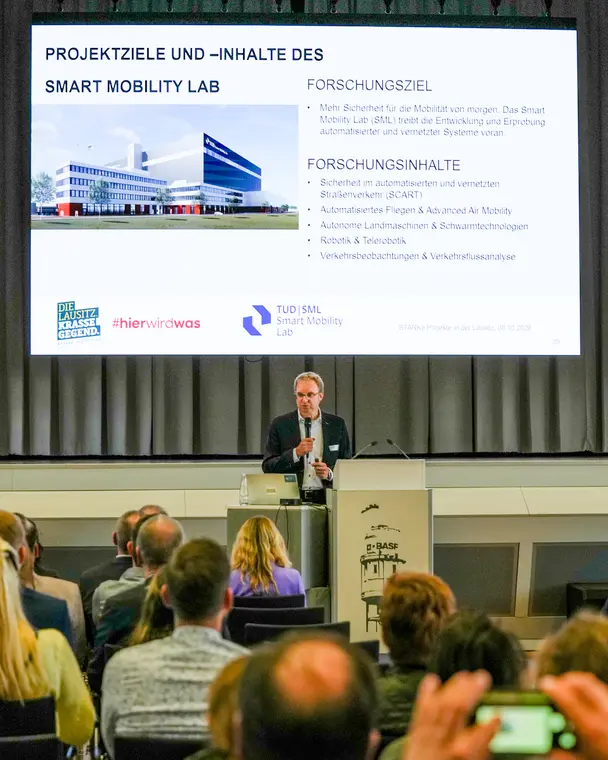
STARK Projects in Lusatia – From the Region, For the Region
About 300 participants from politics, business, academia, associations, and civil society gathered in Schwarzheide on October 8 for a networking event, during which grant award notifications were presented to recipients from Brandenburg and Saxony, and selected STARK projects from both states were showcased. Among them was the Smart Mobility Lab (SML) at the TUD Dresden University of Technology, a key stakeholder in education and technology transfer in Lusatia. Its STARK project will receive a total of 5.8 million euros in funding over four years.
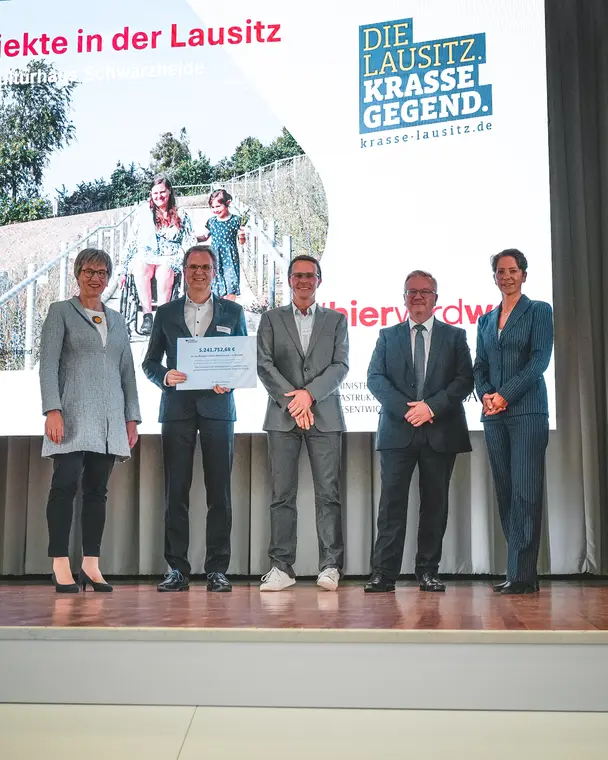
The President of the Federal Office for Economic Affairs and Export Control, Dr. Mandy Pastohr, presented the grant notification to Prof. Günther Prokop on behalf of the Smart Mobility Lab (SML) at the Technical University of Dresden (TUD) in the presence of the Head of the Brandenburg State Chancellery, Minister Kathrin Schneider, and the Saxon State Secretary for Infrastructure and Regional Development, Sören Trillenberg, presented the grant notification to Prof. Günther Prokop for the TUD’s Smart Mobility Lab (SML). Additional funding was awarded to the NET Zero Valley Lausitz office, the project “UNESCO 5 – The Lusatian UNESCO Sites as Pearls of Sustainable Development in Lusatia – Shaping Heritage and Connecting People,” and the project “TRAIL – Transfer and Innovations for Lusatia | Sharing Knowledge, Shaping Change.”
Research, Education, and Engagement Formats
The SML strengthens the Lausitz region as a hub for future-oriented mobility research, education, and technology transfer. The SML’s goal is to further develop automated and connected systems and test them under real-world conditions. The focus is on the safety of tomorrow’s mobility. Core research areas include safety in automated and connected road traffic, automated flight and Advanced Air Mobility, autonomous agricultural machinery and swarm technologies, robotics and telerobotics, as well as traffic monitoring and traffic flow analyses.
The funded STARK project is a key component of this effort. “It aims to establish a continuous research and validation chain for automated driving functions,” explains Prof. Günther Prokop, spokesperson for the SML and holder of the TUD Chair of Automobile Engineering. “This ranges from real-world traffic data to simulations and on to cyber-physical field tests in the Smart Mobility Lab. The world’s largest driving simulator is also used here to develop and validate driver assistance and automated driving functions. The research infrastructure is complemented by a cyber-physical test setup that enables realistic testing of complex traffic situations. In addition, a methodology is being developed to derive safety-relevant traffic scenarios from traffic observations and accident data.”
Actively Engaging and Involving People in the Region
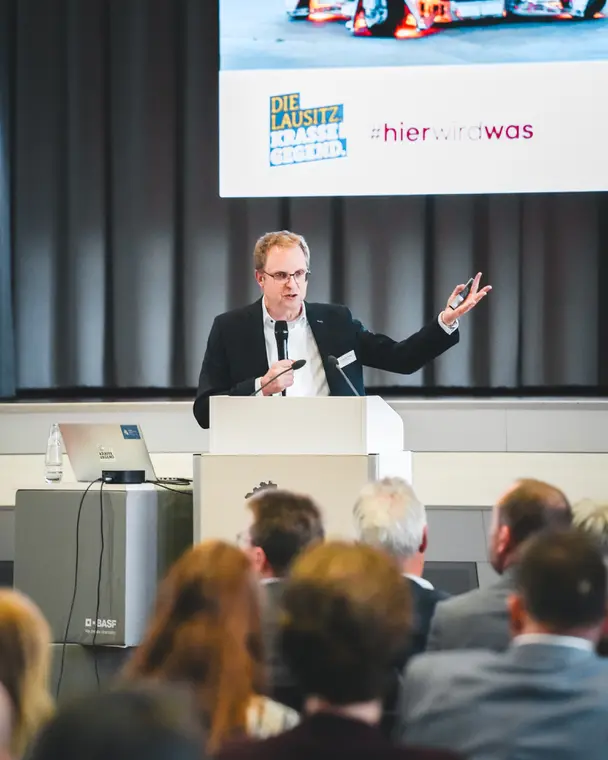
In addition to research, the STARK project also explicitly pursues a social goal. “The MITMACH Lab at the Neustadtforum in Hoyerswerda is intended to actively involve the public in the development of automated mobility,” emphasizes Tobias Zschieschick, coordinator of the SML. “Educational and participatory programs for different age groups and target audiences are designed to impart knowledge, foster acceptance, and open up new prospects for the future of Lusatia.”
The collaboration between the SML and the STARK project is yielding new methods and insights for the safe validation of automated mobility, as well as capabilities for research and validation. At the same time, the practical testing of automated driving functions creates new opportunities for knowledge transfer, collaboration, and educational programs. This strengthens Lusatia as a hub for innovation and builds long-term value creation potential.
Shaping Structural Change in Lusatia Together
At the event in Schwarzheide, Brandenburg and Saxony jointly showcased for the first time what is being developed in the Lusatia region with the support of the federal STARK program. Among other things, the presentation featured funded projects on heat transformation in the Spremberg, Hoyerswerda, and Weißwasser region; the development of the Net Zero Valley Lausitz; the Einstein Telescope; tourism development in the Lausitz Lake District; and the “Jugend bewegt Regionen” project.
Further information on the event and background details on STARK funding are available in the press release from the Saxon State Ministry of Infrastructure and Regional Development.
Further Information
Federal STARK Program in Brandenburg:
STARK – Lusatia Economic Region
STARK Federal Program in Saxony:
https://www.strukturentwicklung.sachsen.de/bundesfoerderung-stark-4097.html
Media Contact
TUD Dresden University of Technology
Smart Mobility Lab
Prof. Dr. Günther Prokop
0351 463 34782
Website www.tu-dresden.de/sml