
Jun 04, 2026
Winckelmann Lecture |Elisabeth Oy-Marra: Antonio Allegri from Correggio. How a painter from the Emilian province achieved world fame | 01.07.2026
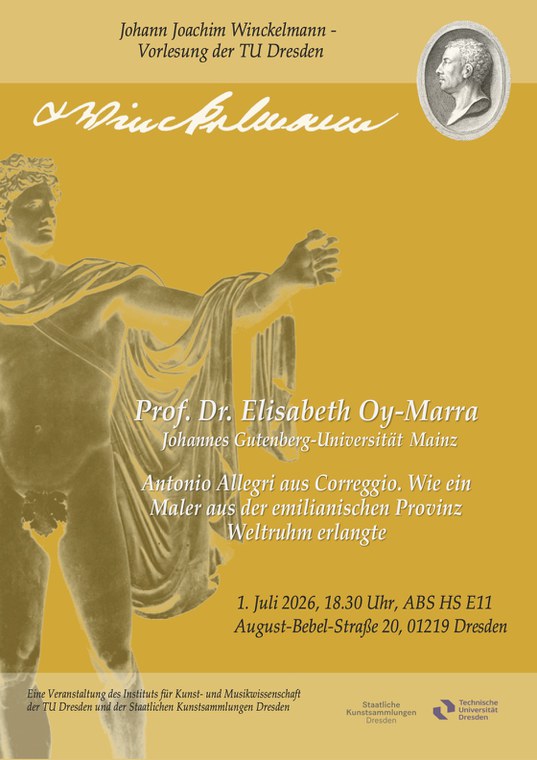
We invite all interested parties to the annual Johann Joachim Winckelmann Lecture!
The Winckelmann Lecture, organized by the Institut für Kunst- und Musikwissenschaft in cooperation with the Staatliche Kunstsammlungen Dresden (SKD), traditionally takes place on July 1.
|
Antonio Allegri from Correggio. How a painter from the Emilian province achieved world fame Lecture by Prof. Dr. Elisabeth Oy-Marra (JGU Mainz) |
|
|
Wednesday, 01.07.2026, 18.30 hrs |
|
This year we are delighted to welcome art historian Prof. Dr. Elisabeth Oy-Marra from Johannes Gutenberg University Mainz, who will give a lecture entitled Antonio Allegri from Correggio. How a painter from the Emilian province achieved world fame .

Antonio da Correggio, Nativity (Adoration of the Shepherds), c. 1529–1530, Oil on canvas, 256.5 cm × 188 cm, Gemäldegalerie Alte Meister, Dresden
Who still knows the painter from the small town of Correggio in Emilia today? While Leonardo, Raphael and Michelangelo have lost none of their fame, their contemporary Antonio Allegri, known as Correggio, seems to be known only to a few specialists today. This was not always the case. At the height of his fame in the 18th century, the Saxon court painter Ismael Mengs chose the name Anton Raphael as his son's nickname, and not only equated Correggio with Raphael, but also saw his son as a direct follower of the two giants. But how could a painter from Correggio achieve fame? How could an altarpiece such as the Adoration of the Shepherds, the so-called Holy Night (Gemäldegalerie für Alte Meister, Dresden), which was painted for a family chapel in San Prospero in Reggio Emilia, become famous beyond many borders?
The lecture examines the mechanisms and media of a reception that managed without influencers and Instagram. It is not least about social structures that are reflected in this reception. The art literature never tired of praising the special colorfulness of his works and, above all, the soft, fluffy application of paint, which lends his paintings a sensual, erotic note. It will also be necessary to discuss why precisely these qualities have apparently been less appreciated since the 20th century and what this reveals about us.

Correggio, 1531-32, Oil on canvas, 161 cm × 193 cm, Galleria Borghese, Rome
It is not only the Winckelmann Lecture that is dedicated to the famous Italian painter this year, but the Gemäldegalerie Alte Meister is also preparing the first exhibition Correggio. Movingly Human, the first show of his complete works, with works from the gallery's own collection as well as loans from Paris, Madrid and Florence. If you would like to get in the mood for Correggio's work before visiting the exhibition, the lecture by Prof. Dr. Elisabeth Oy-Marra is a good opportunity to do so.
You are welcome to stay for a moment after the lecture: The Winckelmann Lecture will be followed by the Institute's annual summer party with a colorful program and refreshing drinks.
We look forward to your participation!