
Mar 19, 2026
An Alumnus' Research Work Helps to Boost Poverty Alleviation in China
Jianfeng Zhang
Currently, the world's population has reached 7.6 billion, with approximately 700 million people living below the poverty line. This clearly shows that the global path to poverty reduction is long and arduous. In most impoverished regions, people's livelihoods heavily rely on the development of agriculture and animal husbandry, both of which are closely linked to ecological environments and climate change, frequently leading to severe environmental pollution problems. Therefore, exploring a path of poverty alleviating ecologically and green development is essential.
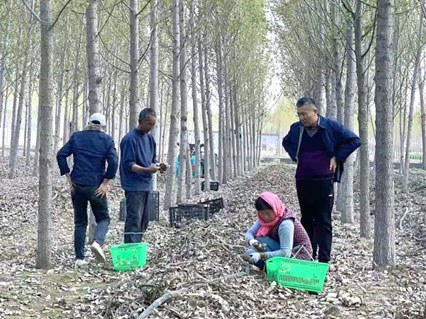
Growing mushrooms in plantations
China has implemented numerous original and distinctive major initiatives, launching the largest and most intensive poverty reduction campaign in human history. After eight years of relentless efforts, nearly 100 million impoverished people in China have been lifted out of poverty, fulfilling the poverty alleviation targets set for the new era and achieving the UN 2030 Agenda for Sustainable Development's poverty reduction goals a decade ahead of schedule.
During this process, Professor Jianfeng Zhang and his team leveraged the professional expertise, actively participated in poverty alleviating ecologically, and contributed outstanding achievements by working on the frontlines and tackling challenges. He has studied for MSc of Tropical Forestry between 1995 and 1997 at TU Dresden. With the course he learned forest management and landscape transition in Germany, and understood the significance of interests balance and sustained development. No doubt, this experience laid a solid professional foundation and enhanced capability building. In the last November Jianfeng Zhang attended the 30-year anniversary of the MSc-program Tropical Forestry at TU Dresden.
His research (see the paper "Developing Forestry Helps Poverty Reduction and Environmental Improvement" published in the Journal of Forestry Research (DOI: 10.1007/s11676-021-01450-5)) has shown that developing forestry can help promote economic growth. Therefore, in some impoverished areas, although natural conditions may be poor, income can still be increased and poverty can be overcome through the developing forestry. Obviously, to fundamentally achieve poverty alleviation, the key is to strengthen ecological construction, combining resource cultivation, environmental improvement, technical innovation and industrial development.
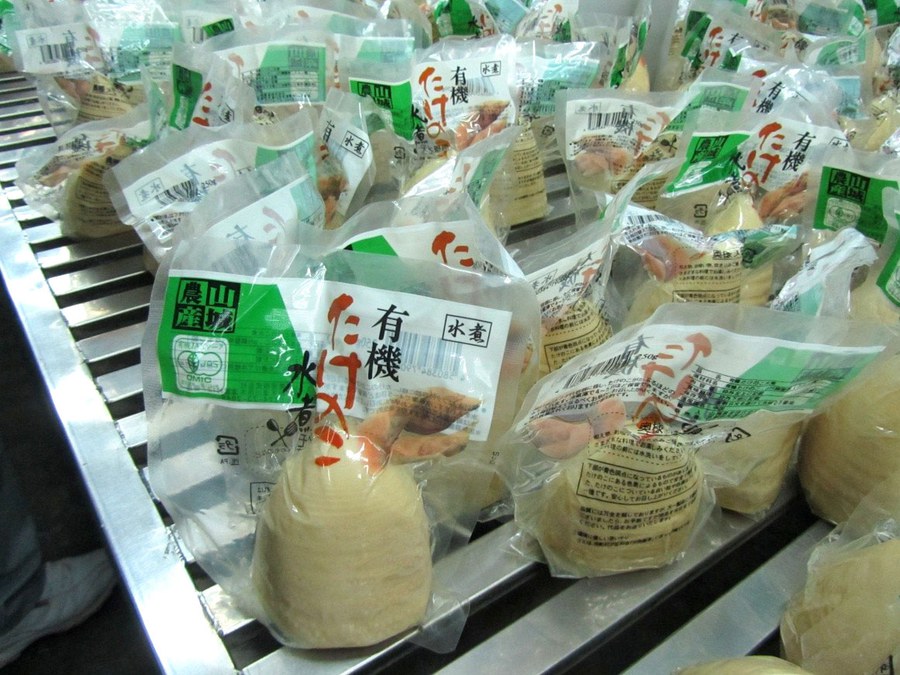
Bamboo shoot processing and exporting to Japan
Moreover, developing bamboo industry is an effective way to help alleviate poverty in mountainous areas and improve the socio-economic situation in rural areas (see the paper 'Practices and Roles of Bamboo Industry Development for Alleviating Poverty in China' published in the journal Clean Technologies and Environmental Policy(https://doi.org/10.1007/s10098-021-02074-3)).
Besides, with continuous growth of China's population and the acceleration of urbanization, environmental problems in drinking water sources areas are becoming increasingly prominent. In view of this, Zhang's team has conducted probe on green development models in the Yangtze River Delta region. The study results are concluded into the article "Cleaner Agricultural Production in Drinking Water Source Areas for the Control of Non-point Source Pollution in China" published in Journal of Environmental Management(https://doi.org/10.1016/j.jenvman.2021.112096.
Clearly these relevant papers have been published in internationally renowned academic journals, demonstrating that China's practices and technologies, which provide valuable experience for global poverty alleviating ecologically and green development.
Brief introduction of Jianfeng ZHANG
Prof. Dr. Jianfeng ZHANG, works at Institute of Subtropical Forestry of Chinese Academy of Forestry.
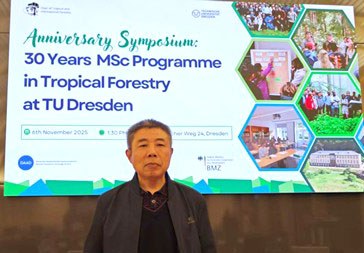
Jianfeng Zhang attended 30-years Anniversary of the MSc-program
His research begun since 1990 after graduating from Shandong Agricultural University (studied for BSc & MSc of Forestry from 1983 to 1990). Main activities are devoted to silviculture and degraded land ecological rehabilitation, especially saline soil amelioration and non-point source pollution control in water source areas. As well, initiates the probe on ecology of human settlement. Based on these, three relevant books have been published in Springer Nature:“Coastal Saline Soil Rehabilitation And Utilization Based on Forestry Approach in China” (https://link.springer.com/book/10.1007%2F978-3-642-39915-2;“Forestry Measures for Ecologically Controlling Non-point Source Pollution in Taihu Lake Watershed, China”(https://link.springer.com/book/10.1007/978-981-10-1850-3);“Study of Ecological Engineering of Human Settlements”(https://link.springer.com/book/10.1007%2F978-981-15-1373-2). Besides of the work he studied for PhD at Beijing Forestry University (1999-2003). Moreover as visiting scholar performed researches at Institute of Soil Science, Technical University of Dresden (TUD) supported by CSC during 2001-2002. Also studied for MSc. at International Institute for Forestry of TUD (1995-1997) sponsored by DAAD. Meanwhile he acted as Topic Editor for the journal Frontiers in Plant Science and Guest Editor of the journal Forests. Currently more than 170 papers have been published by internal/international journals.
Contact:
Professor Jianfeng Zhang