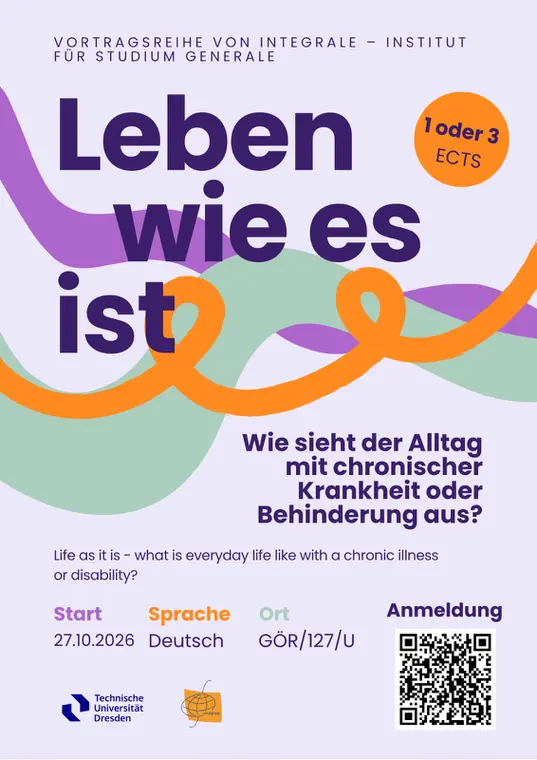
Die Ringvorlesung
Jedes Semester bietet Integrale eine Ringvorlesung zu einem aktuellen Thema an, das aus verschiedenen Blickwinkeln betrachtet wird. Ziel ist es, Studierende und Interessierte an fachübergreifende Themen, Konzepte und Methoden heranzuführen. Für diese interdisziplinäre Veranstaltungsreihe laden wir unterschiedlichste interne und externe ReferentInnen ein, um gemeinsam zu lernen und zu diskutieren.
Studierende haben die Möglichkeit, einen Teilnahmeschein (1 LP) oder einen Leistungsschein über die Teilnahme an der Klausur (3 LP) zu erlangen.
Summer term 2026:
Understanding Artifical Inteliggence: Interdisciplinary Perspectives on Opportunities, Limits and Responsability (English)
The lecture series provides an accessible introduction to the topic of artificial intelligence. Participants learn about fundamental principles and different types of AI, explore legal frameworks, and gain insights into the use of AI in scientific research. Finally, ethical challenges and questions of sustainability are discussed in order to promote a reflective and responsible approach to AI. The lecture will be held in English.
When: Tuesdays from 6:30-8:00 pm
Where: GÖR/127/U
Please enroll via OPAL. You will also find all further information there. We kindly ask all non-TUD students to refer to the Enrollment Instructions.
Please note that the schedule is not final yet and will still be adjusted.
| Date | Title | Lecturer(s) | Description |
| 21.04.26 | Introduction | Josué Cumpa and Elena Altmann (Integrale RV), Stefan Köpsell (Integrale) | General introduction to the lecture series "Understanding Artificial Intelligence"; short Introduction to Integrale, Introduction to the work of Dresden Concept |
| 28.04.26 | AI's Seven Decades of Learning and the Future in Science | Dr. Artur Yakimovich (HZDR) | While AI may seem like an “overnight” success, it has a long-standing history in various domains. This talk offers a glimpse of the fascinating history of Artificial Intelligence, touches upon exciting applications today and unveils some prospects of AI in Science. |
| 05.05.26 |
Knowledge or just probability? An Introduction to Large Language Models |
Dr. Michael Färber (ScaDS.AI, TUD) | This lecture offers an introduction to large language models and the ideas behind today's AI systems such as ChatGPT. It explains the Transformer architecture as the key breakthrough in modern language processing, shows how these models handle text using attention mechanisms, and presents the main types of language models together with their typical strengths and areas of application. |
| 12.05.26 | Neural Information Processing & Deep Learning - Old Wine in New Bottles? | Dr. Hans-Joachim Böhme (HTWD) | The lecture highlights the basics of neural information processing, needed for understanding the modern techniques of deep learning. Starting with formal models of neurons and principles of learning rules, the lecture gives a coarse insight where they can be found in deep learning architectures. Finally, we will discuss the major differences between "old fashioned" neural networks and deep learning models. |
| 19.05.26 | Creativity in the Age of AI: A Legal Perspective | Dr. Anne Lauber-Rönsberg (TUD) | Copyright law protects human creations. What rules apply to AI-generated output? Are there labeling requirements for AI-generated content? What framework applies to training AI with human works: To what extent can creators prevent their works from being used for AI training, and are they entitled to financial compensation in such cases? And does all of this also apply to academic publications and student work? |
| 26.05.26 | Pfingstferien - no lecture! | ||
| 02.06.26 | to be announced... | Dr.-Ing. Elif Bilge Kavun (BI/TUD) | to be announced... |
| 09.06.26 | Will AI replace scientist? On the changes AI will make in science | Dr. Michael Färber (ScaDS.AI, TUD) | Science is producing knowledge at a pace no human can follow. The challenge is no longer access to data, but uncovering meaningful insights. Knowledge graphs help by structuring complex information, while large language models (LLMs) provide reasoning to connect the dots. Together, they enable systems that can analyze millions of research papers, extract evidence-based insights, and turn scattered knowledge into understanding. This lecture will explore how the combination of knowledge graphs and LLMs is changing the way we work with scientific literature and what this means for the future role of AI—and of scientists themselves. |
| 16.06.26 | The Power of Data: An Overview of AI Applications in Healthcare | Dr. Narmin Ghaffari Laleh (Kather Lab) | Artificial intelligence is no longer a concept limited to science fiction. It has become an integral part of our daily lives, influencing how we live and work. The pace of adoption has accelerated significantly with the emergence of large language models. This development is also having a substantial impact on healthcare. In this presentation, we will have an overview of the main applications of AI in healthcare. In addition, we will discuss the potential benefits and limitations of these systems, as well as important considerations and risks that need to be taken into account when applying AI in medical contexts. |
| 23.06.26 | Deep Learning – deep ethics | Dr. Birte Platow (ScaDS.AI, TUD) | The call for legal regulations for AI is rightly becoming louder, because AI has the potential to fundamentally change our society. And yet most ideas of “rules” and ‘ethics’ fall short because they focus “only” on AI and ignore human behavior. In this lecture, we want to bridge this gap and explore ethics for AI from a systemic perspective - in other words, deep ethics. |
| 30.06.26 | to be announced... | ||
| 07.07.26 | to be announced... | ||
| 14.07.26 | Synthesis/exam preparation | Josué Cumpa and Elena Altmann (Integrale RV) | |

| 21.07.26 | Exam | Josué Cumpa and Elena Altmann (Integrale RV) |
© Laura Hartmann
Team "Ringvorlesung"
Eine verschlüsselte E-Mail über das SecureMail-Portal versenden (nur für TUD-externe Personen).
Besuchsadresse:
StuRa-Baracke, Raum 14 George-Bähr-Str 1e
01069 Dresden
Postadresse:
Technische Universität Dresden
Studierendenrat TU Dresden
Integrale
01062 Dresden