
Teaching room equipment
TU Dresden aims to provide diverse, flexible and sustainable learning and teaching environments - both physical and digital. Technically well-equipped, atmospherically appealing rooms enable individual, time- and location-independent learning as well as different teaching formats.
Collaboration and communication are promoted in a targeted manner through flexible room design, maker spaces and learning labs. The campus also offers sufficient space for self-organized learning. The interplay of digital and physical learning spaces strengthens identification with the university and promotes the active participation of all members.
(There are cross-references to the teaching & university development strategy throughout this section).
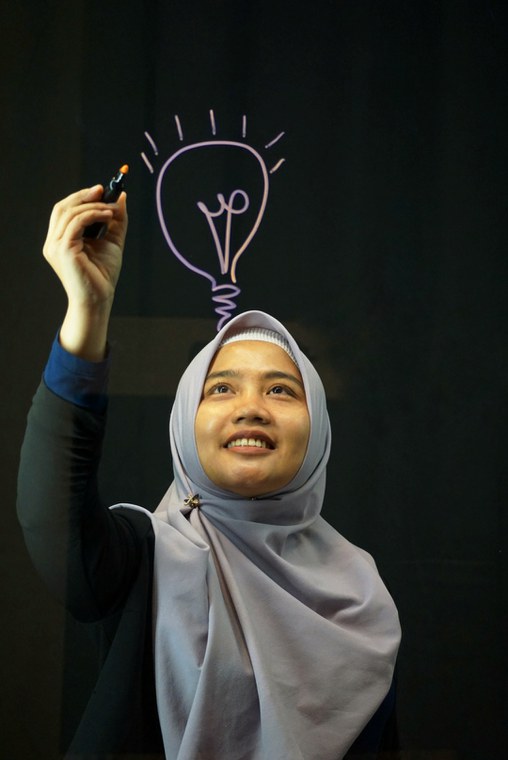
A student has a lightbulb moment.
What do we want?
TU Dresden recognizes the design of spaces as places of learning and teaching, both didactically and technically, as a strategic element in spatial planning. The physical teaching and learning spaces at TU Dresden are equipped in such a way that they enable collaboration and co-creation of knowledge. In this way, they add value and promote identification with the institution. They increase their "added value of presence" through profound learning experiences. The rooms are open, multifunctional and can be designed in a variety of ways, inviting people to linger and awakening a desire to learn.
All learning and teaching spaces at TU Dresden enable interactive and hybrid teaching with the latest technology and room equipment required at the time of implementation and beyond. Both plug-and-play and "bring your own device" (BYOD) are supported with appropriate equipment. The use of the technology is explained in searchable, actively maintained documentation.
Where do we want to go?
From room equipment to room design
TU Dresden provides flexible and sustainable learning and teaching spaces that can be used both analog and digitally. Mobile furniture and flexible room concepts enable a variety of teaching and learning scenarios, from group work to individual learning, and are tailored to the needs of the users.
Both teachers and students have stable access to the university network at all times in order to implement collaborative and interactive formats with real-time multimedia transmission. Digital and physical rooms can be booked centrally, which facilitates spontaneous working and learning meetings. The rooms are equipped with modern technology, suitable adapters, mobile multimedia systems and creative materials such as smartboards and moderation aids. In addition, comfortable seating areas create informal learning settings that also enable digital participation for remote learners. Experimental room concepts and virtual learning spaces complement the offer and promote self-organized learning that is flexible in terms of time and place. Teachers increasingly see themselves as learning guides who support individual learning paths.
Maker spaces and learning labs offer creative and interactive places for experimentation and innovation. In addition, there are sufficient learning spaces available on campus for individual and collaborative learning, which create optimal conditions for independent study.
How do we achieve this?
- Systematic recording of the technical, organizational and financial requirements
- Commitment to providing the necessary resources - Provision of the necessary hardware and software infrastructure
- Systematic analysis of all existing equipment in the teaching/learning rooms
- Care, maintenance and modernization of equipment (incl. hardware and software) is prioritized
- Roadmap for implementing the respective subtasks, including defining responsibilities and deadlines
- Training options for learners and teachers to transfer the opportunities created into use.
- Establish and further develop support structures
- Revive the Campus Navigator project and expand it to include the room equipment segment (as an information system/learning room overview)
- Create different interaction concepts taking into account the respective room concept and use the interfaces between digital and physical learning environments