
Bisherige Pflanze der Woche - Gewöhnliche Pestwurz
Petasites hybridus (L.) G.Gaertn., B.Mey. & Scherb.
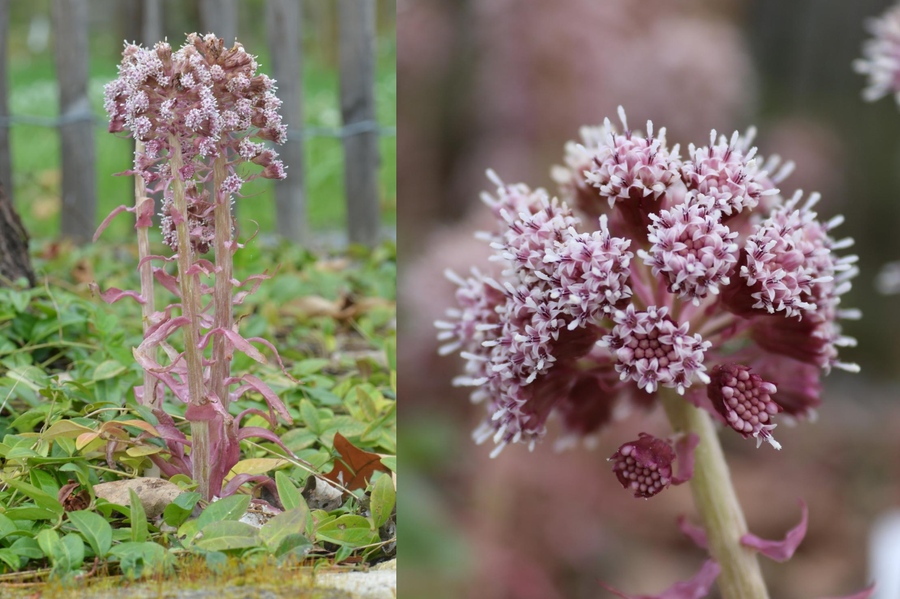
Im Pflanzenbestand des Lehr-Schulgartens sind die weißen männlichen Staubbeutel, welche weit aus den winzigen Röhrenblüten der Gewöhnlichen Pestwurz herausragen, gut zu erkennen.
Gewöhnlich wirkt sie eigentlich gar nicht, die Gewöhnliche Pestwurz Petasites hybridus. Eher ein wenig wie nicht von dieser Welt? Ihre rosaroten Blütenstände mit bleichen, lanzettlichen Stängelblättern durchbrechen im zeitigen Frühling den Erdboden. Sie erinnern an Schmarotzerpflanzen, z.B. an die zeitgleich blühende Schuppenwurz (Lathraea squamaria L.). Die kleinen Röhrenblüten, die familientypisch in Körbchen angeordnet sind, bieten Wildbienen großzügig Nahrung. Bei manchen Exemplaren sind die Staubbeutel mehr oder weniger stark verkümmert, andere tragen nur verkümmerte Fruchtknoten. Man bezeichnet die Art daher als unvollständig zweihäusig. Nach der Blüte streckt sich der Stängel der weiblichen Pflanzen und wird bis zu 1 m lang. Aus dieser exponierten Lage trägt der Wind die Früchte fort– ähnlich wie bei den Pusteblumen des Löwenzahns.
Als weiterer Vertreter der Gattung kommt in Sachsen die Weiße Pestwurz (Petasites albus (L.) Gaertn.) vor. Ihren weißen Blütenköpfchen fehlt jeder rötliche Hauch. Später bilden beide Schwesternarten große, rhababerähnliche Blätter aus, auf die der wissenschaftliche Gattungsname bezugnimmt (altgriechisch ‚petasos‘ = breitkrempiger Hut). Dann hilft ein Schnitt durch den Blattstiel bei der Bestimmung: Bei P. hybridus ist jener hohl, bei P. albus markig gefüllt.
Das bis zu 4 cm dicke, bräunliche Rhizom der Gewöhnlichen Pestwurz dient nicht nur als Speicherorgan, es befestigt auch Flussufer und hält Nachbarpflanzen in Schach. Seine Inhaltsstoffe haben es in sich: Sesquiterpene wirken krampflösend und schmerzlindernd. Speziell isolierte Pestwurz-Wurzelextrakte gelten darum in der Phytotherapie als eines der wirksamsten Mittel zur Migräneprophylaxe. Auch bei Magen-Darm-Beschwerden und Heuschnupfen werden Wirkstoffe der Pestwurz eingesetzt. Doch Vorsicht: Alle Pflanzenteile enthalten auch stark giftige, leberschädigende und krebserregende Pyrrolizidinalkaloide! Als dies noch nicht bekannt war, nutzte die Volksmedizin die Pflanze u.a. als schleimlösendes Mittel bei Reizhusten und Asthma. Im Mittelalter sollte der unangenehme Geruch ihrer „Wurzel“ (gemeint war das Rhizom) die Pest vertreiben, was in die deutsche Namensgebung eingeflossen ist.
Bei uns wächst Petasites hybridus im Lehr-Schulgarten in Nachbarschaft zu anderen Heilpflanzen an einem schattigen, leicht feuchten Ort.
(KW 16/26)