
May 13, 2026
Our plant of the week: the tree heather
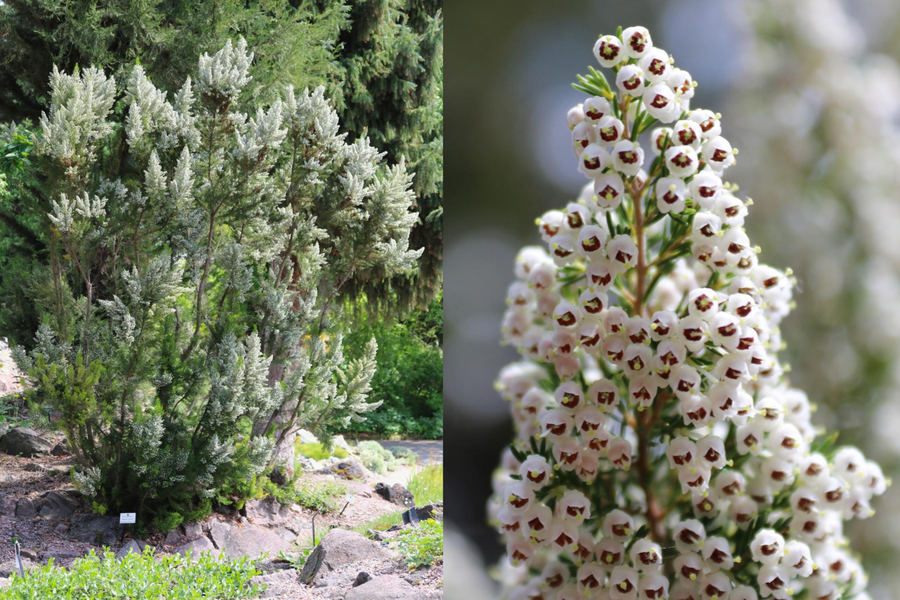
Aus den weißen, kleinen Blütenbechern ragen die weiblichen Griffel weit über die Kronblätter hinaus. Die männlichen Staubbeutel haben eine rötliche Farbe.
Erica arborea L.
In this country, we mainly associate heather (Erica) with low autumn and winter planting. In contrast, the tree heather (Erica arborea L.) surprises us with its extraordinary size: growing in single or multiple stems, it reaches heights of up to 7 m. Its evergreen needle-shaped leaves feel soft and flexible. The leaf flanks are strongly curled downwards - a characteristic that the species shares with many other members of the genus. In April and May, countless small, white and sweetly scented bell flowers open on racemose inflorescences.

Die staubfeinen Samen der Baumheide werden durch Wind verbreitet.
Our tree heather has been in the Alpinum for over 50 years. Unfortunately, its exact age is not documented. The lower part of the plant is protected from the cold in winter. Unprotected branches have recently survived temperatures as low as - 8 °C without damage.
The natural range of the species extends from the mountains of Central and East Africa (afro-alpine habitats) via the Arabian Peninsula to Southern Europe, Northwest Africa and the Canary Islands. It has an important protective function on erosion-prone soils.
It is worth taking a closer look at the base of the tree: the tree heath forms tuber-like thickenings between the roots and trunk - so-called lignotuber. They contain dormant buds that ensure rapid new growth after a disruptive event, such as a forest fire. Nutrients stored in the lignotuber (especially starch) enable regeneration even if the above-ground parts of the plant have died several times in quick succession.
This "life insurance" of the tree heath is used by tobacco pipe manufacturers. In the middle of the 19th century, the first pipes were made in France from the exceptionally grained lignotuber wood (briar) of the tree heath. The raw material came not only from the French Mediterranean region, but also from the then colonies in Algeria and Tunisia. To this day, pipe makers all over the world value it: its taste and mechanical properties, heat resistance and attractive, reddish grain seem comparable to almost no other wood.
Briar is also known colloquially as "burl". Lignotuber takes 30 to 60 years to grow. The plant has to be felled for harvesting. Nowadays, the trade also offers wood from the lignotuber of the tree heath as a "natural chewing root" for dogs, among other things.
(CW 20/2026)
Around 10,000 plant species grow in the Botanical Garden at TU Dresden. On this page, we regularly present an example of this diversity in more detail. The special features of our scientific plant collection can be seen in many different ways: in amazing adaptations, strange names, interesting uses or even in the extraordinary splendor of their flowers.
You can view previous Plant of the Week articles in the archive.