
WiSe26/27 - Main Course
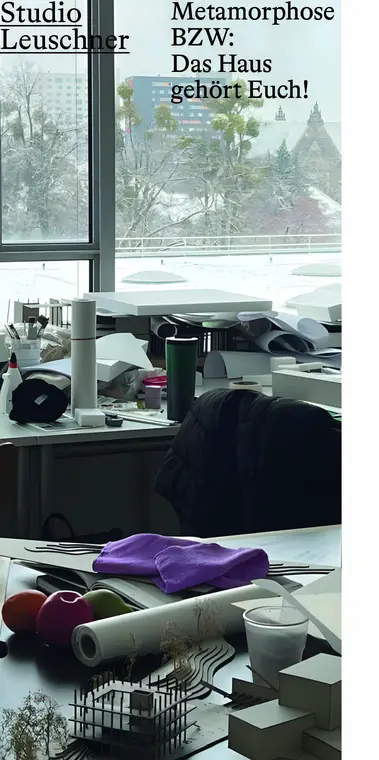
For many years, dissatisfaction with the spatial conditions of the faculty’s teaching and work spaces has been growing. Now that the decision has been made not to proceed with the planned new faculty building, the need for action is all the more apparent: the existing structures must not simply be improved; they need to be fundamentally rethought.
The Faculty of Architecture and Landscape at TU Dresden occupies a distinctive spatial position. The historic campus, with its high-quality open spaces and organically developed structures, remains a lively university environment. The Faculty of Architecture, by contrast, is relatively isolated. In addition, most teaching and office spaces are physically separated from the students’ workspaces, leaving the faculty fragmented both spatially and organisationally.
The design project focuses on transforming and extending the faculty building into an open, productive and communal setting for student life. The aim is to build on the existing fabric as a spatial resource, introduce new uses and establish new spatial connections—developing the site into a lively place for learning, working and living. At the heart of the project is the question of how architectural interventions can create new spatial relationships, forms of community and collective ways of working.
The project calls for a strategy that sets out different phases of transformation and anticipates future forms of appropriation, extension and change. The design should offer a vision for the faculty’s gradual development and articulate a long-term perspective on its spatial and social future. It should present both short-term interventions and long-term structural measures, and explain how they work together.
The faculty’s shared spaces are a central focus. The entrance should be reorganised as a place to meet, and the canteen should be more closely connected to the outdoor spaces, creating a social hub.
The project should also include new workspaces, workshops, overnight accommodation and small-scale public uses such as a café, model-making shop or kiosk. A continuous campus landscape should link the existing building and new additions, providing space to spend time, communicate and work outdoors. It should give the faculty a distinct identity as a place for collaborative and experimental work.
The project will generally be undertaken in pairs. Students completing the advanced design studio will work individually. Students are strongly encouraged to work in the studio spaces at the Chair.
______________________________________
Summer Semester 2026
______________________________________
Winter semester 2025 - 2026
______________________________________
Spring semester 2025
______________________________________

Spring semester 2025
______________________________________
Winter semester 2024 - 2025
______________________________________
Spring semester 2024
______________________________________
Winter semester 2023 -2024