
17.10.2025
Historie trifft Zukunft: Beyer-Bau nach Sanierung, Modernisierung und Umbau an die TU Dresden übergeben

V.l.n.r.: Wissenschaftsminister Sebastian Gemkow, Finanzminister Christian Piwarz, Prof. Dr.-Ing. Birgit Beckmann, Dekanin der TUD-Fakultät Bauingenieurwesen, und TUD-Rektorin Prof.in Ursula Staudinger bei der symbolischen Schlüsselübergabe.
Modernste Bedingungen für Forschung, Lehre und Studium
Nach einer umfassenden Sanierung und denkmalgerechten Modernisierung wurde heute der Beyer-Bau auf dem Dresdner Uni-Campus offiziell an die Technische Universität Dresden (TUD) übergeben. Das historische Gebäude wurde nach Plänen des Architekten Martin Dülfer errichtet und im Jahr 1913 eingeweiht. Es zählt zu den ältesten und markantesten Gebäuden des Hauptcampus und ist eng mit der Geschichte der Bauingenieurwissenschaften und Geowissenschaften verbunden.
Seit 2018 wurde der Beyer-Bau generalsaniert, um die Fakultät Bauingenieurwesen zentral zu bündeln und die Fachrichtung Geowissenschaften dauerhaft am Standort zu verankern. Die Gesamtbaukosten betragen rund 76,5 Millionen Euro, davon stammen rund 8,2 Millionen Euro aus dem Europäischen Fonds für regionale Entwicklung (EFRE). Den überwiegenden Anteil von rund 68,3 Millionen Euro stellte der Freistaat Sachsen bereit.
Finanzminister Christian Piwarz würdigte das Projekt: „Mit der feierlichen Übergabe des Beyer-Baus setzen wir ein sichtbares Zeichen für die Verbindung von Tradition und Moderne. Historische Bausubstanz wurde erhalten, zeitgemäße Technik integriert und die Weichen für exzellente Forschung und Lehre gestellt. Als Bauherr freuen wir uns, dass der Beyer-Bau künftig den modernen Anforderungen an Forschung und Lehre gerecht wird und ein zentraler Bestandteil des TUD-Campus bleibt.“
Wissenschaftsminister Sebastian Gemkow betonte: „Mit der Sanierung des Beyer-Baus investieren wir in die Zukunft von Forschung und Lehre. Gleichzeitig bewahren wir ein Stück Wissenschafts- und Baugeschichte, das für viele Generationen Studierender prägend bleibt. Der modernisierte Beyer-Bau bietet ideale Bedingungen für exzellente Lehre und innovative Forschung. Ich freue mich, dass dank der finanziellen Unterstützung durch die EU mit dieser Sanierung eine CO2-Einsparung bei den Gebäuden unserer TU Dresden geleistet wird.“
Jan Gerken, Kanzler der TUD, verwies auf die große Bedeutung des Gebäudes für die Universität: „Heute dürfen wir den Beyer-Bau mit seinem weithin sichtbaren Turm des Lohrmann-Observatoriums als saniertes Schmuckstück wieder zur Nutzung übernehmen. Nach dem Fritz-Foerster-Bau ist damit ein weiteres zentrales Gebäude unserer langen Geschichte bewahrt und zugleich für künftige Generationen von Studierenden und Forschenden neu eröffnet worden. Und so wird auch das Hubert-Engels-Labor, das 1898 als erstes ständiges Flussbaulabor der Welt gegründet wurde und als Europas ältestes Wasserbaulabor gilt, nach der Rekonstruktion und dem Umbau zu einer modernen Laboreinheit als Hydromechanisches Lehrlabor künftig wieder nutzbar. Der Beyer-Bau erzählt also von unserer Tradition – und zeigt zugleich Wege in die Zukunft auf.“
Modernes, energieeffizientes Hochschulgebäude mit historischer Substanz
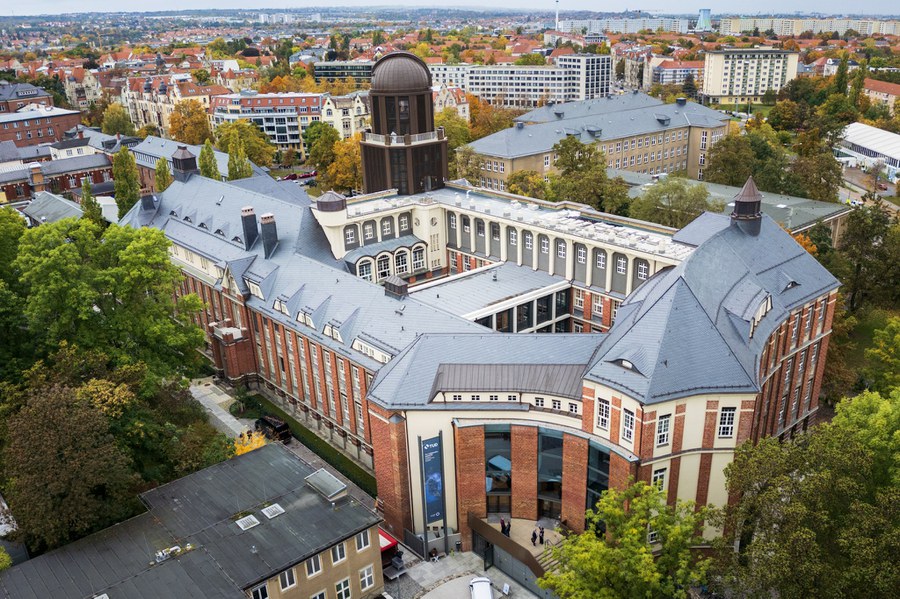
Historie trifft Zukunft: Der Beyer-Bau nach der Sanierung in der Ansicht von oben.
Historie trifft Zukunft: Der Beyer-Bau nach der Sanierung in der Ansicht von oben.
Der Beyer-Bau bietet moderne Arbeits- und Lehrräume, Labore, PC-Pools, Übungs- und Seminarräume sowie Hörsäle. Die Fakultät Bauingenieurwesen mit ihren Instituten für Mechanik und Flächentragwerke, Baukonstruktion, Baubetriebswesen, Bauinformatik, Wasserbau und Technische Hydromechanik, Massivbau, Geotechnik und Stahlbau ist hier angesiedelt. Zudem befinden sich hier das Dekanat Bauingenieurwesen und das Fakultätsrechenzentrum.
Der Südosteingang wurde zum neuen Haupteingang des Beyer-Baus umgestaltet, und auch der 41 Meter hohe Turm mit dem Lohrmann-Observatorium erhielt eine Sanierung. Dabei blieb seine ursprüngliche Form erhalten, ergänzt durch moderne Glasfassaden- und Leichtbauelemente. Historische Hörsäle wurden renoviert, Innenhöfe überbaut und der Verbinderbau aufgestockt, wodurch zusätzliche Büroflächen entstanden.
Zur Generalsanierung gehören außerdem brandschutztechnische Maßnahmen, die Erneuerung der Haustechnik, der Aufbau moderner Datentechnik und umfangreiche energetische Maßnahmen wie Innendämmungen, eine neue Heiz- und Kältezentrale und die Verstärkung historischer Decken mit Carbonbeton. Trotz komplexer baulicher Herausforderungen wie unterdimensionierten Fundamenten und Schadstofffunden konnte die historische Substanz bewahrt und gleichzeitig ein modernes, energieeffizientes Hochschulgebäude geschaffen werden.
Die Baumaßnahme wurde von der Niederlassung Dresden II des Staatsbetriebes Sächsisches Immobilien- und Baumanagement (SIB) realisiert. Der SIB übernahm Planung, Koordination und Umsetzung des komplexen Bauvorhabens und stellte sicher, dass sowohl die denkmalgeschützte Substanz als auch die neuen Anforderungen an ein modernes Hochschulgebäude optimal berücksichtigt wurden.
Kontakt für Medien:
Sächsisches Staatsministerium der Finanzen
Dirk Reelfs, Pressesprecher
Telefon +49 351 564 40060