
May 13, 2026
Presentation of the Züblin Steel Construction Award 2026
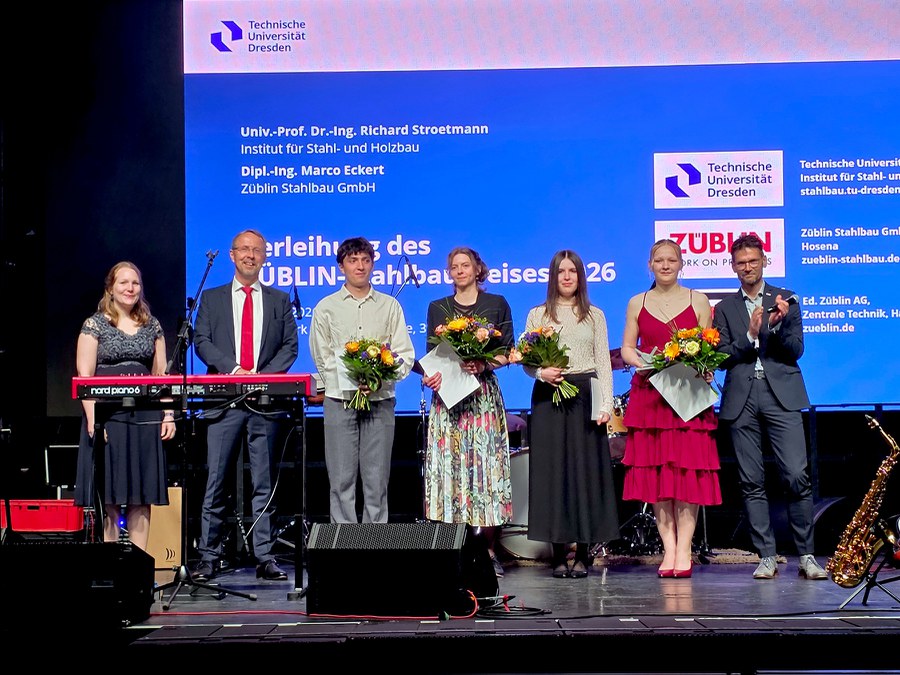
Presentation of the Züblin Steel Construction Prize 2026 at the Construction Ball of the Faculty of Civil Engineering at TU Dresden, from left to right: Uta Lambrette (TU Dresden), Prof. Dr. Richard Stroetmann (TU Dresden), Daniel Zaharescu (2nd prize), Babette Birkle (3rd prize), Mariana Kalmykova (2nd prize), Anna Reichel (1st prize), Marco Eckert (Züblin Stahlbau GmbH).
The ZÜBLIN Steel Construction Prize was awarded for the 14th time this year to students and graduates of the Departments of Architecture and Civil Engineering at the TUD Dresden University of Technology. The steel construction prize, endowed with 3,000 euros, honors outstanding work that contributes to the application and further development of steel construction and was produced as part of a degree or doctorate.
The expert jury consisted of Marco Eckert - Technical Managing Director, Lars Feulner - Head of Construction, both from Züblin Stahlbau GmbH in Hosena, Ralf Braun - Head of the South Division at Ed. Züblin AG in Stuttgart, as well as Uta Lambrette from the Faculty of Architecture and Landscape and Prof. Dr. Richard Stroetmann, Director of the Institute of Steel and Timber Construction at TU Dresden.
The submitted designs as well as student research projects and theses addressed current topics from steel construction practice and research and reflected the wide range of the specialist field. Overall, the entries were of a very high professional standard. They were presented by the students and graduates of TU Dresden during the jury session (Fig. 1). In the subsequent discussions, the nominees impressed with their specialist knowledge of the work submitted.
The award ceremony for the Züblin Steel Construction Prize 2026 traditionally took place in the evening as part of the TU Dresden Construction Ball, which is organized annually by the students of the 6th semester of the Faculty of Civil Engineering. Prof. Stroetmann opened the award ceremony and emphasized in his introductory words the continuing great commitment of Züblin Stahlbau GmbH to teaching and research. He particularly acknowledged the many years of cooperation and the diverse support of the Institute of Steel and Timber Construction and the Faculty of Civil Engineering at TU Dresden, for example through scholarships, the awarding of the Steel Construction Prize, the promotion of student projects and offers for excursions and final theses. In addition, Ms. Lambrette expressed her thanks for the numerous submissions and was particularly pleased with the strong participation from the fields of Civil Engineering and Architecture. Mr. Marco Eckert then took the floor and presented the company and selected current projects. These examples illustrated the wide range of fields in which steel construction engineers work, as well as the challenging tasks that employees face during planning and implementation. Mr. Eckert also addressed the high quality and thematic diversity of the work submitted and emphasized the associated challenge of selecting and ranking the award winners.
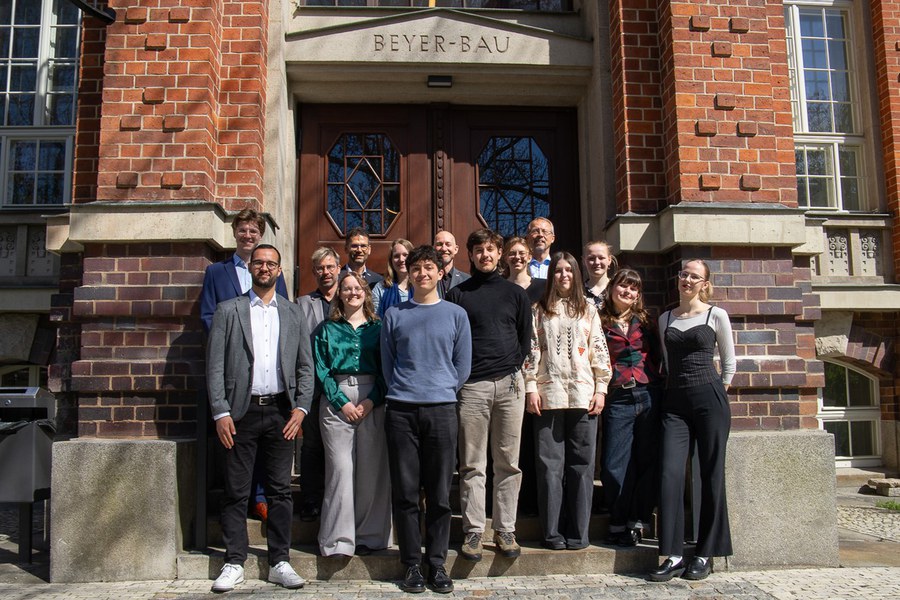
Jury und Nominierte für den Züblin-Stahlbaupreis 2026 vor dem Beyer-Bau der TU Dresden.
As part of her project work, Babette Birkle investigated the influence of welding process parameters on the expansion of the heat-affected zone. She examined butt and fillet welds, which were digitally measured and statistically evaluated using micrographs and hardness measurements. Ms. Birkle's results show that the steel grade, the manufacturing process and the weld shape (welded on one or both sides) have a negligible influence on the expansion of the heat-affected zone. In contrast, the energy per unit length E, the cooling time 𝑡8/5 and the sheet thickness 𝑑 influence the expansion of the heat-affected zone. Ms. Birkle's project work was awarded 3rd prize.
The design for the Tanzhaus Dresden-Hellerau entitled "Pirouette House" by Mariana Kalmykova and Daniel Zaharescu from the Faculty of Architecture and Landscape was awarded 2nd prize. The duo's work impressed the jury with its balance of architectural design, functionality and structural design. The pirouette house with a polygonal floor plan extends over four storeys, which are arranged in rotation to each other on each floor. A steel skeleton construction was designed as a radially oriented structure. In addition, wooden secondary beams were used to shorten the spans for the ceilings. As a result, rooms were created that are spanned by an efficient load-bearing structure of around 27 m without columns.
The 1st prize was awarded to Anna Reichel for her thesis on the design of ortho-composite slabs for road bridges with composite dowel bars. The focus of her investigations was the fatigue safety of the composite dowel bars in clothoid form when loaded in the transverse direction. To this end, Ms. Reichel carried out extensive parameter studies using finite element models. She determined the fatigue load cycles for different strip configurations using the fatigue load model 4 according to DIN EN 1991-2 over the scheduled service life of road bridges and derived damage equivalence factors from this. Using the example of a large bridge, which according to current planning is to be constructed with headed dowel bars, Ms. Reichel carried out the design of the composite dowel bars, demonstrated the fatigue safety and illustrated the potential of composite dowel bars in bridge construction with an economic efficiency comparison. The jury was impressed by the technical depth, the practical relevance and the thorough treatment of the topic in the thesis. The award-winning work impressively illustrates the thematic breadth and technical depth of engineering issues in steel construction, ranging from the metallurgy of welding, structural design and calculation to the evaluation of existing structures and interdisciplinary design and research approaches. The jury and the supervising Institutes of the TUD Dresden University of Technology warmly congratulate the prizewinners (Fig. 2) on their outstanding work!
Report:
Dipl.-Ing. Malte Homeyer, Institute of Steel and Timber Construction, TUD Dresden University of Technology