
Jun 01, 2026
IBB spring excursion 2026
Spring Field Trip, May 11–13, 2026, Hamburg
This year’s student spring field trip organized by the Department of Construction Management took place from May 11 to 13, 2026. This year, our destination was once again in northern Germany - we headed to the Hanseatic city of Hamburg. Over the course of three days, our students gained insights into a wide variety of areas of construction practice: from traditional building construction and interior finishing to bridge construction and specialized civil engineering, all the way to the preservation of historic buildings.
Day 1: Monday, May 11, 2026
Our first stop after a long drive was a construction site right in downtown Hamburg. Here, the Alte Wall neighborhood is being partly rebuilt and partly renovated and refurbished within the existing structure. Art-Invest Real Estate Management GmbH & Co. KG is responsible for the project development of the neighborhood. Alte Wall 40 is currently under construction, and we were given a tour of the site. The project is already in the finishing phase, which is being carried out by Lindner SE, and is expected to be completed in 2026. The central location of the construction site - right between Alsterfleet and Hamburg City Hall - is particularly noteworthy, as it requires special solutions for construction logistics. At the time of our visit, the main activities inside the building included the installation of drywall and other finishing work. Our first tour concluded with a culinary highlight and cool refreshments, kindly provided by Lindner.
The evening was free for the students to enjoy as they wished and was happily spent on a city tour.
Day 2: Tuesday, May 12, 2026
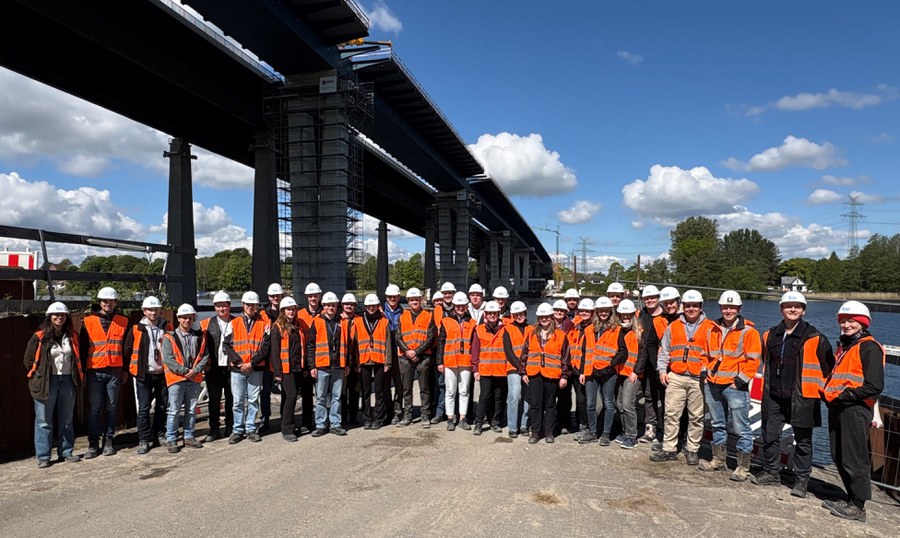
The following day, we set out early in the morning to visit a construction site 120 km north of Hamburg. As we moved further away from Hamburg, the weather became drier, providing us with perfect conditions to inspect the construction site for the replacement of the Rader High Bridge over the Kiel Canal and the Borgstedter Enge. As guests of Implenia GmbH, we were first presented with the key details of the project’s construction site, accompanied by a second breakfast. Construction of the first of the two planned bridge sections began as early as 2023 and is scheduled for completion in December 2026. The structure spans 1,500 m and has a total project volume of approximately 250 million euros. The bridge was commissioned by Autobahn GmbH. We then went on a tour of the construction site, where, after the first highlight—a site-specific ferry—the brave majority of our students ventured up the 40-meter-high scaffolding stair tower to the bridge superstructure. The visit to the Rader High Bridge highlighted a wide range of construction-related and structural engineering features specific to large bridge structures: in particular, the project’s tight schedule and the challenging formwork construction for the pier voids were of great interest.
After touring the Rader Hochbrücke, we headed back to Hamburg’s Altona district, where a building construction site awaited us, managed by P3 Pekrul ProjektPartner as the project manager. The Aurelie project involves the construction of new residential and commercial spaces in a very dense urban setting and is part of a strategic redensification of the district and the creation of new housing. What makes the project unique is its implementation, which takes into account the existing resident structure as well as the subsequent reopening of Hamburg’s iconic pub, AUREL. From the students’ perspective, both the limited space available for the construction site facilities and storage areas were fascinating, as were several structural engineering features, such as the mix of KS stone and Poroton brick masonry, as well as the use of cast-in-place concrete and precast construction methods.
To conclude our second day of field trips, we drove to the historic Gängeviertel - the oldest neighborhood in downtown Hamburg—which is home to buildings dating back to the 18th and 19th centuries. The Gängeviertel is managed by the Gängeviertel e.V. association and the Gängeviertel Genossenschaft 2010 eG cooperative. The district serves as an inner-city hub for art and culture, working in close collaboration with the City of Hamburg. A key objective here is the preservation and restoration of historic buildings. Through an in-depth presentation and a walking tour of the district, our students gained a detailed insight into the activities of the association and the cooperative. Notable features include the structure of the residential and commercial spaces, which promotes social art, culture, and exchange, as well as the preservation and renovation of the buildings. From a structural engineering perspective, the tour of the neighborhood’s oldest building—which is awaiting renovation and repurposing—was particularly fascinating. To wrap up the day, we stopped by the Jupi Bar together and kicked off the leisurely part of the day with some refreshing drinks.
Day 3: Wednesday, May 13, 2026
On the final day of our field trip, we visited ZECH Hochbau at the construction site of the Campus HafenCity project, Hamburg’s largest new school building. Work on the project began in late 2025 and is scheduled to be completed by the end of 2027. The project involves the construction of an eight-track neighborhood school in a new six-story building. Unique features of the project include the wood-hybrid construction method and the construction of three stacked sports halls. At the time of our visit, we were able to observe primarily earthwork and specialized civil engineering activities, which complemented and rounded out our other construction site visits from a technical perspective. The construction site provided the students with fascinating insights into the technical aspects of civil engineering construction, as well as the organizational challenges involved in building adjacent to protected cultural monuments. Finally, ZECH Hochbau AG invited us to the nearby cafeteria for a hearty lunch.
Enriched with many fascinating insights into various aspects of construction operations and construction engineering, as well as new connections with professionals in the field, we began our journey home to Dresden.
We would like to express our sincere thanks to all the individuals, companies, and associations that made this excursion possible. Special thanks go to the companies and stakeholders who gave us access to the construction sites and projects, took the time to engage with us and our students, and provided us with excellent food and drinks. Special thanks to Lindner SE, Art-Invest Real Estate Management GmbH & Co. KG, Implenia GmbH, P3 Pekrul ProjektPartner GmbH, Gängeviertel e.V., and ZECH Hochbau AG.
Finally, we would like to thank our students, who not only showed great interest at the construction sites and asked thought-provoking questions, but also enriched the entire trip with their cultural contributions.