
Sep 09, 2026
Successful SPP100+ 2026 Annual Meeting & SMAR Conference
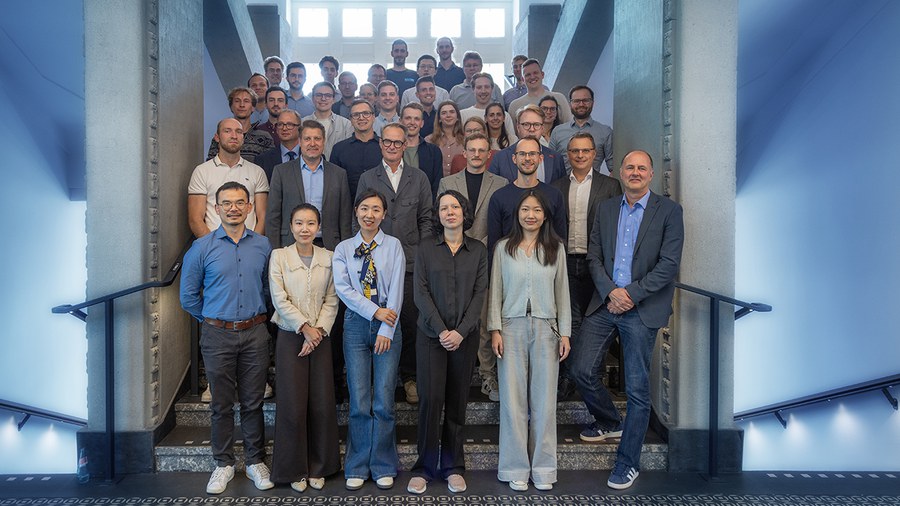
Researchers and participants of the SPP100+ Annual Meeting
From August 24 to 28, 2026, the DFG Priority Program SPP 2388 "Hundert Plus" (SPP100+) experienced a highly fulfilling and productive academic week in Dresden. Following the successful 2026 Annual Meeting and PhD Workshop held at TU Dresden on August 24 and 25, the project team actively participated in the subsequent SMAR2026 international conference. There, they successfully hosted an exclusive SPP100+ Special Session, comprehensively showcasing the project's latest advancements to the international academic community.
Annual Meeting (August 24)
The agenda of the annual meeting's first day centered around status reports from the subprojects. Following updates on the coordination project and Spatio-RAG, the four core clusters of SPP100+ (Clusters A to D) took the stage to present their fruitful results in areas such as damage detection, physics- and data-driven condition simulations, and condition indicators.
Furthermore, experts from MKP GmbH delivered a fascinating presentation on the digital twin of the Nibelungenbrücke (Nibelungen Bridge). In the afternoon, the working groups shared interdisciplinary topics through an efficient format of "5-minute pitchs." All members then engaged in productive discussions regarding the annual plan for 2026/27.
M3 Colloquium & RDM Workshop (August 25)
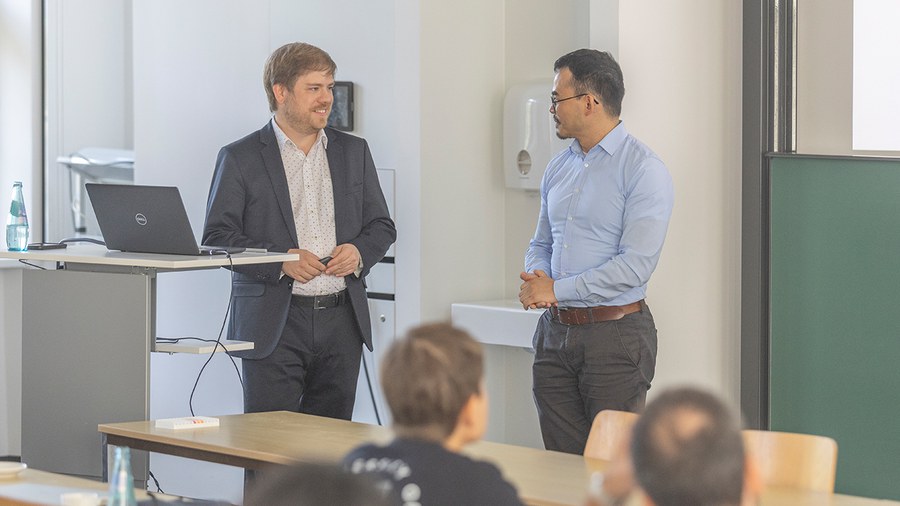
Petr Máca (Czech Technical University / Virginia Tech) discussing his research during the M3-Fachkolloquium
The second day featured the highly anticipated M3-Fachkolloquium (M3 Colloquium), jointly organized by SPP100+ and SFB/TRR 280. Several internationally renowned scholars were invited to deliver academic reports. The insightful presentations covered the innovative application of Textile-Reinforced Concrete (TRC) by Giulio Zani and Marco Carlo Rampini (both from Politecnico di Milano), the sustainability of non-metallic reinforcement materials by Julita Krassowska (Bialystok University of Technology), the application of digital twins and artificial intelligence in infrastructure by Weiwei Chen (University College London), and new technologies for enhancing the blast resilience of structures by Petr Máca (Czech Technical University, currently working at Virginia Tech).

Prof. Jakob Beetz (RWTH Aachen University) leading the RDM workshop
Following the engaging academic discussions, the afternoon agenda shifted to skill development. A workshop on "Research Data Management," hosted by Prof. Jakob Beetz from RWTH Aachen University, provided highly practical guidance for the participating PhD students and researchers, further strengthening the project team's soft skills in data processing and science communication.
SMAR Conference (August 26–28)
Immediately following the annual meeting and workshops, the SPP100+ team deeply engaged in the SMAR2026 (8th International Conference on Smart Monitoring, Assessment and Rehabilitation of Civil Structures) from August 26 to 28.
At this international conference, SPP100+ hosted an exclusive Special Session titled "MS13: Intelligent digital methods for extending the service life of structures beyond 100 years."
During this session, project members gathered once again, not only continuing the enthusiastic academic atmosphere of the annual meeting but also bringing the latest research outcomes of SPP100+ to a broader international stage. Participants delivered excellent presentations and engaged in profound intellectual exchanges and technical discussions with peer experts from around the globe, significantly enhancing the project's academic influence in the international field of structural monitoring and assessment.
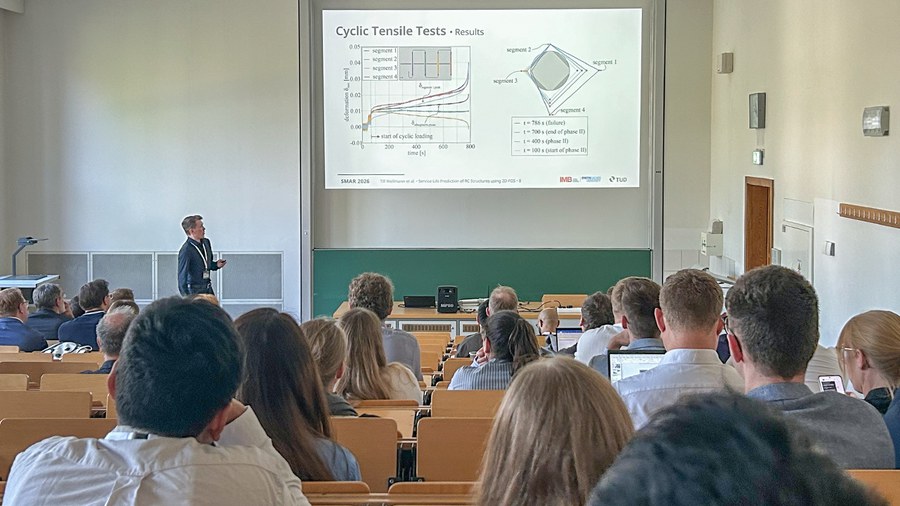
Till Wellmann (RWTH Aachen University) delivering a presentation during the SPP100+ Special Session at the SMAR2026 conference
From the in-depth discussions within internal clusters to the prominent appearance at the SMAR2026 international conference, the 2026 SPP100+ Dresden Annual Meeting was a resounding success. This event not only consolidated the collaborative foundation for the project's second phase but also injected new inspiration and momentum into future research endeavors. We look forward to more breakthrough scientific discoveries from all teams in the next year!