
Mar 30, 2026
Jan-Hauke Bartels receives the Sensors and Materials Young Researcher Paper Award 2025
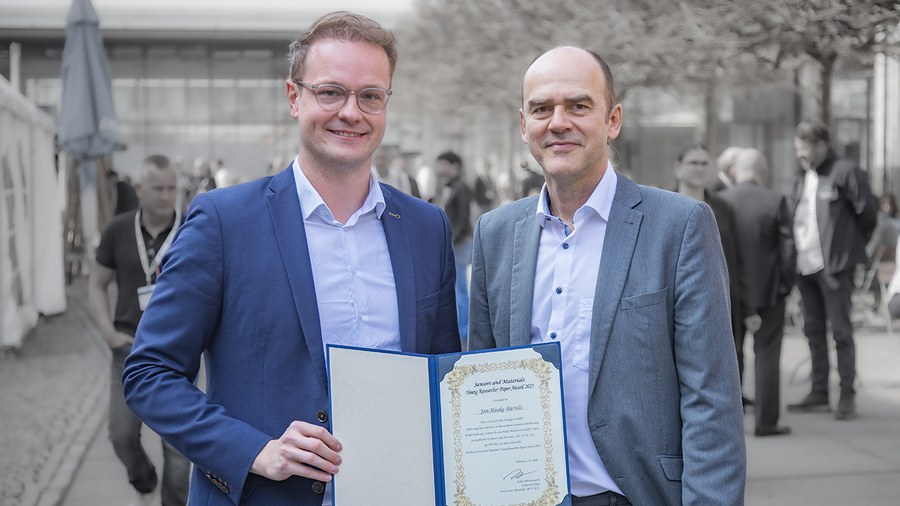
Dr.-Ing. Jan-Hauke Bartels and Prof. Dr.-Ing. Steffen Marx
Dr.-Ing. Jan-Hauke Bartels has been awarded the Sensors and Materials Young Researcher Paper Award 2025. Presented annually by the international scientific journal Sensors and Materials, the award recognizes outstanding scientific contributions by early-career researchers under the age of 40 in the fields of sensors, sensor materials, and related measurement technologies.
The award was granted for the paper “Addressing Time Variance in Measurement Systems with Bayesian Model Updating”, published by Dr.-Ing. Jan-Hauke Bartels together with Prof. Dr.-Ing. Steffen Marx. The article appeared in Sensors and Materials (Vol. 37, No. 3(2), 2025, pp. 921–942).
https://doi.org/10.18494/SAM5393.
The award-winning paper focuses on the investigation of time-dependent changes in measurement systems using laser triangulation sensors as a case study. The aim of the study was to systematically identify and compensate for aging effects and their influence on measurement accuracy. To this end, an approach based on Bayesian model updating was developed. In more than 140 subtests, both random and systematic sources of measurement error were quantified, including effects caused by cable length, sensor positioning, and temperature variations. The results show that time-dependent drift processes, particularly in the early stages of aging, can be captured precisely and compensated experimentally with high accuracy. The work thus makes an important contribution to the development of reliable and durable monitoring systems in the field of Structural Health Monitoring.
Commenting on the award, Jan-Hauke Bartels said: “I am deeply honored to receive the distinguished S&M Young Researcher Paper Award 2025 from Sensors and Materials. My sincere thanks go to my co-author and PhD supervisor, Prof. Dr.-Ing. Steffen Marx, for his continuous support and invaluable academic guidance throughout this work.”
In his future research, Jan-Hauke Bartels will continue to focus on uncertainty quantification in measurement systems, as well as on robust sensing concepts and related materials, to further advance reliable methods for Structural Health Monitoring.
The award-winning research was conducted as part of a project funded by the German Research Foundation (DFG) within Collaborative Research Centre 1463 “Integrated Design and Operation Methodology for Offshore Megastructures”, subproject C01 (project number 434502799).
Abstract: Measurement systems are widely used in engineering applications such as structural health monitoring and nondestructive evaluation to enhance periodic inspections with continuous data acquisition. These systems are often assumed to exhibit linear time-invariant behavior, although over time, their performance is affected by environmental factors and internal degradation, resulting in time-variant behavior. In this study, we investigated the effects of aging on measurement systems, using laser triangulation sensors as a case study, and propose a novel approach to compensate for these time-dependent effects. Through a series of more than 140 subtests, we identified both random and systematic measurement errors, such as those caused by cable length, sensor placement, and temperature variations. We introduced a compensation method based on Bayesian model updating (BMU) that effectively accounts for the time-dependent drift in measurement accuracy, especially in the early stages of sensor aging. The BMU model was validated through experiments, demonstrating its ability to mitigate aging-induced measurement errors with high accuracy. In this work, we highlight the importance of compensating for time-variant behavior and provide a reliable approach to ensuring measurement accuracy in long-term measurement systems. The results are applicable to various engineering applications and contribute to improving the longevity and reliability of monitoring systems.