
Apr 24, 2026
Promotion Conrad Pelka
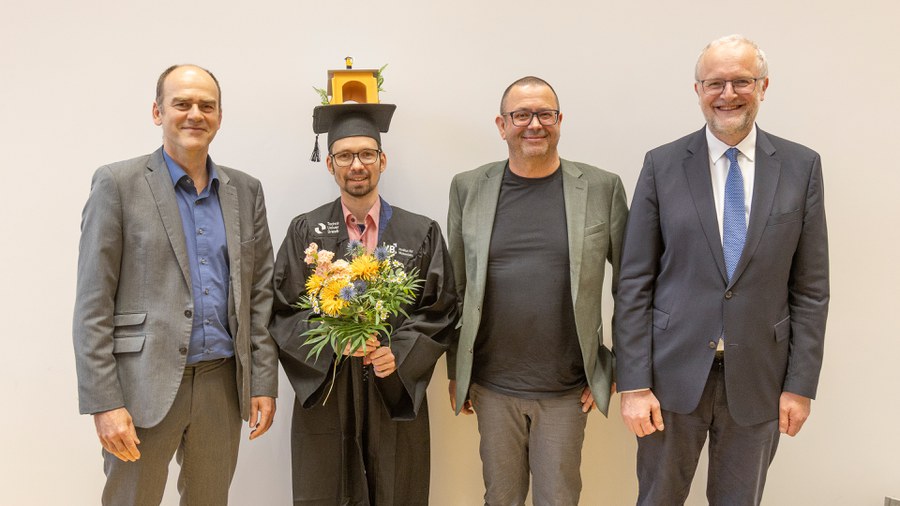
Conrad Pelka and the present promotion committee
On April 20, 2026, Conrad Pelka successfully defended his dissertation 👨🎓 entitled "Effectiveness of roadway slabs on railroad vault bridges". The event took place in the Beyer Building of TU Dresden.
Abstract:
Historic masonry arch bridges account for approximately 23% of Deutsche Bahn’s (DB) total railway bridge stock, making them a key part of the national rail infrastructure. These bridges have an impressive average service life of about 111 years, around 40 years longer than the average of all railway bridges in Germany. This clearly reflects their high structural robustness and long-term performance.
However, many of these bridges receive poor condition ratings due to visible signs of deterioration, such as moisture damage, efflorescence, vegetation, and cracks. These condition ratings (ZK) are often used to justify complete replacement. Yet recent findings from the research project “Trough Constructions on Masonry Arch Bridges” at TU Dresden, in cooperation with DB InfraGO AG, show that many of these visually damaged bridges still have very high load-bearing capacity. In on-site assessments of over 55 bridges, even those classified in the lowest condition category (ZK 4) showed structural reserves up to six times greater than those required by Load Model LM71.
The majority of damage is related not to structural failure, but to long-term moisture exposure. This is often caused by poor drainage and water retention above the arch barrel. In this context, waterproof and durable retrofitting systems combined with adapted drainage designs become increasingly important.
A structured method was developed to record damage patterns and repair interventions before and after installing trough constructions. It was shown that moisture levels in the masonry could be significantly reduced for periods of 50 to 60 years. Data sources included technical documentation from SAP R/3 Netz, digital archives of DB InfraGO AG, and analogue bridge records from the Southeast region (Netz Dresden). These sources also showed that, out of 5,891 masonry arch bridges in the DB network (as of 2023), 4,931 are single-span bridges with a clear span of less than 10 meters.
Based on these findings, a detailed technical analysis and optimization of trough constructions was carried out. The aim was to reduce moisture-related damage, increase durability, and ensure a better integration into the bridge cross-section. However, mechanically induced damage such as cracking or spalling cannot be resolved by the track slab alone and must be addressed through masonry repair works in the substructure.
The successful application of trough constructions depends on their geometry, material quality, resistance to environmental impacts, correct placement of backfill, and high construction quality. The study also evaluated the potential of ultra-high-performance fiber-reinforced concrete (UHPFRC) for trough constructions. Although still in the pilot project in Germany, UHPFRC offers a durable, waterproof, and very slender slab with high mechanical capacity, making it attractive for both technical and heritage-sensitive applications.
Integrating track slabs, whether made of reinforced concrete or UHPFRC, into the maintenance strategy of historic masonry arch bridges offers clear benefits compared to complete replacement. Service life can be extended by at least 50 years, CO₂ emissions from construction activities can be reduced by up to 70%, and prefabricated slab systems allow for much shorter construction times. These measurable benefits are supported by a heritage-sensitive repair approach in line with the concept of technical continuation, which helps to preserve both the engineering and cultural value of these bridges.
In 2024, the technical findings were integrated into DB’s system-wide maintenance strategy. The forecasted total service life of retrofitted masonry arch bridges is now up to 199 years. The methodology is also suitable for transfer to other historic bridge types and viaducts. In the future, more advanced digital diagnostics and continuous monitoring systems are planned to improve predictive maintenance and long-term observation.
Finally, a probabilistic analysis suggests that around 75% of all masonry arch bridges with single spans under 10 m, currently not retrofitted with trough constructions, are structurally worth preserving. This work strengthens the broader understanding of a sustainable and resource-efficient railway infrastructure that respects cultural heritage, by recognizing historic arch bridges not only as structural assets, but as valuable examples of railway engineering history that can be successfully integrated into today’s rail network.
Dear Conrad, we would like to take this opportunity to wish you every success in your scientific career and all the best for the future. 🥳 👍