
Dec 22, 2025
Promotion Jan-Hauke Bartels
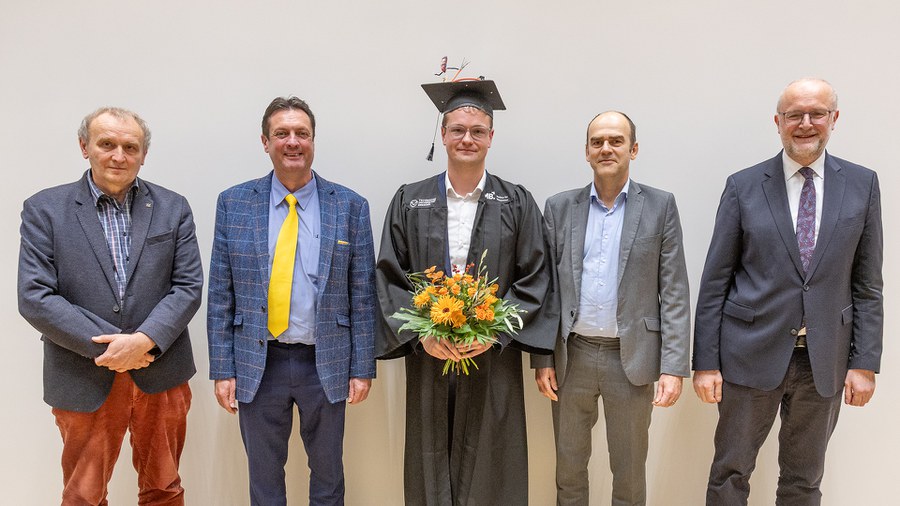
Jan-Hauke Bartels and the doctoral committee present
On December 15, 2025, Jan-Hauke Bartels successfully defended his dissertation 👨🎓 entitled "Ageing Structural Health Monitoring Systems - Description of Long-Term Behaviour and Probabilistic Sensor Fault Detection". The event took place in the renovated Beyer Building at TU Dresden.
Abstract:
Measurement systems are used in engineering applications such as SHM and nondestructive testing to support periodic inspections with continuous data acquisition. These systems are often assumed to exhibit linear, time-invariant behavior. In practice, however, they are subject to environmental influences and internal aging processes that result in time-varying behavior. SHM systems use sensor networks to monitor the integrity of structures, sometimes over several years. While the structures may suffer age-related damage over time, the measurement systems themselves are also subject to an aging process that leads to erroneous sensor data. Such sensor faults may seem plausible at the first moment of data interpretation, but can lead to misinterpretations of the structural condition. Therefore, it is crucial to distinguish between structural damage and sensor faults to ensure the long-term reliability of SHM systems.
This thesis investigates experimentally the aging effects in measurement systems and develops a probabilistic method for the robust detection of sensor faults in SHM systems. The focus is on strain measurements, displacement measurements and acceleration measurements. The associated measurement chains are analyzed with respect to measurement uncertainty and long-term stability.
The results show that the tested measurement systems already exhibit significant systematic and random measurement errors under stationary conditions, which can be minimized by an optimized measurement chain design. Long-term measurement system tests, however, show a time-variant behavior, so that the common assumption of a time-invariant measurement system is no longer valid. Especially in the case of strain measurements, time-dependent signal changes occur that are comparable in magnitude to structural damage, making it difficult to distinguish between structural damage and sensor faults.
To solve this problem, a probabilistic sensor fault detection method is presented that allows a reliable distinction between these two states. In particular, the Mahalanobis distance (MD) method with probabilistic threshold proves to be a robust metric for detecting sensor faults in active SHM systems. A detection accuracy of over 90 % is achieved. In comparison, an approach based on linear regression with a probabilistic threshold shows significantly worse performance with only 21 % detection accuracy.
Based on these results, recommendations for SHM practice are derived, which allow an optimized design of measurement chains and an effective detection of sensor faults. The results of this work show that a reliable long-term condition assessment of structures can only be guaranteed if, in addition to structural changes, the aging effects of the measurement systems are also taken into account. The presented method makes a decisive contribution to the improvement of sensor diagnostics and forms the basis for an even more reliable practice in structural monitoring in the future. Future work should extend the developed method with advanced machine learning techniques, such as neural networks, and explore data-based sensor recalibration strategies to further develop adaptive, lifetime reliable SHM systems.
Dear Hauke, we would like to take this opportunity to wish you every success in your future scientific career and all the best for the future! 👍🥳