
Sep 18, 2026
Promotion Max Herbers
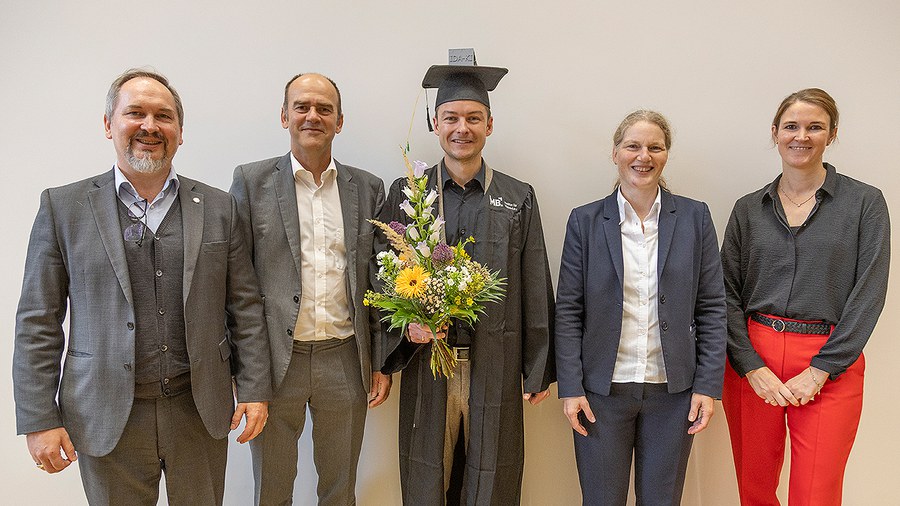
Max Herbers and the doctoral committee in attendance
On September 14, 2026, Max Herbers successfully defended his dissertation 👨🎓 titled “Distributed Fiber Optic Crack Monitoring on Concrete Structures: Model-Informed Sensor Selection” The event took place in the Beyer Building at TU Dresden.
Abstract:
Distributed fiber optic sensors (DFOS) offer substantial potential for crack monitoring on concrete structures by enabling continuous strain measurements with high spatial resolution over long sensor lengths. In particular, coherent optical frequency domain reflectometry (c-OFDR) enables early crack detection, precise crack localization and detailed assessment of complex crack patterns.
However, reliable DFOS-based crack monitoring critically depends on the interaction between DFOS type, installation method, and measurement settings. An inadequate DFOS/adhesive combination (DAC) may either attenuate strain peaks, leading to undetected cracks, or cause excessive strain concentrations, resulting in fiber breakage and signal degradation. Despite numerous influencing parameters, the design of DFOS monitoring systems is still largely based on empirical knowledge.
The primary objective of this thesis was to develop a framework for physically informed DAC selection. To this end, experimental investigations were conducted to characterize the bond behavior of various DACs under static and cyclic loading. In addition, the influence of different installation methods on the strain transfer was analyzed, resulting in the derivation of semi-empirical bond models. The results revealed pronounced influences of bond stiffness, sensor length, and the associated spatial resolution on the measurable crack width. With increasing bond stiffness and DFOS length, the measurable crack width decreases markedly, while overly compliant bond behavior compromises crack detection and quantification.
Based on these findings, the strain curve prediction (SCP) framework was developed to calculate crack-induced strain distributions for arbitrary crack patterns while explicitly accounting for DAC-specific bond behavior and measurement limitations. The SCP framework reliably reproduces the key characteristics of DFOS strain measurements, including overlapping effects, peak attenuation due to plastic deformations, and the occurrence of measurement dropouts. This capability enables systematic parameter studies to identify a balanced DAC stiffness tailored to the crack pattern to be monitored. Additionally, nomograms were derived that illustrate the relationship between measurable crack width, DFOS length and bond stiffness.
While the previous investigations focused on the design of DFOS monitoring systems, the final part of this thesis addresses the field of data evaluation and knowledge extraction. To this end, the integral method for crack width calculation in reinforced concrete structures was validated and extended to prestressed concrete applications. Crack widths derived from DFOS strain measurements show high agreement with reference measurements for both DFOS embedded in concrete and bonded to reinforcement.
This dissertation therefore addresses both the planning and operation phase of a DFOS-based crack monitoring. By systematically linking bond models with measurement-related limitations within the SCP framework, a foundation is established for informed DAC selection. This enables the acquisition of high-quality strain measurements with sufficient peak prominence, enabling reliable crack detection and crack width calculation. Consequently, this work contributes to more robust and reliable DFOS-based crack monitoring, applicable to both new and existing concrete structures.
Dear Max, we would like to take this opportunity to wish you every success in your future scientific career and all the best for your future. 🥳 👍