
Jul 20, 2026
Olga Benedix's Doctoral Dissertation
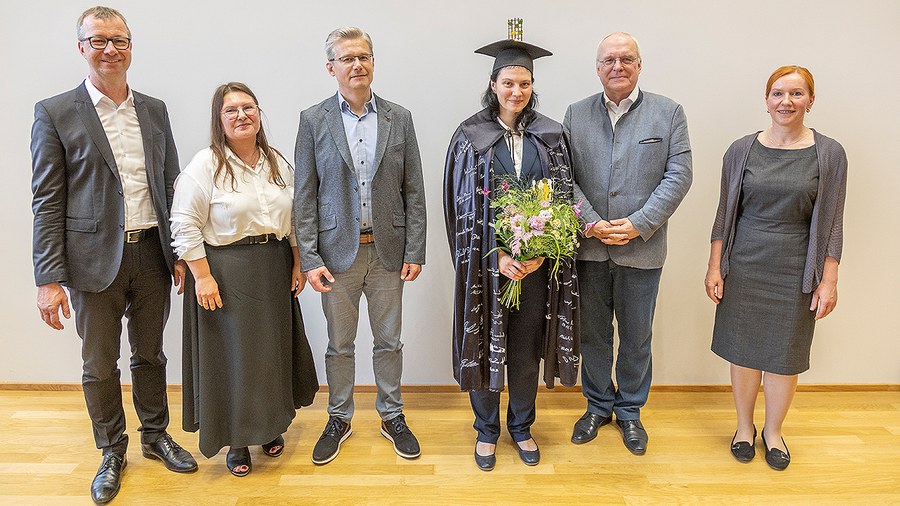
Olga Benedix and the doctoral committee in attendance at the Beyer Building at TU Dresden
On July 14, 2026, Olga Benedix successfully defended her dissertation 👨🎓 titled “Measures to improve the fire resistance of carbon-reinforced concrete.” The event took place in the Beyer Building at TU Dresden.
Abstract:
Concrete components with non-metallic reinforcement, especially carbon-reinforced concrete, are of great interest in research and development in the construction industry. Due to the corrosion resistance of its reinforcement material, carbon-reinforced concrete is characterised by a thin concrete cover, resulting in slender and resource-efficient structures with increased durability. The resulting reduction in energy and resource consumption as well as CO2 emissions contributes to an environmentally friendly construction process.
In the event of a fire, carbon-reinforced concrete is particularly disadvantaged precisely because of its slenderness. Thin concrete layers heat up quickly, which can lead to explosive spalling of the concrete. Furthermore, the polymer-based impregnation of the carbon reinforcement softens, melts, and decomposes,leading to a decrease in bond strength and tensile strength of the composite material.
For widespread practical application of carbon-reinforced concrete, a high fire resistance is essential. This work aims to improve the fire behaviour of carbon-reinforced concrete through the precise use of flame retardants. Therefore, the components of carbon-reinforced concrete, high-strength concrete and a polymer-based impregnation for carbon reinforcement, were modified with suitable fire retardants and examined separately. Spalling of the concrete was investigated on two high-strength concretes widely used for carbon-reinforced concrete and prevented by the addition of short polypropylene fibres. Particular emphasis was placed on maintaining good processability of the concrete to preserve its laminating and casting ability. To improve the temperature stability of the polymer impregnation, an additive was developed and its effect investigated in small-scale pyrolysis tests. The developed additive consists of hybrid core-shell particles of two geometries with the flame-retardant functionalities of nitrogen and phosphorus.
Dear Olga, we would like to take this opportunity to wish you every success in your future academic career and all the best for your future. 🥳 👍