
Reinforcements made of rCF
Project data
|
Titel | Title |
Short description
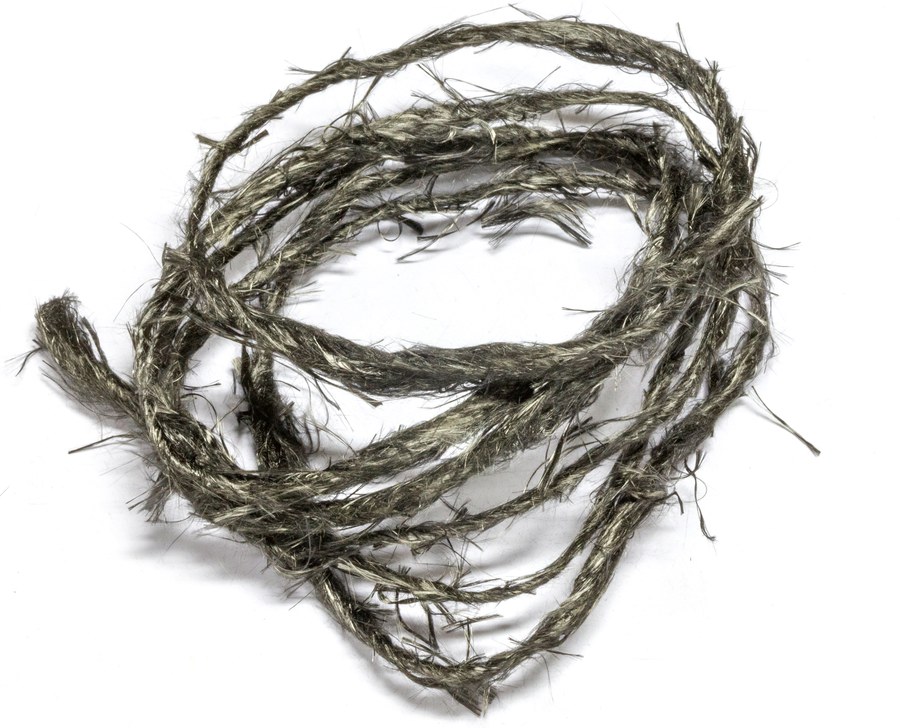
Unimpregnated yarn made from rCF as a base material for grids and rebars
The joint project, which is funded by the Federal Ministry of Education and Research, builds on the knowledge gained in the WIR!-basic projects. The process chain previously developed there is to be implemented and expanded in this project, in accordance with the findings of the aforementioned research. As part of the project, the objective is to produce rebars from recycled carbon fibers (rCF) using pultrusion. As the project progresses, the continuously producible rebars will be subjected to a series of tests to ascertain their properties, including tensile and bond strength. In advance of the bond tests, a range of surface profiles for non-metallic reinforcements were considered. The rebars have been profiled, including the geometric dimensions, based on the preliminary considerations.
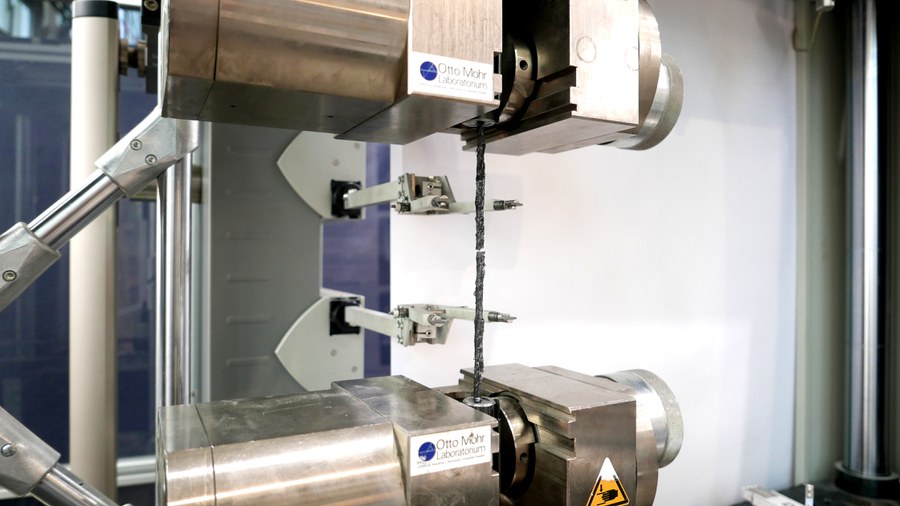
Failed single rCF yarn after tensile test
Further project content is the material-technical investigation of grids made of rCF. During the course of the project, grids will be produced by the project partners using warp knitting technology and direct yarn forming. These grids will be examined in regard of their structural properties in accordance with the DAfStb guideline for non-metallic reinforcement. This encompasses, for instance, the bending stiffness of the fabrics, the weight per unit area, and the determination of the nominal diameter. In addition, the tensile behavior of rCF yarns from the preceding project WIR-B1 was investigated. These yarns were produced by spinning nonwoven material and impregnating it with a matrix. The initial material for the yarns were rCF of varying fiber lengths and compositions, derived from disparate recycling processes (e.g. pyrolysis).
Moreover, the consideration of non-metallic connectors was pertinent to the construction sector. Another project’s objective was to develop a high-performance connecting element enabling the connection of very thin CRC elements and ensuring a reduction in thermal bridges. To achieve this, the performance and suitability of existing connecting elements were investigated. The knowledge gained was the basis for the development of rCF fasteners. In the concluding phase of the project, concrete components reinforced with rebars or grids made from recycled carbon fibres were produced and their performance compared with that of reinforcementsmade of virgin carbon fibers.