
Basic research on recycled carbon fiber yarns
Table of contents
Project data
|
Titel | Title |
Report in the annual report 2024/25
Yarns made from recycled carbon
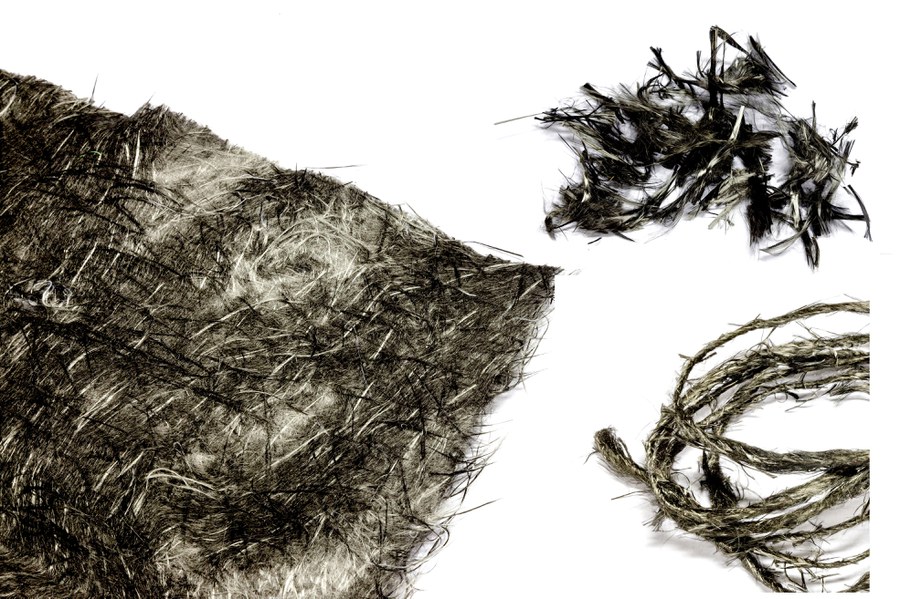
Material cycle from recycled fibers to nonwovens to yarns
Fiber-reinforced plastics made from carbon fibers (CFRP) are experiencing growing demand in a wide range of applications, for example as non-metallic reinforcement in the construction industry – cue carbon-reinforced concrete. However, the growing demand for CFRP is leading to increased resource and energy consumption as well as CO2 emissions. As the production and use of CFRP generates considerable amounts of waste containing fibers, the development of a circular value chain is a key challenge. This requires technical and organizational processes for the comprehensive recycling of CFRP waste and the development of marketable products made from recycled carbon fibres (rCF).
The WIR-B1 basic project, part of the overall “WIRreFa | WIR! recyceln Fasern” project, which was successfully completed in 2024, was dedicated to establishing an end-to-end process chain for the recycling of carbon fibers. This included the development of requirement profiles for rCF, the development of corresponding recycling processes and products as well as the implementation of a numerical model to simulate the mechanical behavior of reinforcements made from rCF for the construction industry.
The numerical model developed is based on a shell model consisting of alternating radial layers of fibers and matrix. The layer thicknesses depend on the radius and the fineness of the model as well as the fiber volume fraction. Model approaches were developed to take into account the discontinuous lengths of the rCF compared to virgin continuous fibers. For a flexible application, all relevant material and geometry parameters - including fibre volume fraction, single fibre and overlap length as well as mechanical parameters - were fully parameterized in the model.
The numerical model was calibrated by means of tensile tests on rCF yarns, which were developed in the project. Various processes for fiber recovery (solvolysis, pyrolysis) had previously been investigated for their production. Subsequently, tests were carried out to form nonwovens from these rCF in dry or wet fleece processes. Finally, the rCF yarns were produced from the rCF nonwovens. However, the nonwovens are also suitable for the production of flat components and can therefore be used in a wide range of industries.
Report in the annual report 2023
Recycling of carbon fibers

Yarn made from recycled carbon fibers using the wetlaid method
The basic project B1, which was launched in 2022, serves as a starter project for the joint research project “WIRreFa | WIR! recyceln Fasern” (WIRreFa | We! recycle fibers) together with a 2nd basic project. This initiative seeks to recycle carbon fibers and repurpose them in several fields, including automotive and construction. Downcycling is strictly prohibited. By engaging numerous local corporations and practical partners in Saxony, this project aims to generate optimal reception and foster innovations. The primary aim is to produce carbon reinforcements such as rebars and grids using recycled fibers.
The basic tasks of the project are:
- setting up a process chain,
- acquisition of partners from building practise,
- developing and investigating reinforcements,
- identifying gaps in the development of fiber-based reinforcement, and
- creating an application concept for the use of recycled fibers in other cross-industry areas.
Based on the gained insights, a numerical model for semi-finished products manufactured from recycled fibers was generated. With that model, we examined fiber length and orientation as well as the bond in semi-finished products. Recycled carbon fiber yarns or rovings underwent tensile tests to calibrate the model using material-specific characteristic values.
Yarns and rovings were produced and examined for calibration purposes in the project. The loose, recycled fibers were processed via wetlaid production method by Fraunhofer Institute for Casting, Composite and Processing Technology (Institut für Gießerei-, Composite- und Verarbeitungstechnik, IGCV) firstly into nonwovens and these nonwovens could then be processed into yarns. In addition, yarns and fabrics made from natural fibers were also scrutinized. This analysis allowed for distinguishing and comparing rovings made of natural fibers and carbon. By incorporating CO2-reduced concretes, it was possible to explore the combination of an alternative concrete and the carbon reinforcements. The produced wetlaid nonwoven enables the fabrication of flat structures. This ensures cross-branch use alongside the construction sector.
Report in the annual report 2022
New task for old fibers
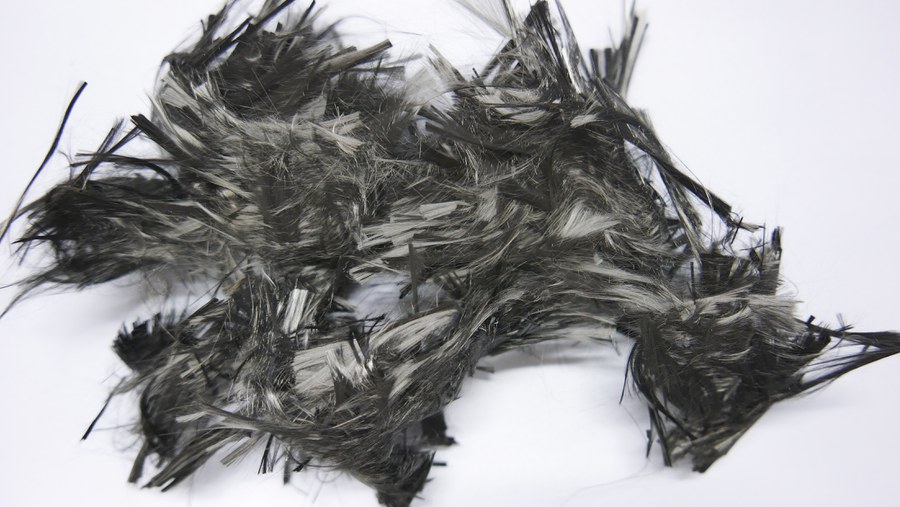
Recycled carbon fibers
The basic project B1 serves as a starter project for the entire project WIRreFa: WIR! recyceln Fasern (in English: WE! recycle fibers) as part of the BMBF initiative WIR! – Change through Innovation in the Region. The aim of the overall project is to make the region “Elbe Valley Saxony” a pioneer in the reprocessing and recycling of carbon fibers. The focus is on producing new reinforcements from recycled non-metallic fibers. Downcycling is categorically excluded. By involving a large number of locally resident companies, the project is expected to generate as many innovations as possible.
Together with a second basic project, the basic project B1 will be the basis for a large number of follow-up projects. The aim of the project is to create a requirements profile for recycled fibers, their preparation and further processing. This will be achieved by setting up a process chain, developing and testing reinforcements made from recycled fibers, and drawing up an application concept for the use of recycled fibers in other cross-sector areas. In the basic project, the investigations are to relate specifically to the application of the fibers as fiber strands, as nonwovens or as a disordered arrangement in short-fiber reinforced concrete.
Furthermore, a numerical model for semi-finished products made of recycled fibers is to be developed. The specific mechanical properties of the short fibers will be decisive here in comparison to as-new components. By taking into account the disordered fiber orientation and the presence of residues on the fibers, the model is to be created as close to reality as possible. This numerical model will be calibrated and adapted by experimental tests (tensile tests, bond tests) with semi-finished products made of recycled fibers.
The final concept for the cross-industry use of universal recycled fiber constructions envisages the application of linear or flat recycled fiber products inside and outside the construction industry.