
Praxisgerechte Transportbetone für Carbonbeton
Inhaltsverzeichnis
Projektdaten
|
Titel | Title |
Bericht aus dem Jahrbuch 2024/25
Trommelwirbel für Carbonbeton
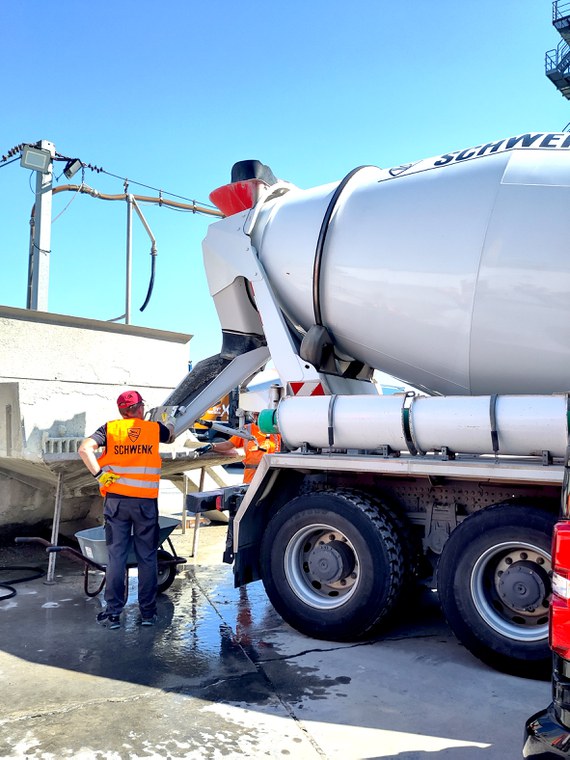
Betonanlieferung aus dem Fahrmischer im Transportbetonwerk
Fehlende Erfahrungswerte sind aus Sicht der Transportbetonindustrie ein wesentliches Hemmnis für eine breitere Anwendung von Carbonbeton im Neubau. Das Projekt „ReadyCarbonCret“ legte eine Grundlage für den künftigen Einsatz von Carbonbeton im Ortbetonbereich mit Fokus auf Transportbetonrezepturen mit klinkereffizienten Zementen.
Im Mittelpunkt standen drei fließfähige, vom Institut für Baustoffkunde der Bauhaus-Universität Weimar entworfene Betonrezepturen mit den Zementen CEM II/C-M (S-LL), CEM III/A und CEM III/B und zwei unterschiedliche Carbongitter. Zuerst wurden mit diesen Materialkombinationen Probekörper für verschiedene Kleinkörperversuche gemäß DAfStb-Richtlinie „Betonbauteile mit nichtmetallischer Bewehrung“ unter Laborbedingungen hergestellt und geprüft. Den Untersuchungsschwerpunkt bildeten Versuche an zentrisch gezogenen Dehnkörpern mit einem einlagig ausgeführten, in der Länge variierenden Übergreifungsstoß. Die Ergebnisse zeigten, dass sich die Rezepturen in Bezug auf das Verbundverhalten weder grundlegend voneinander unterscheiden noch von den Versuchsergebnissen mit konventionellen Rezepturen abweichen. Im zweiten Arbeitspaket erfolgte die Herstellung von Proben mit Übergreifungsstoß unter variierenden Witterungsbedingungen in zwei verschiedenen Transportbetonwerken mit jeweils einer der drei Betonrezepturen. Es wurden zwei Betonagezeitpunkte untersucht: Eine Probekörperserie wurde unmittelbar nach dem Mischvorgang hergestellt; die zweite nach 1,5 Stunden im Fahrmischer. Trotz der teilweise schlechteren Verarbeitbarkeit bzw. der teilweise niedrigeren Festbetoneigenschaften konnte, sofern die Gitteröffnung ausreichend groß war, kein signifikanter Einfluss der Herstellung im Werk bzw. der längeren Verarbeitungszeit auf die Verbundeigenschaften festgestellt werden.
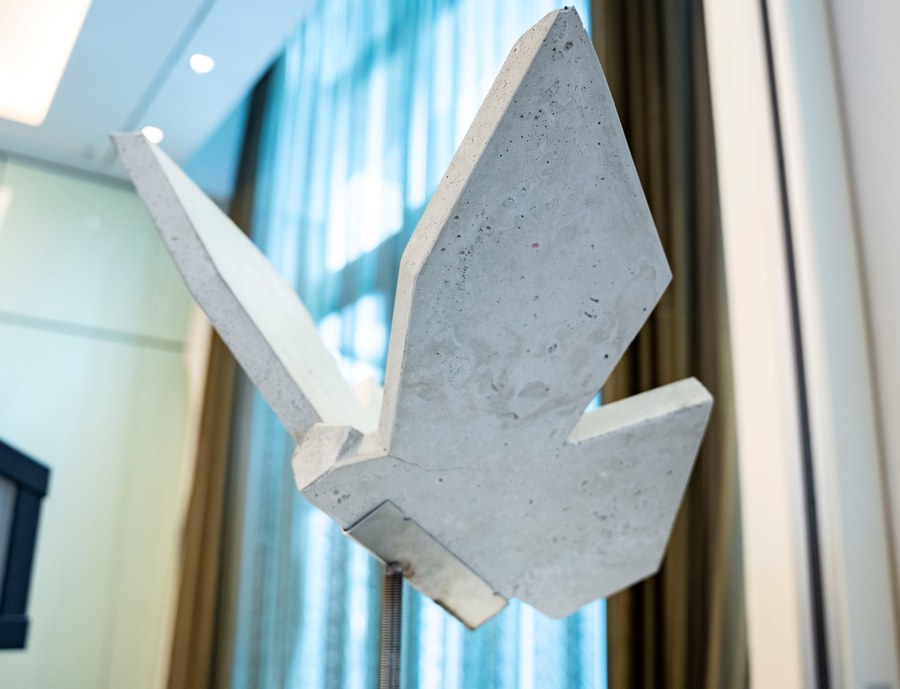
Carbonbetonschmetterling als Projektdemonstrator
Das Projekt hat gezeigt, dass sich Carbonbeton unter den Randbedingungen der Transportbetonpraxis gut herstellen lässt. Um ein optimales Verbundverhalten zwischen Carbongitter und Betonmatrix zu erreichen, werden ausreichend grobmaschige Carbongitter in Verbindung mit einem leicht verdichtbaren Beton empfohlen. Den Abschluss des Projekts bildete die Herstellung von zwei Demonstratoren in einem Transportbetonwerk.
Bericht aus dem Jahrbuch 2023
Transportbeton für Carbonbeton
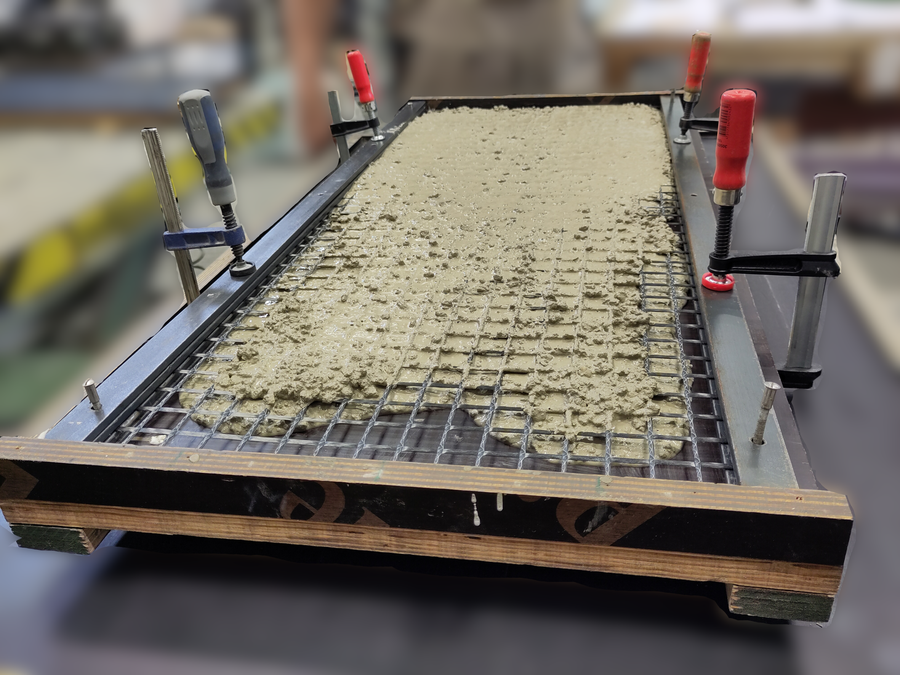
Betonage der Dehnkörper
Neubauteile aus Carbonbeton werden derzeit überwiegend in Fertigteilwerken und Forschungslaboren hergestellt, welche eine hohe Fertigungsgenauigkeit und damit eine konstante Materialbeschaffenheit gewährleisten können. Eignungstests entsprechend den Anforderungen der Transportbetonindustrie standen in den letzten Jahren nicht im Fokus von Forschung und Entwicklung. Mit der Entwicklung neuer Carbonbewehrungen und der wachsenden Erfahrung im Umgang mit Carbonbeton rücken die Anwendungen mit Ortbeton in Neubau und Bestand zunehmend in den Fokus.
Das Forschungsprojekt „ReadyCarbonCret“ hat zum Ziel, die Praxistauglichkeit von Carbonbeton für Ortbetonbauteile nachzuweisen. Die Transportindustrie wird dabei aktiv eingebunden. Das Institut für Baustoffkunde der Bauhaus-Universität Weimar übernimmt die Erstellung der Mischungsentwürfe sowie die Beurteilung der Frisch- und Festbetoneigenschaften von drei exemplarischen Betonrezepturen. Bedingt durch die Notwendigkeit, die Treibhausgasemissionen des Bausektors drastisch zu verringern, erfolgt die Entwicklung der Rezepturen mit klinkerreduzierten, normgemäßen oder zugelassenen Bindemittelsystemen.
Anhand der als geeignet bewerteten Rezepturen werden am Institut für Massivbau der TU Dresden die spezifischen Kennwerte des Verbundwerkstoffs Carbonbeton beurteilt. Dazu werden zwei Carbonbewehrungen mit unterschiedlicher Geometrie und Imprägnierung eingesetzt. Die Untersuchungen der Verbundcharakteristik zwischen Beton und Carbonbewehrung orientieren sich vergleichend am Vorgehen und an Ergebnissen aus vorangegangen Projekten. Neben der Zugfestigkeit des Verbundwerkstoffs am Dehnkörper wird das Verbundverhalten im einseitigen Auszugversuch sowie im Übergreifungstest unter einaxialer Zugbeanspruchung überprüft.
Die Herstellung und Prüfung der Probekörper unter Laborbedingungen erfolgt derzeit. In einem zweiten Arbeitspaket werden die Betone in einem ausgewählten Transportbetonwerk hergestellt. Dabei werden die Frischbetoneigenschaften bei zwei unterschiedlichen Verarbeitungszeiten geprüft und Probekörper zur Bestimmung der Festbetoneigenschaften sowie der carbonbetonspezifischen Verbundkennwerte hergestellt. Die gewonnenen Erkenntnisse sollen am Ende des Projektes an einem Demonstrator validiert werden.
Kurzfassung
Neubauteile aus Carbonbeton werden momentan überwiegend in Fertigteilwerken und Forschungslaboren hergestellt, die eine hohe Fertigungsgenauigkeit und dadurch konstante Materialbeschaffenheit gewährleisten können. Mit der Entwicklung von robusteren Carbonbewehrungen mit größeren Querschnitten sowie Stababständen und den zunehmenden Erfahrungen im Umgang mit Carbonbeton rücken die Anwendungen mit Ortbeton in Neubau und Bestand nun verstärkt in den Fokus. Für Ortbetone verändert sich das Anforderungsprofil. Es werden robustere Mischungszusammensetzungen und Ausgangsmaterialien benötigt. Der Beton muss pumpfähig sein und eine deutlich erhöhte Verarbeitungsdauer ermöglichen. Gleichzeitig ergibt sich aus der zumeist feingliedrigen Carbongitterbewehrung die Notwendigkeit, besonders gut einzubringende und zu verarbeitende Betone einzusetzen.
Die Zielstellung des Forschungsvorhabens besteht darin, die Praxistauglichkeit von Carbonbetonzusammensetzungen für Ortbetonbauteile auf der Basis von Transportbeton nachzuweisen. In Hinblick auf eine drastische Reduktion der Treibhausgasemissionen erfolgt die Entwicklung von Mischungsentwürfen mit klinkerreduzierten, normgemäßen oder zugelassenen Bindemittelsystemen. An einem Demonstrator werden die gesammelten Erkenntnisse validiert. Es erfolgt eine Transferierung der Ergebnisse des Projektes in die aktuelle Normungsarbeit zum Thema Carbonbeton.
Mit Erreichung der Projektziele wird ein wesentlicher volkswirtschaftlicher und gesellschaftlicher Beitrag im Hinblick auf die Ressourceneffizienz und die Verringerung von CO2-Emissionen im Bauwesen geleistet. Zudem bietet die Ausweitung der Carbonbetonbauweise auf die Ortbetonbauweise eine Erweiterung der bestehenden Geschäftsfelder der Transportbetonhersteller sowie Unternehmen des Betonfördergewerbes und führt damit zu einer Steigerung der Wettbewerbsfähigkeit der kleinen und mittelständischen Unternehmen dieser Branchen.