
High-temperature protective hybrid impregnation and coating for carbon reinforcement in concrete structures
Project data
| Titel | Title Hochtemperatur-Hybridimprägnierung und -beschichtung für Carbonfaserbewehrung in Carbonbeton | High-temperature protective hybrid impregnation and coating for carbon reinforcement in concrete structures Förderer | Funding Deutsche Forschungsgemeinschaft (DFG) Zeitraum | Period 10/2020 – 12/2025 Leiter | Project manager Prof. Dr.-Ing. Dr.-Ing. E.h. Manfred Curbach Bearbeiterin | Contributor Olga Benedix Projektpartner | Project artner Leibniz-Institut für Polymerforschung Dresden e.V. (IPF) |
Abstract
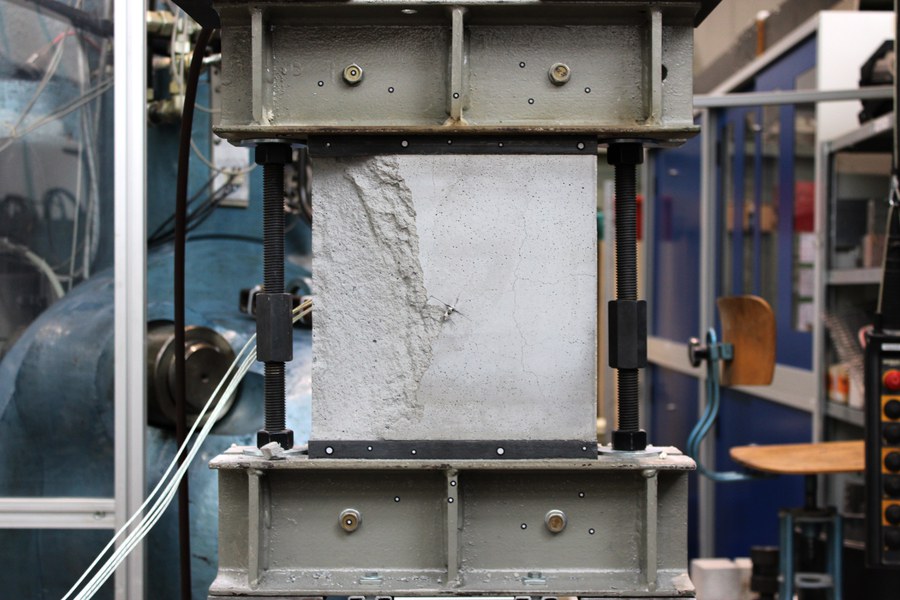
Test specimen with superficial concrete spalling after temperature stress
In the event of a fire, explosive spalling poses a significant risk to the load-bearing capacity of any component, especially in high-strength concrete. Such spalling behaviour results from a strong increase in pore pressure due to the evaporation of pore water on the one hand and internal stresses caused by the different thermal expansion of the individual components on the other hand. The addition of short polypropylene fibres is well known, particularly in tunnel construction, to prevent spalling. The fibres create microcracks in the cement matrix, thereby increasing permeability and enabling the reduction of thermally induced stresses in the concrete. To induce spalling under laboratory conditions, a steep temperature increase is necessary. In the PTM test (pressure, temperature, mass) an unreinforced concrete slab is clamped into a steel frame and subjected to a one-dimensional load of 10% of the concrete’s 28-day compressive strength. The stresses generated in the concrete make it possible to cause concrete spalling even without thermal stress according to the standard temperature-time curve.
The project investigated the high-strength concrete HF-2-145-5. To track the temperature profile within the test specimen, five temperature sensors were embedded at 10 mm intervals, each starting at the surface. The originally proposed steel frame, has been replaced by four stiffened steel elements connected and arranged in pairs above and below the specimen. The one-dimensional load was applied via two test cylinders on top of the setup. A total of nine ceramic radiators heated the specimen up to 600 °C surface temperature. Spalling occurred at surface temperatures as low as 240–260 °C. The addition of only 1 wt-% polypropylene fibres completely prevented spalling while maintaining good workability of the raw concrete.