
Profilgarne mit einstellbaren Verbundeigenschaften
Projektdaten
|
Titel | Title |
Kurzfassung
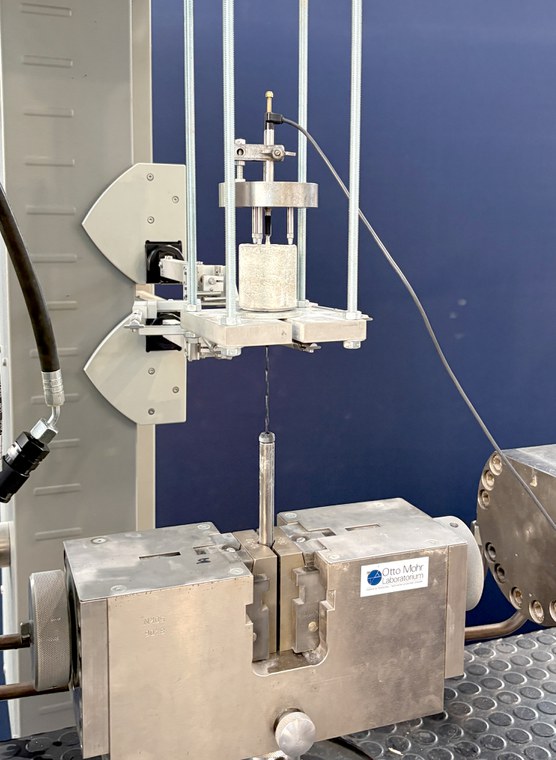
YPO-Versuch an einem profilierten Garn
Das Projekt adressiert eine der zentralen Herausforderungen im Carbonbetonbau: den Verbund zwischen Carbonrovings und der umgebenden Betonmatrix, der für die Kraftübertragung, die Risskontrolle und eine effiziente Tragwerksplanung von entscheidender Bedeutung ist. Der Verbund herkömmlicher textiler Bewehrungen beruht primär auf Adhäsion und Reibung. Im Projekt, welches gemeinsam mit dem Institut für Textilmaschinen und Textile Hochleistungswerkstofftechnik (ITM) durchgeführt wird, wird nun untersucht, wie eine definierte geometrische Profilierung des Rovings einen gezielt steuerbaren mechanischen Formschluss erzeugen kann. Dieser ist im Grundprinzip mit der Wirkung gerippter Stahlbewehrung vergleichbar, jedoch an die anisotrope und filamentbasierte Natur von Carbongarnen angepasst.
Das übergeordnete Ziel ist, eine numerisch und experimentell validierte Grundlage für die gezielte Modifikation und Steuerung der Verbundeigenschaften faserbasierter Bewehrungsstrukturen im Betonbau zu schaffen. In der ersten Projektphase erfolgt eine methodische Grundlagenuntersuchung der Referenzmaterialien: herkömmliche glatte Carbongarne, die Basisvariante eines profilierten Garns und ein hochfester Beton sowohl alleine als auch als Komposite. Das Prüfprogramm umfasst für den Beton Standard-Prismenversuche und Druckversuche an Zylindern. Die Carbongarne werden hinsichtlich ihrer Zugtragfähigkeit getestet. Zur Erfassung des Verbundverhaltens und zur Bestimmung der Verbundspannungs-Schlupf-Beziehung wurde eine Versuchsreihe von Garn-pull-out-Versuchen (YPO) vorgesehen. Ergänzend wurde eine Serie einaxialer Zugversuche (DK) konzipiert, um das Rissbild für jeden Garntyp zu dokumentieren. Das zentrale experimentelle Programm umfasst dann YPO-Versuche und Dehnkörperversuche mit Parametervariationen zu Garntypen, Umgebungstemperaturen von 20 und 80 °C, verschiedenen Betonen von normalfest bis hochfest sowie unterschiedlichen Betondeckungen. Die resultierende experimentelle Datenbasis wird im Anschluss für die Kalibrierung numerischer Modelle genutzt.
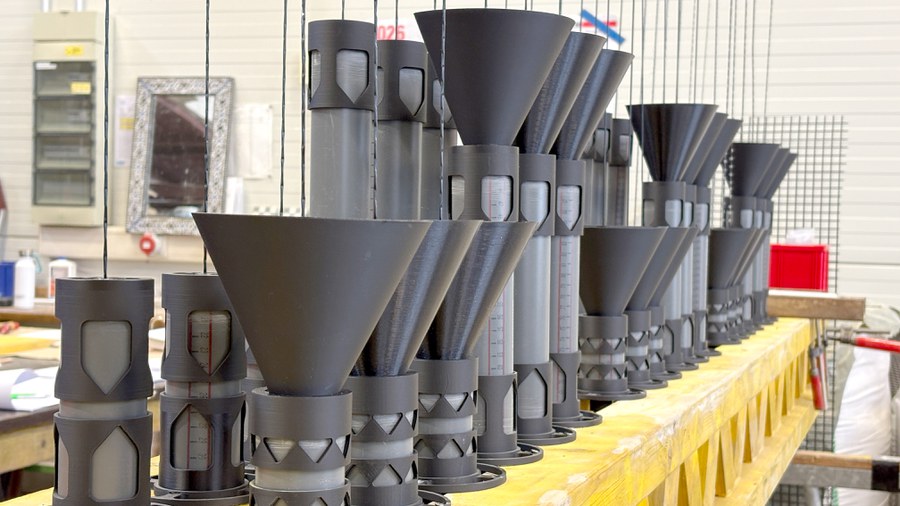
Neu entwickelte Schalungen für YPO-Proben
Um eine hohe Genauigkeit bei der Herstellung der Probekörper zu erreichen und den Arbeitsablauf zu optimieren, wurde der Herstellungsprozess für die YPO- und einaxialen Zugproben neu konzipiert. Es wurde ein spezieller Aufbau entwickelt, der auf einer möglichst umfassenden Nutzung parametrischer Bauteile basiert, die mittels 3D-Druck aus PLA gefertigt und mit marktüblichen Standardkomponenten kombiniert werden.