
Biaxial fatigue loading
Table of contents
Project data
| Titel | Title TP Experimentelle Untersuchung und Charakterisierung des biaxialen Ermüdungsverhaltens von Beton im institutsübergreifenden Forschungsprojekt PHYBIA: Physikbasiertes Bewertungsmodell für biaxiale Ermüdung zur verbesserten Lebensdauerprognose | SP Experimental investigation and characterization of the biaxial fatigue behaviour of concrete within the inter-institute research project PHYBIA: Physics-based biaxial fatigue assessment model for enhanced life prediction Förderer | Funding Deutsche Forschungsgemeinschaft (DFG) / CARE Seed Funding Program Zeitraum | Period 06/2026 – 12/2026 Projektleiter | Project manager Dr.-Ing. Chongjie Kang Team | Team Aleksei Shmorgun, Kerstin Speck, Chongjie Kang Projektpartner | Project partner Institut für Mechanik und Flächentragwerke, TU Dresden |
Summary
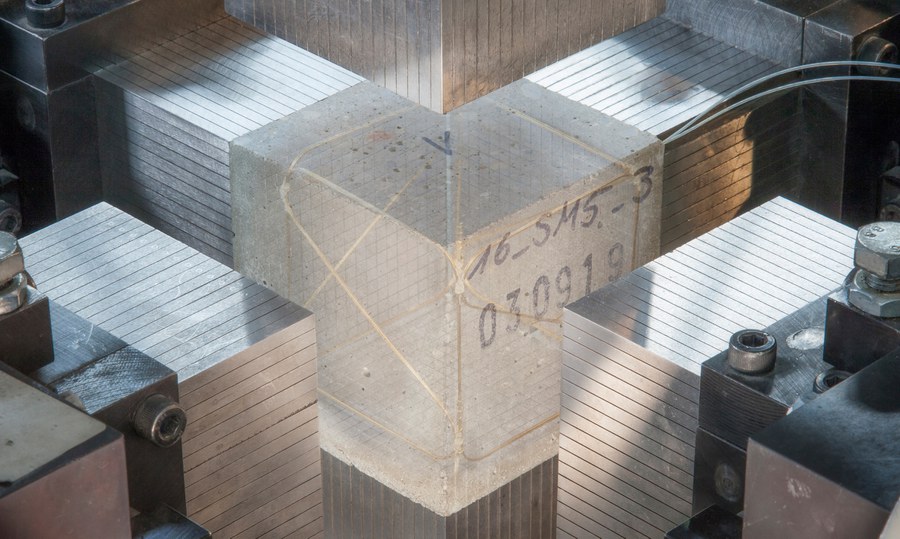
Although the fatigue behavior of concrete under uniaxial loading has been extensively studied, current models still lack a mechanistic basis for describing multiaxial fatigue states, particularly under simultaneous tension-compression and changing loading paths. Such stress states are highly relevant in structural components such as bridges and slabs. The biaxial stress interaction strongly influences fatigue damage by governing crack initiation, propagation, and progressive stiffness degradation. However, existing fatigue life prediction models are predominantly based on uniaxial loading assumptions or rely on empirical approaches, with limited measurement capabilities further restricting the availability of data for reliable model calibration. Consequently, the fatigue behavior of concrete under simultaneous tension-compression remains insufficiently understood due to the lack of adequate experimental characterization and advanced modeling methods.
To address this gap, the project focuses on the experimental characterization of biaxial concrete fatigue. This involves systematic tests on small-scale concrete cubes under uniaxial compression, uniaxial tension, and combined biaxial compression-tension loading. Both static and cyclic loading tests will be conducted. Advanced measurement techniques, including distributed fiber-optic sensors, laser displacement sensors, and strain gauges, will enable detailed monitoring of the material response. The experimental results will serve as the basis for the calibration and validation of an advanced physics-based anisotropic constitutive material model for numerical simulation of fatigue behavior.