
Properties of 40-year-old nuclear power plant concrete
Project data
| Titel | Title Charakterisierung der statischen und dynamischen Materialeigenschaften von 40 Jahre altem KKW-Beton | Characterization of the static and dynamic material properties of 40-year-old nuclear power plant concrete Förderer | Funding Bundesministerium für Umwelt, Klimaschutz, Naturschutz und nukleare Sicherheit (BMUKN) / GRS Zeitraum | Period 07/2026 – 06/2029 Projektleitung | Project leader apl. Prof. Dr.-Ing. Birgit Beckmann Bearbeiterin | Contributor Ghazaleh Taheri |
Abstract
Since these facilities are built largely from reinforced concrete, a detailed knowledge of the behavior of the concrete used in their construction is essential for ensuring their safe and reliable performance over such extended periods.
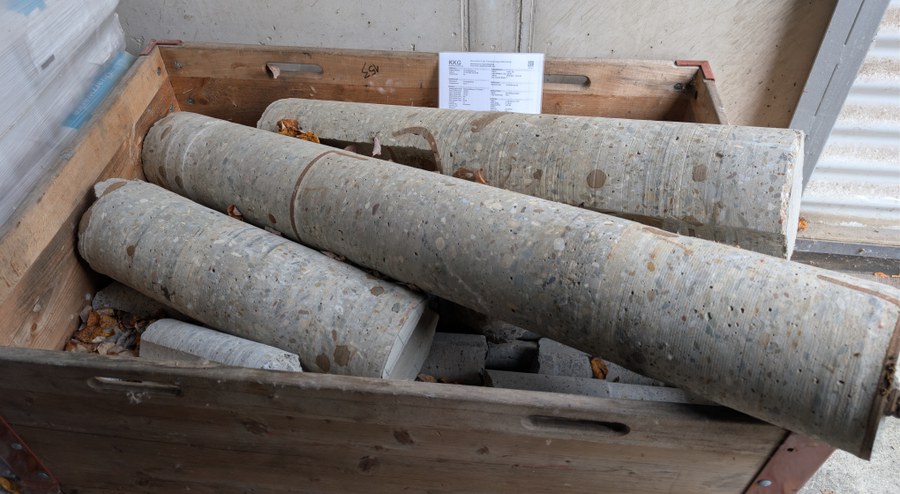
Cylindrical core-drilled specimen from the wall of a nuclear power plant
This project examines approximately 40 years old concrete taken from an operational power plant. The aim is to characterize a variety of its material properties, among them the uniaxial and multiaxial strength obtained from specimens taken from different faces of a two-meter-thick concrete wall. In order to establish a complete picture of the properties of this 40-year-old material, a series of experimental investigations is planned, consisting of the following tests.
The first stage comprises static testing. This includes uniaxial and multiaxial compressive tests, tensile tests, and measurement of the concrete's modulus of elasticity, alongside tensile testing of the reinforcing steel. The results obtained from the aged material will be compared with those of newly produced concrete to identify any age-related changes in mechanical behavior. The second stage involves creep testing of the aged concrete, complemented by microstructural analysis using scanning electron microscopy (SEM) in conjunction with energy-dispersive X-ray spectroscopy (EDX). This combination of methods provides insight into the long-term deformation behavior of the material as well as its microstructural and compositional characteristics. The third stage consists of dynamic material testing carried out with a split-Hopkinson pressure bar (SHPB), used to determine the dynamic increase factor of the aged concrete under high strain-rate loading. As before, these findings will be compared with the equivalent dynamic properties of new concrete.
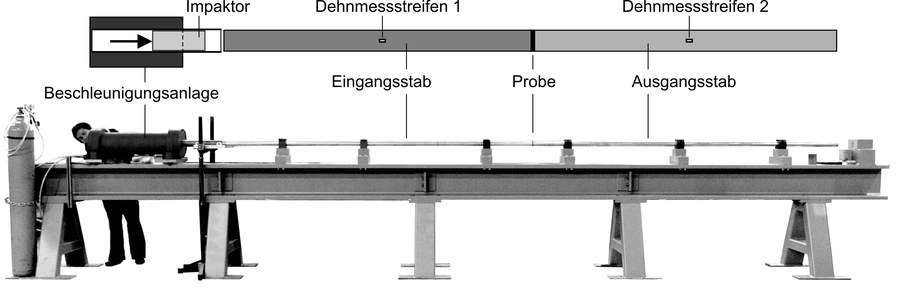
Test setup of the Split Hopkinson Bar
The outcomes of these experimental investigations are expected to contribute to the maintenance and design of concrete structures. A deeper understanding of the behavior of aged concrete constitutes an essential basis for evaluating existing structures and for advancing and refining repair measures and analytical methods. This is of particular importance for safety assessments addressing the durability and structural integrity of nuclear facilities.