
Weitere Themen
Inhaltsverzeichnis
- H – 15 Bewertung der Oberflächenzugfestigkeit niedrigfester Stahlbetonplatten
- H – 14 Bohrkernfestigkeit
- H – 13 Rissbildung und Wasseraufnahme im Bohrkern
- H – 12 Kriechen von Altbeton
- H – 11 Nutzungsdauerverlängerung von Spannbetonschwellen
- H – 10 Nachrechnung und Bewertung historischer Bemessungen von Festen Fahrbahnkonstruktionen
- H – 5 Einflüsse auf die Übertragung akustischer Signale
H – 15 Bewertung der Oberflächenzugfestigkeit niedrigfester Stahlbetonplatten
Bei der Instandsetzung historischer Stahlbetonbauwerke ist die zuverlässige Bewertung der vorhandenen Betonqualität eine zentrale Voraussetzung für die Planung geeigneter Maßnahmen. Eine wichtige Kenngröße ist dabei die Oberflächenzugfestigkeit des Altbetons. Insbesondere bei sehr niedrigfestem Beton fehlen jedoch bislang belastbare und normativ abgesicherte Ansätze für deren statistische Bewertung.
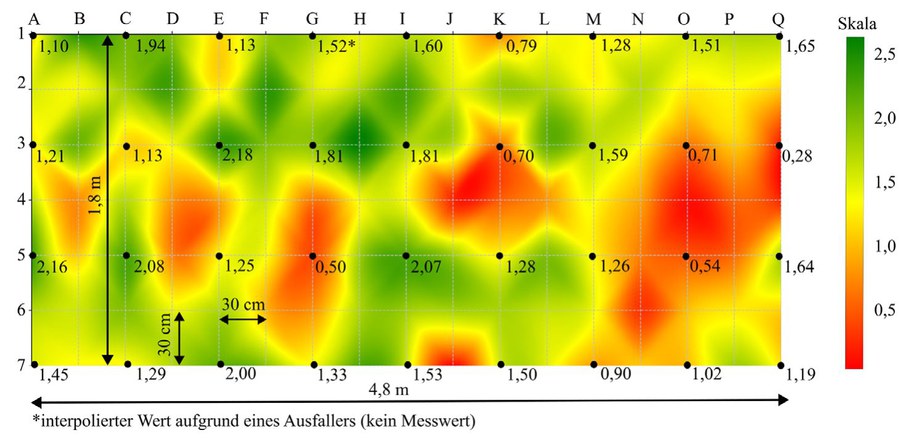
Heatmap zur Verteilung der Oberflächenzugfestigkeit in einer Decke im Zechenhaus Brieske
Im Rahmen dieser Arbeit werden umfangreiche Messdaten aus historischen Bauwerken, unter anderem dem Zechenhaus Brieske, dem Feintuchwerk Forst und dem Flughafen Tempelhof, sowie aus reproduzierten niedrigfesten Betonplatten ausgewertet. Ziel ist es, die Verteilung und Streuung der Oberflächenzugfestigkeit zu untersuchen und den Einfluss des Stichprobenumfangs auf die Ermittlung charakteristischer Werte zu bewerten. Dabei wird auch untersucht, inwieweit Zusammenhänge zwischen Oberflächenzugfestigkeit, Druckfestigkeit und Spaltzugfestigkeit bestehen.
Auf Grundlage der statistischen Auswertungen und einer kurzen Recherche zu bestehenden normativen Regelungen soll schließlich ein praxistauglicher Bewertungsvorschlag entwickelt werden. Dabei steht insbesondere die Frage im Mittelpunkt, wie eine ausreichende Datengrundlage gewählt werden kann, um sowohl eine unnötig konservative als auch eine zu optimistische Bewertung der vorhandenen Betonqualität zu vermeiden.
Die Arbeit bietet die Möglichkeit, mit realen Messdaten aus historischen Bauwerken zu arbeiten, statistische Methoden praktisch anzuwenden und einen direkten Beitrag zur Weiterentwicklung der Bestandsbewertung zu leisten.
Ansprechpartner:
Dipl.-Ing. (FH) Jan Berger (HTW Dresden / KREBS+KIEFER Ingenieure GmbH)
0162 329 1392
0351 462 3313
David Sandmann M.Sc. (TU Dresden)
0351 463-35529
H – 14 Bohrkernfestigkeit
Ausführlicher Titel: Einfluss von Stahlbewehrung auf das Drucktragverhalten von Betonbohrkernen
Untersuchungen an Bohrkernen ermöglichen auf kosteneffiziente Weise zahlreiche wichtige Erkenntnisse über ein Bestandsbauwerk. Trotz der Möglichkeit, Bewehrung zerstörungsfrei zu orten, ist es oft unvermeidlich, dass Bohrkerne bei der Entnahme Bewehrung enthalten. Die in der Praxis für die Prüfung von Bohrkernproben maßgebliche Norm DIN EN 12504-1 gibt vor, dass, falls vorhanden, Durchmesser und Lage der Bewehrung zu dokumentieren sind. Die Einflüsse auf die Prüfergebnisse werden allerdings nicht näher beschrieben oder mit Korrekturfaktoren quantifiziert.
Im Rahmen einer studentischen Arbeit sollen die Einflüsse, die sich aus Durchmesser und Lage der Bewehrung ergeben können, auf das Materialverhalten von Betonbohrkernen unter Druckbeanspruchung näher untersucht werden. Neben einer Literaturrecherche wird die Arbeit durch numerische und/oder experimentelle Untersuchungen ergänzt. Ziel ist die Ausarbeitung von Empfehlungen für die Auswertung von Prüfergebnissen aus Kurz- und Langzeitversuchen unter Druck (Druckfestigkeit, E-Modul und Kriechverhalten). Je nach Interesse und Ausrichtung des/der Studierenden liegt der Schwerpunkt auf numerischer Simulation, experimentellen Untersuchungen oder einer Kombination aus beidem.
Die Arbeit umfasst die folgenden Arbeitspakete:
- Literaturrecherche zu normativen Empfehlungen/Vorgaben sowie zum Stand des Wissens zu Einflüssen von Bewehrung in Betonbohrkernen auf das Materialverhalten
- Ggf. numerische Simulation von kleinformatigen Betonzylindern unter Druckbeanspruchung mit variierendem Bewehrungsgehalt bzw. variierender Lage
- Ggf. Erarbeitung eines Versuchskonzeptes, Versuchsdurchführung und Ergebnisauswertung von Laborversuchen an Betonzylindern mit variierendem Bewehrungsgehalt bzw. variierender Lage
-
Erarbeitung von Empfehlungen zur Beprobung von Betonbohrkernen mit Bewehrungsgehalt
Die konkrete Aufgabenstellung wird individuell mit der/dem Studierenden abgestimmt. Es besteht die Möglichkeit, Projekt- und Diplomarbeit aufeinander aufzubauen.
Ansprechperson:
Dipl.-Ing. Jenny Pech
+49 351 463-34665
H – 13 Rissbildung und Wasseraufnahme im Bohrkern
Ausführlicher Titel: Untersuchungen einer potenziellen Rissbildung und der Wasseraufnahme infolge einer Bohrkernentnahme sowie weiterer Nassbearbeitung
Untersuchungen an Bohrkernen ermöglichen auf kosteneffiziente Weise zahlreiche wichtige Erkenntnisse über ein Bestandsbauwerk. Somit ist die Kernbohrung eine der wichtigsten Verfahren zur Probengewinnung in der Bestandsanalyse. Dabei kommen zwei Methoden infrage: die Zugabe von Wasser reduziert im Nassbohrverfahren die entstehende Reibungswärme und ermöglicht den Abtransport des Bohrmehls. Es kann davon ausgegangen werden, dass ein Teil des Bohrwassers vom Beton kapillar aufgenommen wird. Gleiches gilt bei weiteren Bearbeitungsschritten wie dem Schleifen und Sägen unter Wasserzugabe. Bei der aufwändigeren Trockenbohrung trocknet der Beton hingegen infolge der entstehenden Reiberhitzung aus. Mit einer Veränderung des ursprünglichen Feuchtezustands ist folglich bei beiden Verfahren zu rechnen. In Literatur und Praxis gibt es darüber hinaus Hinweise, dass während des Bohrprozesses Mikrorisse im Bohrkern entstehen können.
Im Rahmen einer Abschlussarbeit (Projekt- und/oder Diplomarbeit/Masterarbeit) sollen die Wasseraufnahme und die Rissbildung infolge der Probengewinnung und Bearbeitung anhand verschiedener Bestandsbetonproben, die im Rahmen der Bearbeitung zur Verfügung gestellt werden, untersucht werden. Ziel ist die Ausarbeitung von Empfehlungen, ob und wenn ja wie, diese Einflüsse für bautechnische Untersuchungen am Bohrkern bewertet werden können.
Die Arbeit besteht aus den folgenden Arbeitspaketen:
- Darstellung des Stand des Wissens zur Beeinflussung von Bohrkernproben infolge verschiedener Probengewinnungsmethoden und Einflussparameter (Einwirkungsgrößen, Dauer der Einwirkung, Betoneigenschaften)
- Erarbeitung eines Versuchskonzeptes zur Untersuchung der genannten Einflussgrößen
- Begleitung, Durchführung und Auswertung der Versuche im Labor
- Ausarbeitung von Empfehlungen zur Berücksichtigung der Rissbildung und Wasseraufnahme infolge der Probengewinnung
Die konkrete Aufgabenstellung wird individuell mit der/dem Studierenden abgestimmt.
Ansprechpartnerin:
Dipl.-Ing. Jenny Pech
+49 351 463-34665
H – 12 Kriechen von Altbeton
Bestandsbauwerke erfahren durch Umnutzung oder Verstärkungsmaßnahmen häufig höhere Ausbau- und Nutzlasten. Die zusätzlichen Druckbeanspruchungen führen zu einem erneuten Kriechprozess im Bestandsbeton. Diese Kriechverformungen müssen durch geeignete Prognosemodelle in der Planung berücksichtigt werden, um Spannkraftverluste, Durchbiegungen, Schnittkraftumlagerungen und andere verformungsbedingte Veränderungen im Bauwerk quantitativ abschätzen zu können. Die derzeit gültigen normativen Kriechmodelle beruhen jedoch ausschließlich auf Versuchen mit vergleichsweise jungem, bislang unbelastetem Beton und sind daher für die Vorhersage von Kriechverformungen im hohen Belastungsalter nicht verlässlich. Die sehr wenigen vorliegenden Kriechuntersuchungen an Altbeton belegen, dass die Kriechverformungen auch im sehr hohen Betonalter nicht vernachlässigbar sind und von normativen Kriechmodellen unterschätzt werden.
Vor diesem Hintergrund finden derzeit am Institut für Massivbau Untersuchungen an zum Kriechverhalten alter Betone statt. Studentische Arbeiten können entscheidend zum Erkenntnisgewinn im Projekt beitragen, indem Entnahme- und Messmethoden, Material- und Bauteilverhalten und Fehlereinflüsse durch Recherchearbeiten und Laborversuche detailliert untersucht werden.
Mögliche Themenfelder umfassen derzeit unter anderem:
- Entwicklung von Modellansätzen zum Kriechen von Altbeton aus der Literatur
- Untersuchungen zu Fehlereinflüssen bei Kriechversuchen an Bohrkernproben
- Auswirkungen der Über- und Unterschätzung des Kriechens von Altbeton (bspw. infolge Lasterhöhungen in einem Bestandsbauwerk oder bei der Wiederverwendung von Bauteilen)
- Schwinden und Quellen von Altbeton
- Bestimmung der Druck- und Zugspannungen an Betonbauwerken mit der Bohrloch- und Ringkern-Methode
- Rückdehnungsmessung von Beton nach sehr langer Belastungsdauer
- Literaturrecherche zu vorgespannten Betonfertigteilen in der DDR
Die konkrete Aufgabenstellung wird individuell mit der/dem Studierenden abgestimmt. Es besteht die Möglichkeit, die Aufgabenstellung so zu gestalten, dass die Diplomarbeit auf der Projektarbeit aufbaut.
Ansprechpartnerin:
Dipl.-Ing. Jenny Pech
+49 351 463-34665
H – 11 Nutzungsdauerverlängerung von Spannbetonschwellen
Schotteroberbau mit Spannbetonschwellen ist mit Abstand die verbreitetste Oberbauart in Netz der Deutschen Bahn. Schwellen sind ein integraler Bestandteil des Eisenbahnoberbaus und verantwortlich für die Weiterleitung der Kräfte von der Schiene in den Schotter und die Sicherstellung der Gleislage. Jährlich werden im Netz der DB ca. 2,7 Millionen alte Schwellen ausgebaut bzw. neue Schwellen verbaut, was sowohl wirtschaftlich als auch aus Gründen der Nachhaltigkeit nachteilig ist. Ziel sollte daher eine Verlängerung der Nutzungsdauer der Schwellen sein. Im Rahmen dieses Projekts ergeben sich folgende Themen für Abschlussarbeiten:
- Literaturrecherche zur historischen Entwicklung der Spannbetonschwellen (Bemessung, frühere Schwellentypen, vorhandene Untersuchungen zur Nutzungsdauer)
- Vergleich der Schwellenbemessung nach DIN EN 12320 bzw. UIC 713 und den Vorgaben im EC 2 mit anschließender Parameterstudie zum Einfluss der Abweichungen zwischen den Regelwerken.
- Parameterstudie zum Einfluss unterschiedlicher Randbedingungen auf das Tragverhalten/ die Bemessung der Schwellen (Zustand des Schotters, Zustand der Schiene, Einfluss der Steifigkeit des Oberbaus etc.)
- Simulation des Tragverhaltens unterschiedlicher Schwellentypen von der Herstellung bis zum Ende der Nutzungsdauer
Ansprechpartner:
Elias Will, M.Eng.
+49 351 463 35467
H – 10 Nachrechnung und Bewertung historischer Bemessungen von Festen Fahrbahnkonstruktionen
Die Feste Fahrbahn wird allgemein als bevorzugte Option für den Bau neuer Hochgeschwindigkeitsstrecken betrachtet. Die über 50-jährige Entwicklung dieser Technologie hat zu zufriedenstellenden Ergebnissen bei den derzeit eingesetzten Bauformen geführt. In der Entwicklungsgeschichte haben sich jedoch nicht alle Varianten als dauerhaft bewährt – in einigen Fällen kam es zu Schäden. Im Rahmen von Instandhaltungsmaßnahmen sind daher statische Nachrechnungen bestehender Konstruktionen erforderlich. Dafür müssen auch historische Bemessungsmethoden analysiert und nachvollzogen werden. Daraus ergeben sich folgende Themen und Aufgabenstellungen für Projekt- und Abschlussarbeiten (Master und Diplom), die individuell mit den Studierenden abgestimmt werden können:
- Literaturrecherche zur historischen Bemessung der Festen Fahrbahn (Deutschkenntnisse erforderlich)
- Parameterstudie zur Bemessung der Festen Fahrbahn gemäß DIN EN 16432-2 und Betonkalender 2015
- Nachrechnung historischer Feste-Fahrbahn-Konstruktionen
- Vergleichsstudie: Bemessung der Festen Fahrbahn nach DIN EN 16432 im Vergleich zu anderen Normen (z. B. Eurocode oder Model Code)
Kontakt:
Franz Grützmacher
+49 351 463-40412
H – 5 Einflüsse auf die Übertragung akustischer Signale
Ausführlicher Titel: Untersuchung verschiedener Einflussparameter für die Übertragung akustischer Signale in der Schallemissionsanalyse (SEA)
Akustische Signale sind überall in unserem Leben zu finden. Im Alltag können sie von unserem Gehirn verarbeitet werden, um die benötigten Informationen, z. B. von einem Gespräch, zu erhalten. Auch im Bauwesen können sie in Kombination mit verschiedenen Messtechniken für die Bauwerksdiagnostik verwendet werden. Die Schallemissionsanalyse (SEA) ist eine zerstörungsfreie Prüfmethode, welche anhand der Analyse der vom Bauwerk emittierten Schallwellen Rückschlüsse auf eine Zustandsänderung des Bauwerks schließen kann.
Für eine erfolgreiche Bauwerksdiagnose ist die Qualität der gemessenen Signale entscheidend, welche von vielen Parametern beeinflusst werden können. Diese Parameter können grundsätzlich in drei Gruppen aufgeteilt werden, die Schallquelle im Bauteil, den Ausbreitungsweg der akustischen Signale von der Quelle bis zum Sensor und das Messsystem. Während die ersten beiden von den Materialeigenschaften des Bauteils abhängig sind, können Parameter aus der letzten Gruppe, z. B. die Ankopplung des Messsensors, vom Messaufbau beeinflusst werden. Eine gute Ankopplung sichert nicht nur eine gute Signalqualität, sondern auch die Reproduzierbarkeit der Messungen.
Im Rahmen der Arbeit sollen verschiedene Einflussparameter wie Koppelmittel, der Anpressdruck des Messsensors bezüglich der Sensorankopplung anhand Versuche an kleinformatigen Probekörpern untersucht werden.
Details zur Aufgabenstellung werden während der Bearbeitungszeit präzisiert.
Kontakt:
Ronghua Xu
0351 463-33776