
Sep 24, 2026
Water security and climate adaptation: TUD strengthens international exchange
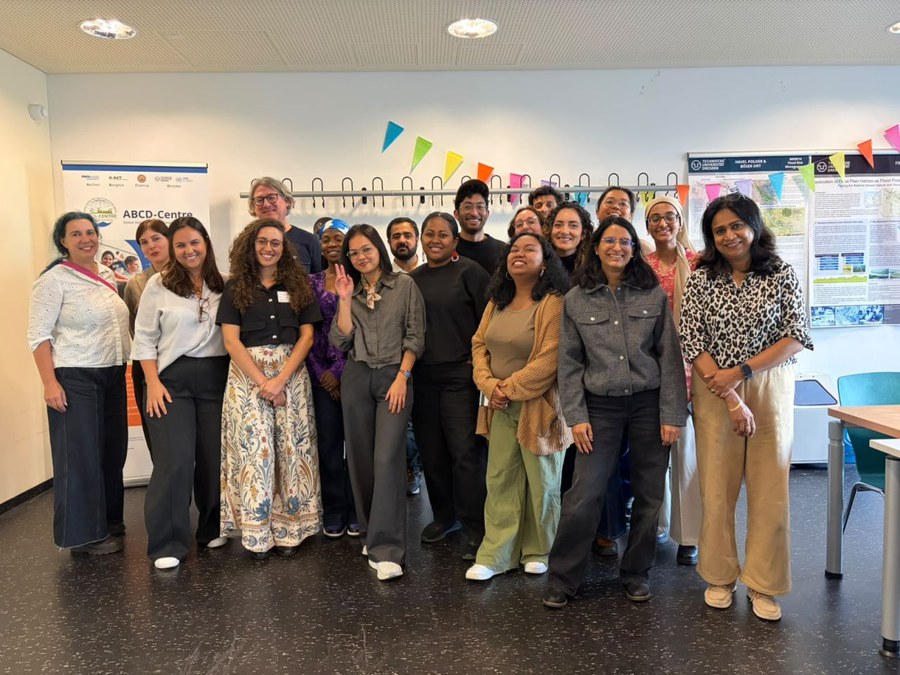
The 2026/27 cohort of Alexander von Humboldt Foundation Climate Protection Fellows visits TU Dresden.
How can research, practical experience and different knowledge systems contribute to greater climate resilience? Two encounters at TUD Dresden University of Technology opened up opportunities for international cooperation and mutual learning. The UNU Hub on Climate Resilience and Sustainable Technologies (CREST) helps connect research, education and practice.
Water security and climate adaptation require cooperation across institutional and disciplinary boundaries. With this in mind, representatives of universities, international networks and development practice met at TUD for an exploratory discussion. They considered where shared interests and complementary experience could provide starting points for future collaboration.
Participants included Marcella D’Souza and Crispino Lobo from India’s Watershed Organisation Trust (WOTR); Professor Anandaroop Bhattacharya, Dean for International Relations at the Indian Institute of Technology (IIT) Kharagpur; and Richa Srivastava, representing ICARS at IIT Roorkee. Dresden-based participants were Sarah Elser from the ABCD-Centre – Global Water and Climate Adaptation Centre; Mareike Braeckevelt from TUD’s emerging field “Forest Water Dynamics in Climate Change”; Avinash Chekuru from TUD’s International Office; Professor Daniel Karthe, Director of UNU Resource Nexus; and André Lindner, Deputy Director of the UNU Hub CREST.
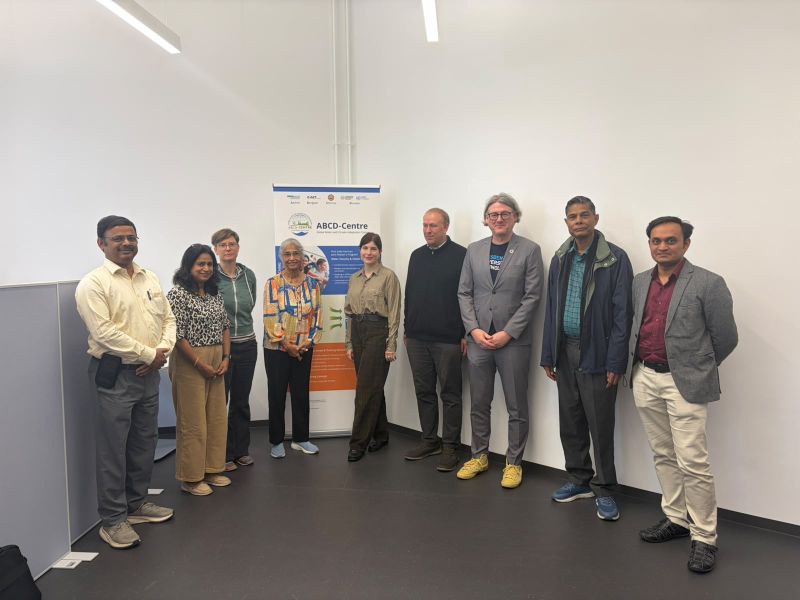
from left to right: Prof. Anandaroop Bhattacharya, Richa Srivastava, Mareike Braeckevelt, Marcella D’Souza, Sarah Elser, Prof. Daniel Karthe, André Lindner, Crispino Lobo, Avinash Chekuru.
Identifying shared interests
The meeting provided an open setting to explore potential cooperation. Discussions covered water security, climate adaptation and forest–water interactions, alongside community-based approaches, capacity building and the translation of scientific knowledge into practice. Participants drew on their institutions’ experience, networks and ambitions to identify areas of common interest.
Several of these themes continued a few hours later in a different setting. As part of the annual study tour for the Alexander von Humboldt Foundation’s International Climate Protection Fellows, organized by CIPSEM at TUD, an interactive session explored different knowledge systems for water security. Richa Srivastava contributed insights into India’s Adaptation, Resilience and Sustainability Network (ADRES).
UNU Hub CREST connects partners and supports mutual learning
Both encounters addressed how scientific knowledge can work alongside the experience of practitioners and local communities to support effective climate adaptation. In this context, capacity building also means creating opportunities for mutual learning and bringing different perspectives into cooperation.
The UNU Hub on Climate Resilience and Sustainable Technologies (CREST) at TUD provides a platform for this exchange. It connects international university partners, practice-oriented organizations and networks, helping to establish relationships from which further cooperation can develop. Its mandate brings together research, education and knowledge transfer at the interface of science, policy and practice. The two encounters illustrate how such exchange can identify concrete starting points for future collaboration.
Contact:
 © Thorsten Eckert
Managing Director
NameMr Dr. rer. nat. André Lindner
& Advisor Internationalisation
Send encrypted email via the SecureMail portal (for TUD external users only).
School of Civil and Environmental Engineering
Visitors' Address:
Hülsse-Bau, south wing, room 384 Helmholtzstr. 10
01069 Dresden
None