50th UNEP/UNESCO/BMUKN International Postgraduate Course on Environmental Management for Developing Countries (EM50)
>> Selection Process Ongoing
Please note that the selection process is currently underway. Selected applicants will be notified of the results by mid-August 2026. We appreciate your patience and understanding throughout the selection process.
-----
A flagship six-month postgraduate program in Dresden, strengthening environmental professionals from developing and emerging economies to integrate science, policy, and practice in designing and implementing sustainable development strategies.
|
Funding period |
07 January – 23 July 2027 |
|
Course period |
14 January – 16 July 2027 |
|
Duration |
6 months, full-time |
|
Location |
On-site, Dresden |
|
Participants |
21 fellows |
|
Language |
English |
|
Application Period |
09 February – 17 March 2026 |
This course combines a modular curriculum covering resource management, climate action and governance with intensive peer learning and field excursions. Participants develop practical skills through project work, group exercises and a final research paper, supported by a comprehensive fellowship.
Motivation
The Sustainable Development Goals (SDGs), adopted by the United Nations in 2015, represent a landmark commitment to addressing the world’s most pressing challenges—from climate action and biodiversity loss to sustainable urban development, poverty reduction and responsible consumption.
Despite broad international support, progress on the 2030 Agenda remains significantly off track, highlighting the urgent need for professionals who can translate these global frameworks into coherent, context-specific strategies for environmental protection and sustainable development in their home countries.
Concept
The UNEP/UNESCO/BMUKN International Postgraduate Course on Environmental Management adopts an integrated and interdisciplinary approach to equip participants with the knowledge, skills and strategic perspectives needed to advance sustainable development.
The six-months programme addresses core dimensions of environmental management—covering nature conservation and restoration ecology, water and land resources, sustainable urban and regional development, waste management and circular economy, renewable energy systems, and climate change governance—all framed by an overarching science–policy interface. Lectures by TU Dresden faculty and international experts are combined with practical exercises, collaborative group work, peer learning, field excursions (including a study visit to the International Academy for Nature Conservation on the Isle of Vilm), and a self-chosen final research project presented at the end of the course.
Lectures are delivered by professors from TU Dresden University of Technology and experts from a wide range of national and international institutions, including the German Environment Agency, the German Federal Ministry for the Environment, Climate Action, Nature Conservation and Nuclear Safety, UNU-FLORES, the Federal Agency for Nature Conservation, and the Leibniz Institute of Ecological Urban and Regional Development, among others. The course programme is further enriched by contributions from CIPSEM alumni.
Structure and modules
The curriculum is organized into interconnected modules covering nature conservation and restoration ecology, water, soil and land resources, sustainable urban and regional development, waste management, renewable energy and energy systems, climate change and governance. An overarching science–policy interface links all modules and ensures that participants learn to connect scientific evidence with policy and management decisions. The curriculum is enriched through practical exercises, collaborative group work, peer learning with participants from diverse regions, and a variety of field excursions.

Figure 1: Modular structure of the course contents of the UNEP/UNESCO/BMUKN International Postgraduate Course on Environmental Management for Developing Countries (EM)
Learning targets
Upon completion, participants assess environmental risks, develop solutions, and predict management impacts for sustainable resource use using modern methods. CIPSEM adopts an integrative, interdisciplinary teaching approach that not only provides knowledge of global environmental processes and sustainable resource management methods but also fosters holistic, systems-oriented thinking about environmental challenges and solutions; academic knowledge is deliberately combined with local, traditional, and professional expertise. All participants acquire essential cross-sector skills with broad applicability—including policy advisory competencies, presentation and communication skills, project planning and management, interdisciplinary and intercultural communication, participatory governance approaches, and geospatial information use—designed to be readily transferable to local and institutional contexts. As a core academic component, participants conduct a research project on a selected environmental topic, write a scientific paper, present their findings at the end of the course, and develop a Post-Training Action Plan (PTAP).
“Upon completing the course, participants will be equipped to design and implement multi- and interdisciplinary strategies for sustainable development, tailored to address environmental protection and management while integrating ecological, socio-economic, political, and cultural considerations.”
Target groups
This course program is specifically designed for experts and future leaders in public governance and administration at the national, regional, and local levels who require comprehensive competence in environmental matters. Professionals from academia, the private sector, or civil society who already hold responsibilities related to sustainable development in their countries are also encouraged to apply.
Eligibility is limited to candidates who originate from and are currently working in developing countries, including emerging economies. Applicants are expected to have several years of relevant professional experience within the scope of the course, enabling a mutually beneficial exchange of knowledge and practical insights. A first university degree (e.g., BA or BSc), strong English communication skills, and formal nomination by the delegating institution are mandatory.
Why participate?
- Extensive experience of the CIPSEM team in delivering high-quality, impactful training programmes that address the specific challenges faced by professionals in developing countries and emerging economies.
- An intensive six-month, full-time learning experience that combines classroom sessions, field excursions, collaborative group work, peer learning, and a research project.
- Instruction by renowned international and German facilitators with strong academic and practical expertise.
- Increased motivation and professional inspiration through experience sharing, peer learning, and strong cohort bonding in a diverse group of 21 experts.
- Integration into a large and active international network of environmental professionals and leaders, supported by ongoing alumni activities.
- Practical transfer of knowledge and skills through the mentored development of Post-Training Action Plans (PTAPs) for implementation in participants’ professional contexts.
- Eligibility for course alumni to apply for Training-to-Action Fellowships of €2,000 each to support the implementation of their post-training action plans.
How to apply?
Qualified alumni are welcome to apply for this training from 09 February until 17 March 2026 via CIPSEM’s online application portal. The Steering Committee selects 21 participants by Mid-August 2026. All applicants will be notified by email. Successful participants are awarded a Postgraduate Diploma in Environmental Management.
For more information and to apply, please visit https://crm.bu.tu-dresden.de/ausschreibung?call=CIPSEM2026-EM50
Before applying, please also take a look at our hints on application, explanations regarding the application portal, and answers to frequently asked questions. For information on other courses, please visit https://tud.de/cipsem/upcoming.
► If you have an important question that is not addressed on our website or in the help texts within the application form, please contact us at . Before reaching out, we ask you to check the resources provided thoroughly.
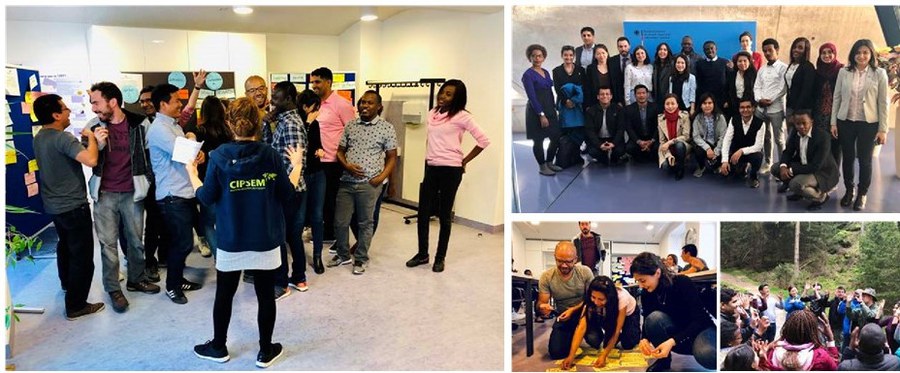
Impressions from past trainings on environmental management (photos by CIPSEM)