
Navigating Uncertainty – A Dialogue Model for Peer Consultation on Sustainability Cases
Navigating Uncertainty: A Workbook for Dialogue and Peer Consultation.
Navigating Uncertainty is a flexible dialogue model and workbook that helps “challenge holders” and their peers navigate complex sustainability issues by combining systemic analysis, peer consultation, and co‑creative action planning.
It is intended for practitioners, decision‑makers, and anyone working on real sustainability cases who want structured, low‑threshold guidance to move from “thinking alone” to “thinking together” and identify leverage points for change.
What is the Navigating Uncertainty dialogue model?
Navigating Uncertainty is a flexible dialogue model and toolbox that structures conversations around real sustainability cases into four main phases – from understanding the challenge to identifying leverage points and sketching next steps for action. It combines simple, well‑tested tools from systems thinking, facilitation, and peer coaching into an accessible process architecture that people can adapt to their own context.
The model is designed for “challenge holders” and their peers who want practical support to move from thinking alone to thinking together, uncover hidden dynamics in their case, and co‑create responses that are good enough to start while leaving room to learn and adjust.
Systemic lens, principles, and tools
A systemic lens on sustainability challenges
The dialogue model encourages participants to zoom out and in: to look at broader trends, actor constellations, and power relations around a case, and to explore deeper layers such as values, assumptions, and mental models. By expanding system boundaries in this way, groups can move beyond symptoms to identify patterns and leverage points where relatively small shifts can lead to meaningful change.
Across all phases, Navigating Uncertainty is guided by principles such as collaboration, inclusivity and diversity, agility, visionary thinking, and a holistic perspective on human and ecological well‑being.
Tools you may already know – combined in a practical way
Many of the methods used in Navigating Uncertainty – such as Case Clinic formats, iceberg thinking, influence‑interest grids, Utopian Charge, or impact‑oriented reflection tools – are well‑established and were not invented by us. The contribution of this dialogue model is to bring these and similar approaches together into a coherent, practice‑oriented toolbox and process architecture that supports facilitators and practitioners with limited time or prior exposure to such methods.
The workbook points to the original sources of each tool and respects their respective licenses; our intention is to connect practitioners with existing, proven approaches and to make them easier to apply to complex sustainability challenges.
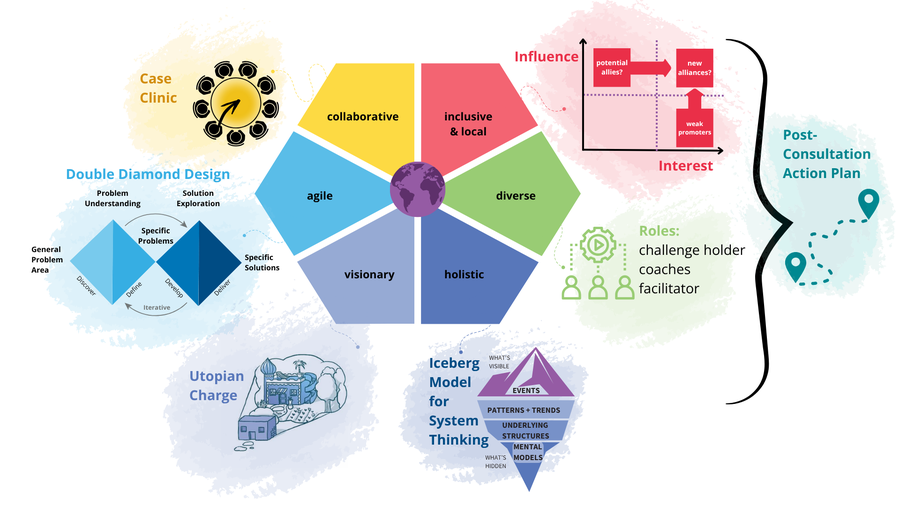
The “Navigating Uncertainty” dialogue model and selected tools used to move from system understanding to collaborative action.
Building on these tools, the dialogue model encourages participants to zoom out and in: to look at broader trends, actor constellations, and power relations around a case, and to explore deeper layers such as values, assumptions, and mental models. To make diversity itself a tool, each case is worked on by a small group of “coaches” with different backgrounds and experiences – including some who are new to the context – so that blind spots are challenged and genuinely new options can emerge.
Where the dialogue model comes from
Navigating Uncertainty grew out of a joint learning process called “Navigating Uncertainty: Diplomacy and Sustainability Actors Forging New Alliances”, developed in preparation for the Hamburg Sustainability Conference 2024. Over seven months, around 20 professionals from 16 countries – drawn from the Global Diplomacy Lab network and the CIPSEM alumni community – worked on their own sustainability cases and, together with the facilitators, co‑created a low‑threshold dialogue model that responds to uncertainty, polycrises and diverging interests in a practical way.
The process was guided by TES Academy at the German Environment Agency (UBA), the Centre for International Postgraduate Studies of Environmental Management (CIPSEM) at TUD Dresden University of Technology, and the Global Diplomacy Lab (GDL), who helped weave the insights of this community of practice into the Navigating Uncertainty workbook and toolbox.
The dialogue model is therefore not a top‑down design, but the result of joint knowledge production between practitioners from the GDL and CIPSEM networks and the three partner institutions
How we use the model at CIPSEM
At CIPSEM, we use Navigating Uncertainty as a practical method to work with real cases from our participants, alumni, and partners. The dialogue model fits our mission to provide practice‑oriented, interdisciplinary learning formats that connect local realities with global sustainability agendas, and it strengthens capacities for peer consultation, systemic analysis, and co‑creative action.
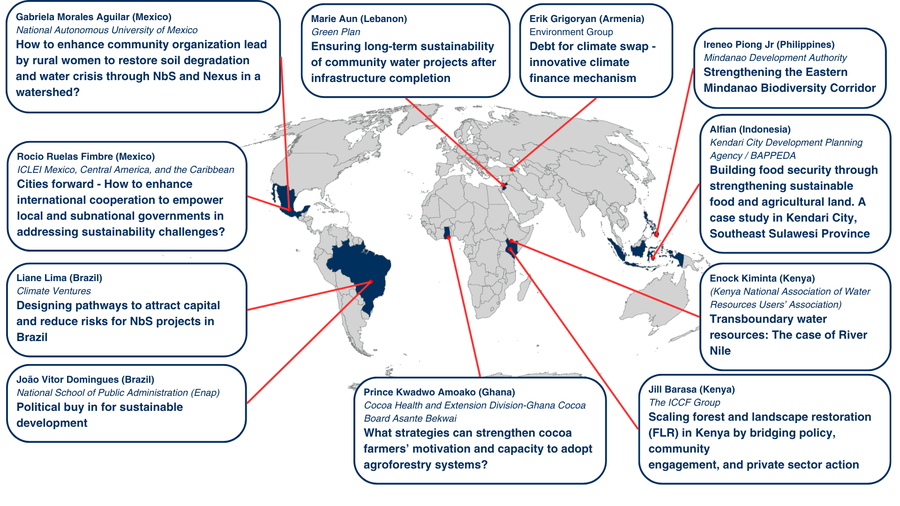
Selected Navigating Uncertainty cases facilitated between 2024 and 2025.
Examples from our practice
Conferences and high‑level fora
At the Hamburg Sustainability Conference 2024, TES Academy at UBA, the Global Diplomacy Lab, and CIPSEM hosted a dedicated accelerator session, inviting other accelerator partners to explore how a dialogue model could support their initiatives. In this session, the team presented the emerging Navigating Uncertainty dialogue model and the reasons for co‑creating it with the community of practice, and discussed with fellow accelerator projects how such a model might help them navigate uncertainty, conflicting interests, and complex actor constellations.
Co‑creators from the community of practice who joined the conference also used the time in Hamburg to reflect together on their experiences, give feedback on the model, and identify next steps for applying and further adapting it in their respective contexts.
In April 2025, CIPSEM contributed to the Dresden Nexus Conference 2025 under the theme “The Future of Resources – Resources for the Future” with Session B6: “Navigating Uncertainty: Catalyzing the implementation of Nexus approaches in research and practice through inclusive dialogue and collaboration.” Together with partners in the Resource Nexus community, we invited researchers, practitioners, and decision‑makers to explore how structured dialogue formats can help move from Nexus concepts to concrete cooperation on the ground. The session combined short inputs with interactive reflection and discussion on real‑world implementation challenges, highlighting the potential of inclusive, cross‑sectoral dialogue to address trade‑offs, build trust, and strengthen resilience in Nexus settings.
You can find more highlights from our participation in CIPSEM’s LinkedIn post about the Dresden Nexus Conference 2025.
UNEP/UNESCO/BMUKN courses
In March 2025, the Navigating Uncertainty dialogue model was integrated into the six-month 48th UNEP/UNESCO/BMUKN International Postgraduate Course on Environmental Management for Developing Countries (EM48) as a pivotal one-day intensive workshop. Moderated by the CIPSEM team and Ralph Wollmann from the German Environment Agency (UBA), this session provided participants with practical, hands-on exposure to the power of co-creation and peer consultation. While the overall course offered a broad landscape of expert inputs and field excursions, this workshop served as a focused "laboratory" for applying systemic frameworks to real-world challenges.
During this intensive day, participants were able to test a full suite of Navigating Uncertainty tools, applying them to two primary cases:
-
“Scaling forest and landscape restoration (FLR) in Kenya by bridging policy, community engagement, and private sector action”, presented by Jill Barasa (The ICCF Group).
-
“Building food security through strengthening sustainable food and agricultural land” (Kendari City case study), presented by Alfian (Kendari City Development Planning Agency / BAPPEDA).
The workshop utilized a highly agile sequence of methods, including:
-
Case Clinics: Used to leverage the diverse expertise of the group, allowing participants to act as coaches for their peers and uncover hidden leverage points in the presenters' cases.
-
The Iceberg Model: Used to look beneath visible events to identify the underlying structures and mental models that reinforce existing patterns.
-
Power-Interest Matrix: Applied to map stakeholders and identify potential new allies for systemic change.
-
Pinararri & Utopian Charge: Tested as creative approaches to help the groups envision future-oriented solutions and maintain momentum during the co-creation process.
Key Learnings from the EM48 workshop:
-
Impact of Focused Co-Creation: The workshop demonstrated that even within a single day, an intensive co-creation format can fundamentally shift a participant’s perspective on a long-standing sustainability problem. The "Case Clinic" approach was particularly effective at breaking down institutional silos by forcing participants to step outside their usual roles.
-
Agile Tool Integration: The model's agility enabled the groups to pivot among multiple tools—from deep-dive systemic analysis (Iceberg Model) to strategic planning (Power-Interest Matrix) and creative visioning (Utopian Charge)—without losing the core thread of the challenge.
-
Trust Through Peer Consultation: Participants learned that trust-building is not just a precursor to dialogue but an outcome of it. By actively engaging in each other's challenges, the alumni built a collaborative spirit that carried over into the remainder of their six-month program, reinforcing the value of peer-to-peer support in navigating complex sustainability landscapes.
In April 2026, the Navigating Uncertainty dialogue model was again embedded into the curriculum, this time for the EM49 cohort. As part of a day-long intensive workshop, participants engaged in a collaborative "laboratory" setting to apply systemic frameworks to three specific, real-world sustainability challenges:
-
Case 1: The Stampriet Transboundary Aquifer vs. Uranium Mining – Presented by Bertha Tuvangapi Shifeta, this case examined the tension between economic development and the long-term ecological protection of a vital shared water resource.
-
Case 2: Digital Savings Groups for Smallholder Farmers in Ghana – Presented by Zibrina Salifu, this case explored how digital financial tools can address systemic exclusion and build climate resilience for smallholder farmers.
-
Case 3: Case of Massive Flood in Bali Island – Presented by Pipit Ardhi Putri, this case analyzed the nexus of land-use change, environmental governance, and the urgent need for more responsible tourism development following disaster.
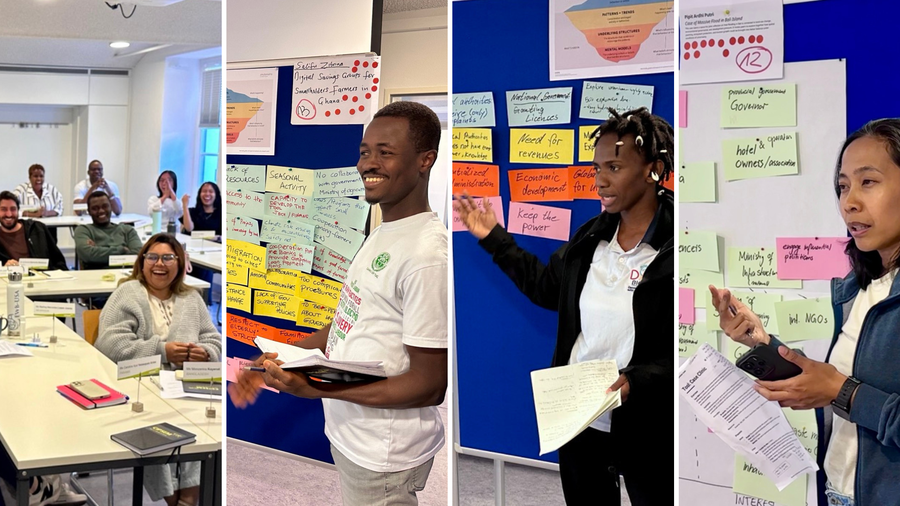
Reflection session at the end of the workshop, where the three challenge holders present the peer consultation process of their groups and share a few laughs with EM49 participants.
Workshop Dynamics & Methodology
The EM49 workshop, facilitated by Ralph Wollmann (German Environment Agency, UBA) and the CIPSEM team, prioritized a highly agile, practitioner-focused approach. In place of theoretical instruction, the sessions utilized the Case Clinic methodology, supported by the Iceberg Model and the Power-Interest Matrix, to deepen understanding of systemic dynamics. This session focused on tightening the integration of systemic analysis with actionable, "low-level" intervention strategies—emphasizing that participants are practitioners solving active leadership challenges rather than academic facilitators.
Key Lessons Learned from EM49
-
Systemic Mapping as Trust-Building: The Case Clinic proved once again that peer consultation is as much a relational exercise as a technical one. By forcing participants to step outside their professional "silos" and listen to the diverse perspectives of their peers, the workshop built a collaborative spirit that inherently strengthened the EM49 community.
-
The Power of Agile Pivot: Participants successfully demonstrated the model's flexibility by shifting from deep systemic mapping (the Iceberg Model) to strategic stakeholder alignment (the Power-Interest Matrix) in real-time. This reinforced the idea that systemic change does not require a rigid, long-term master plan; it can be advanced through smaller, iterative, and highly targeted interventions.
-
Cross-Pollination of Solutions: By working on these three distinct cases simultaneously, participants identified shared patterns of governance, funding, and inclusion that transcended their specific geographic contexts. The "cross-pollination" of ideas from different regions—ranging from transboundary water governance to digital financial inclusion—provided case holders with novel, non-traditional solutions that they might not have reached through local consultation alone.
Alumni formats and partner workshops
CIPSEM, the TES Academy at the German Environment Agency (UBA), and the Global Diplomacy Lab launched the initiative “Navigating Uncertainty: Diplomacy and Sustainability Actors Forging New Alliances” in early 2024 as a multi‑month accelerator group in the run‑up to the Hamburg Sustainability Conference. Around 20 network members from the GDL and the CIPSEM alumni community, representing 16 countries, formed a community of practice at the interface of diplomacy and sustainability and brought in self‑selected sustainability cases with a strong local anchor.
Over a series of online workshops and local experiments, they explored common questions about barriers and incentives for international cooperation, tested different dialogue tools and process designs, and reflected on what enables trust‑building, inclusive participation, and action‑oriented, systemic conversations in their contexts. Shortly before the Hamburg Sustainability Conference, co‑creators met in person to weave these experiences together, refine the emerging Navigating Uncertainty dialogue model, and outline an agile process architecture that later became the backbone of the workbook and toolbox.
The community of practice selected three challenges for deeper work in this first phase:
- “Transboundary water resources: The case of River Nile”, presented by Enock Kiminta, Kenya, Kenya National Association of Water Resources Users’ Association
- “Political buy-in for sustainable development”, presented by João Vitor Domingues, Brazil, National School of Public Administration (Enap)
-
“Cities forward – How to enhance international cooperation to empower local and subnational governments in addressing sustainability challenges?” presented by Rocio Ruelas Fimbre, Mexico, ICLEI Mexico, Central America, and the Caribbean
In the second phase of the Navigating Uncertainty Community of Practice, the initiative expanded its focus to test the adaptability of the dialogue model across even more diverse international contexts. From February through May 2025, this phase centered on a refined co-creation process where alumni and practitioners from the initial cohort worked with new case holders to apply systems thinking and peer consultation to deeply entrenched sustainability challenges. The process emphasized "local anchoring" to address the practical implementation gaps encountered in their respective home regions.
The community of practice focused on the following two primary challenges for deeper co-creation:
-
“Strengthening the Eastern Mindanao Biodiversity Corridor”, presented by Ireneo Piong Jr., Philippines, Mindanao Development Authority. The case explored how to navigate multi-level water and biodiversity governance in a complex watershed, focusing on reconciling conflicting stakeholder interests and the need for cross-sectoral cooperation.
-
“Debt for climate swap - innovative climate finance mechanism”, presented by Erik Grigoryan, Armenia, Environment Group. This case examined the systemic barriers to scaling innovative climate finance, highlighting the challenge of aligning national debt-management strategies with ambitious climate targets and attracting international investment.
Key Learnings from Phase II:
-
Contextual Flexibility: The second phase confirmed that while the model’s core tools are robust, their effectiveness depends heavily on the facilitator's ability to adapt the rhythm of dialogue to the local organizational culture—particularly regarding how power and hierarchy are perceived in the case holder's home institution.
-
Deepening the "Understanding" Phase: Participants observed that in truly complex, high-stakes local cases, nearly 70% of the value often comes from the "Double Diamond" exploration phase itself. Learning to sit with the complexity of a challenge—rather than rushing toward a predetermined policy solution—was identified as a critical capacity for effective long-term diplomacy and sustainability action.
-
The Role of Diverse "Coaches": This phase highlighted the value of bringing in "outside" coaches—participants with technical expertise unrelated to the specific case—to disrupt the "groupthink" that often plagues institutional problem-solving. This cross-pollination of perspectives was instrumental in helping case holders identify leverage points previously invisible to them.
During the "Alumni seminar: Nature-based Solution: Enhancing the Water-Food-Biodiversity Nexus" 21 UNEP/UNESCO/BMUKN course alumni engaged in a diverse program of expert inputs, field excursions, and peer exchange. A central pillar of the seminar was the Navigating Uncertainty dialogue model, which provided a structured framework for an intensive co-creation process. Four participants brought real-world sustainability challenges to the table, using peer consultation and systems mapping to move from complex problem analysis to actionable next steps.
The seminar reinforced that the model’s agility is its greatest strength: it supports diverse groups in navigating systemic complexity, provided there is sufficient time to build a shared understanding of the local context before exploring solutions. The community of practice selected the following four challenges for deeper work during the seminar:
-
“How to enhance community organization led by rural women to restore soil degradation and water crisis through NbS and Nexus in the independence Watershed in Guanajuato, Mexico?”, presented by Gabriela Morales Aguilar, Mexico, National Autonomous University of Mexico.
-
“What strategies can strengthen cocoa farmers motivation and capacity to adopt agroforestry systems, considering obstacles such as tree-registration procedures and other systemic constraints?”, presented by Prince Kwadwo Amoako, Ghana, Cocoa Health and Extension Division – Ghana Cocoa Board Asante Bekwai.
-
“Designing Pathways to Attract Capital and Reduce Risks for NbS Projects in Brazil”, presented by Liane Lima, Brazil, Climate Ventures.
-
“Ensuring long-term sustainability of community water projects after infrastructure completion in the light of currently absent governance mechanisms?”, presented by Marie Aun, Lebanon, Green Plan.
Stay connected and share your experience
Navigating Uncertainty will continue to evolve as we and our partners test and adapt the model in new contexts. If you would like to hear about future applications in CIPSEM courses and alumni activities, you can subscribe to the CIPSEM newsletter via our website.
We also welcome reflections and short stories on how you have used the dialogue model or individual tools in your own work. If you would like to share feedback or examples, please contact us using the CIPSEM contact details or the email addresses provided in the workbook.
Licensing and use
Unless otherwise indicated, the content of the Navigating Uncertainty workbook – including introductions, guiding questions, process guidance and our adaptations – is shared under a Creative Commons Attribution‑ShareAlike 3.0 Unported License (CC BY‑SA 3.0). This means you are free to share and adapt the material, including for commercial purposes, as long as you give appropriate credit and distribute your contributions under the same license.
Several referenced tools, such as Utopian Charge, the Iceberg Model, Impact Garden and the influence‑interest grid, are provided by other organisations and keep their original licenses; please check the source links in the workbook for details and respect the terms set by their creators.