
Study contents
Program description
The orientation of forestry has changed from being solely state-directed to an increasing involvement of a large number of stakeholders. This is fueled by the ongoing
processes of globalization and devolution. The program qualifies graduates to deal with the huge challenges in contemporary tropical forestry and to adapt to future
developments. These tasks call for extended skills in:
- management of natural forests, forest plantations, and urban tree resources in tropical and subtropical regions
- integrated land use management, agroforestry, carbon forestry and forest landscape restoration
Expertise in such areas is needed in national and international institutions, consulting agencies, universities and research institutes. The graduates act as change agents to develop forest management and rural regions towards sustainability in terms of economic, social and ecological aspects. The Master program is development-oriented,
internationally staged and addresses primarily students from countries of the tropics and subtropics. Corresponding to the professional perspectives importance is
attached to the increasing participation of students from Germany and other European countries. The target group of the Master program are future decision-makers
in the management of forest resources as well as at the junctions with other specialist disciplines. This refers to forestry, agriculture, horticulture, landscape and regional planning, geography, water management, nature conservation and biology. The graduates are qualified for development-relevant interventions in rural areas and in
transitional zones between town and countryside.
Video of the Tropical Forestry Master's Program
Curriculum overview
The new curriculum came to effect in October 2025. The Master’s program is taught entirely in English language. The program is built around three thematic focus areas namely,
- Social system
- Ecological system
- Integrating backbone
runs over four semesters, and follows a modular structure. Most modules (subject or course) are completed within the first three semesters. The fourth semester is dedicated to the Master’s thesis, including the thesis colloquium.
The program includes 14 compulsory modules (participation is mandatory to qualify for the masters degree), and offers a number of elective modules. In the third semester, the students choose to build an academic profile on forest governance or forest management, by selecting fitting electives.
Each module is worth 5 ECTS credits. ECTS credit points document the average workload of the students as well as their individual study progress. One ECTS credit point equals 30 hours of work. Students usually earn 30 ECTS per semester (60 per academic year). The total workload for the program corresponds to 120 ECTS, covering courses, exams, and the Master’s thesis with colloquium, which are described in detail within the module descriptions below:
Program structure
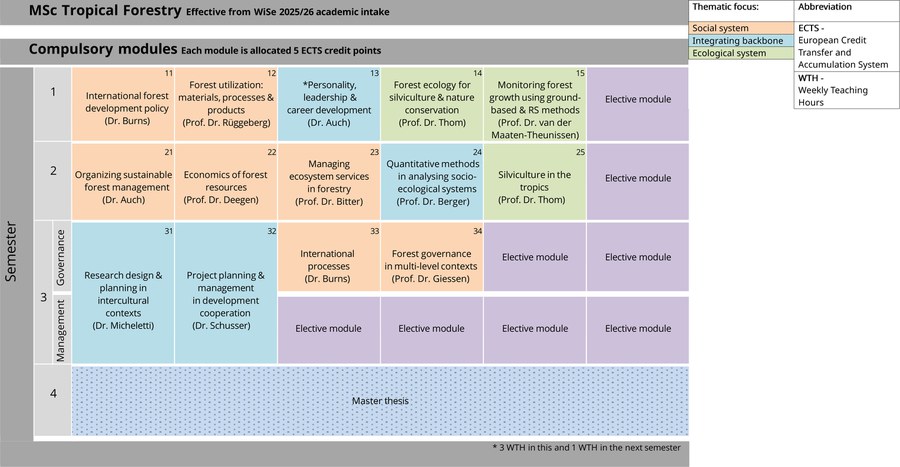
Structure MSc Tropical Forestry (effective from WiSe 2025/26 academic intake)
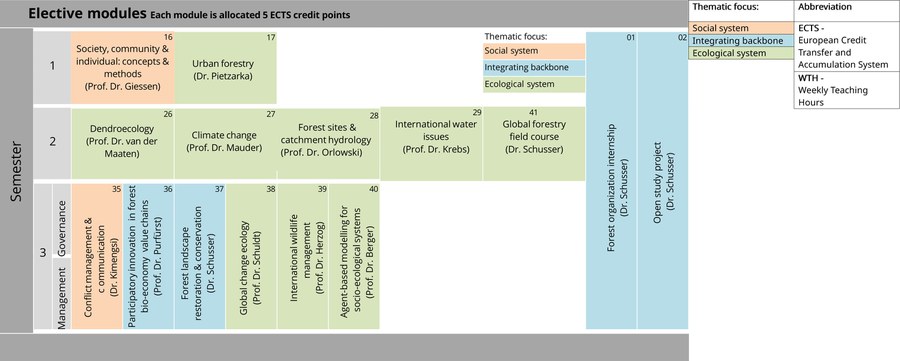
Structure MSc Tropical Forestry (effective from WiSe 2025/26 academic intake)
Student adivising and support
General student advising is provided by TU Dresden’s central student advisory service (Service Centre Studies), which supports questions about study options, enrollment procedures, and general student matters.
During your studies, we provide guidance on planning and organizing your studies. The Academic Advisor for M.Sc. Tropical Forestry is Dr. Eckhard Auch
After graduation
Are you curious about career paths after graduation? Would you like to know how our graduates have shaped their careers after completing this program? Click here to learn more about the master’s program’s development, current projects, and alumni experiences.
Fields of employment and career prospects
-
Management of forestry and forest-product enterprises and bilateral or multilateral forest management projects
-
Advising governments on forest development and land-use planning
-
Leadership roles in international organizations, NGOs, and public authorities
-
Forestry extension and environmental education
-
Research positions in national and international forestry and environmental institutions
-
Professional work in forestry engineering consulting
Career guidance and support
For career guidance and individual support, you can contact the Career Service at TU Dresden. Here, you will find information there on one-on-one counselling, career planning, and application support. Further resources, including links to potential employers, job portals, and networking opportunities, are also available here.
Tuition fees
TU Dresden is a public university and therefore does not charge tuition fees. However, all students have to pay a nominal semester contribution which includes a ticket for public transport in Dresden and all regional trains in Saxony. Furthermore, students can use the rental bike system in Dresden for 1 hour for free. All general living expenses have to be paid by the student. We currently advise to budget about 700 € per month for living in Dresden.
Scholarships
Development-Related Postgraduate Courses (EPOS) • DAAD
The EPOS programme offers individual scholarships to participants from developing countries so that they may study development-related postgraduate courses.
Erasmus Mundus Joint Master • Global Forestry
Erasmus Mundus Joint Masters are delivered by multiple higher education institutions and run across various countries. They are distinguished by their academic excellence and by their high level of integration. Students at master's level from all over the world can apply. In addition, scholarships are available for the best students. If you have completed or are in your final semester of a relevant Bachelor’s degree programme you are eligible to apply for the Global Forestry programme.
Get to know your campus
The Department of Forest Sciences of the TU Dresden is located in Tharandt, a picturesque small town close to Dresden, surrounded by forests. Higher education in
forestry has been taking place here for more than 200 years. The tradition of tropical forestry dates back to the 1930s. Frequently running suburban trains connect Dresden and Tharandt within less than 20 minutes. The scientific institutes, lecture rooms and labs are housed in buildings of the former Royal Academy of Forestry as well as recent constructions with modern equipment for teaching, studying and experimenting.
Tharandt campus tour © TU Dresden