
Oct 20, 2026
Drought and mistletoe: new collaborative project on the future of Scots pine
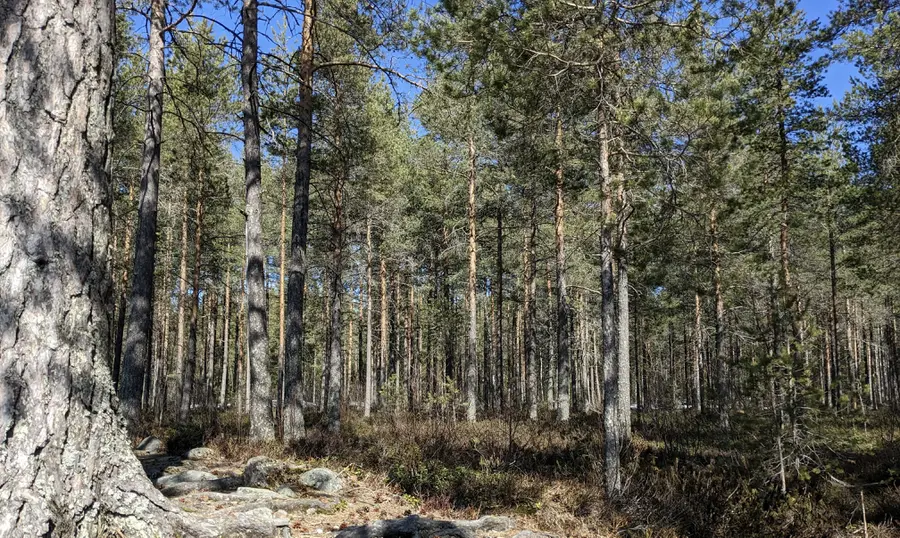
On October 1, 2026, the interdisciplinary collaborative project „Scots pine in a changing climate: Climate stress, biotic risks, and strategies for sustainable management" (KliBiK) was launched. Three professorships at TU Dresden are working on the project together with the Thünen Institute of Forest Genetics and the State Enterprise Sachsenforst. The Eva Mayr-Stihl Foundation is funding the project through 2031 with a total of 1.3 million euros, continuing its strategic support for forest sciences in Tharandt.
Scots pine (Pinus sylvestris L.) shapes large parts of Europe and is today the most common tree species in Germany — in the eastern German states, it plays a dominant role. For a long time, it was considered particularly resilient. The exceptional drought years of 2018 to 2020, however, fundamentally changed that picture: in many regions of Central Europe, pine forests show markedly reduced vitality, increased mortality, and a greater incidence of biotic stressors. The 2025 Forest Condition Report confirms this trend.
Pine mistletoe (Viscum album subsp. austriacum) is spreading especially rapidly. This hemiparasite reduces the availability of water and light to the pine, causing growth increments to decline and mortality to rise. Despite the economic and ecological importance of the species, the body of research remains limited — particularly in comparison with intensively studied species such as European beech and Norway spruce. What is lacking above all are integrative studies that jointly examine provenance-related differences in drought stress tolerance, the effects of mistletoe infestation, and the resulting stress dynamics at the stand level.
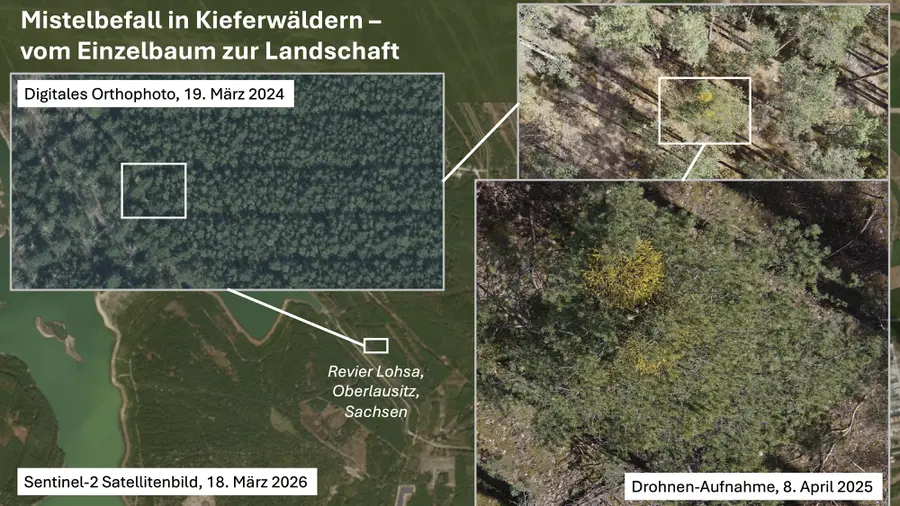
Mistletoe infestation in pine forests, visualized using satellite, airborne laser scanning (ALS) and drone imagery from the Lohsa forest district, Upper Lusatia, Saxony, Germany.
The aim of the research project is therefore to comprehensively investigate the vulnerability and adaptive capacity of Scots pine in the face of drought stress and mistletoe infestation, and to determine the role of genetic and phenotypic variation in its resilience under climate change. The project thereby seeks to establish the scientific basis for climate-adapted management strategies that support forest owners and decision-makers in the long-term stabilization of this tree species, which is central to Europe.
Prof. Ernst van der Maaten of the Chair of Forest Growth and Dendrosciences, who coordinates the collaborative project, points to the first-ever integrative linkage of genetic, growth-physiological, and spatial stress indicators: on provenance trial sites ranging from southwestern Germany to northeastern Poland, pine provenances will first be compared on the basis of growth traits and survival rates in order to derive provenance-specific patterns of vulnerability and resilience — in close cooperation with the Thünen Institute of Forest Genetics. In addition, mistletoe-infested and mistletoe-free trees will be compared in pine stands along environmental gradients: tree-ring analyses at multiple stem heights, complemented by quantitative wood-anatomical traits as well as oxygen and carbon isotopes, allow conclusions to be drawn about how mistletoe infestation and drought affect water balance and photosynthetic processes. The Chair of Environmental Remote Sensing scales stress and infestation dynamics from the stand to the landscape level using drone and satellite data. At the Chair of Silviculture, all findings ultimately feed into the process-based forest landscape and disturbance model iLand, for which Scots pine will be comprehensively parameterized for the first time — making it possible to test adaptive management strategies under various climate scenarios, such as the selection of more resilient provenances or site-specific interventions.
The empirical work is concentrated primarily in Saxony, supplemented by sites in Brandenburg, Mecklenburg-Western Pomerania, and Saxony-Anhalt — regions with a high proportion of pine that are therefore particularly affected by drought stress and mistletoe infestation. The integration with forestry practice is correspondingly close: a workshop with the state forest administrations of these states is planned for the early phase of the project, and interim results will be discussed directly in the field on excursions as the project progresses. Also planned is a web-based visualization tool that will allow spatially differentiated risk and management options to be retrieved and applied to individual sites.
Contact: Prof. Dr. Ernst van der Maaten
Chair of Forest Growth and Dendrosciences
E-Mail: