
Oct 28, 2026
Forest history and archaeological heritage: excursion in the Ore Mountains
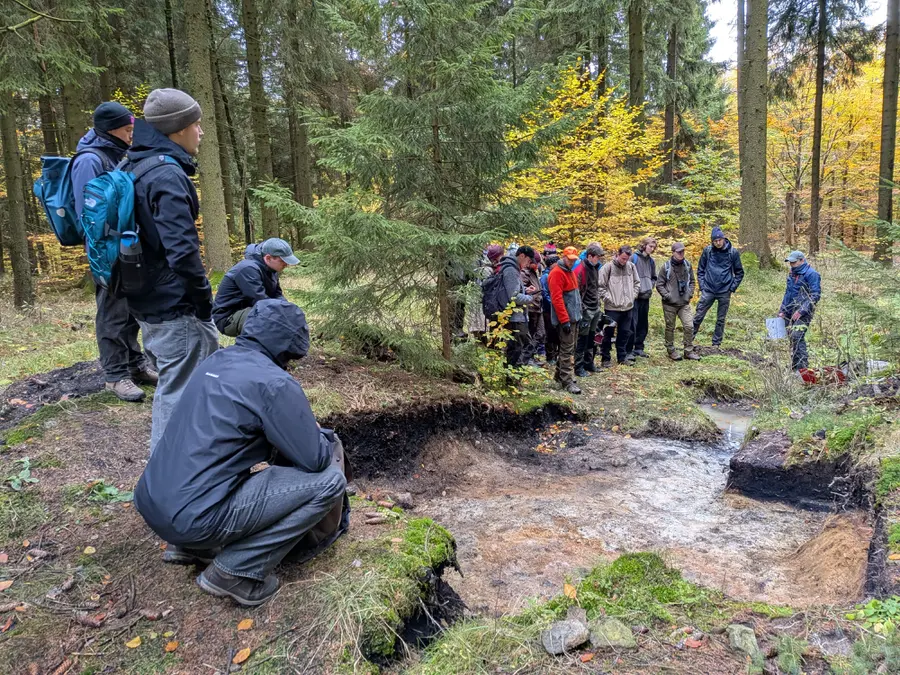
On 26 October 2026, around 60 students enrolled in the Bachelor's module “Forest law and forest history” explored the diverse history of the forests in the Ore Mountains. Coordinated by the Chair of Forest Growth and Dendrosciences, the excursion took place within the framework of the Interreg project MonuWoods and linked historical aspects of forest development with questions of forest management and the protection of archaeological heritage.
In the morning, the group visited the Kahleberg to learn about the impacts of forest dieback caused by high sulphur dioxide emissions, as well as subsequent reforestation and forest conversion. Bert Hommel, Head of the Bärenfels Forest District, and Denny Werner, Forest Ranger for the Schellerhau district, explained these developments and provided insights into practical forest management.
In the afternoon, the excursion continued to Vorderer Grünwald in collaboration with the Archaeological Heritage Office of Saxony. Dr Christiane Hemker, Dr Matthias Schubert, and excavation technician Heide Hönig used examples such as mining pits, linear chains of mining depressions, and other relics to demonstrate how forests preserve archaeological evidence of the region's mining history. Grit Neubauer from our Chair introduced anthracology and showed how historical charcoal kiln sites can be used to reconstruct the former composition of forests. Jörg Fleischer and Leon Reißig from the Upper Forestry and Hunting Authority of Saxony's state forest enterprise, Sachsenforst, complemented the programme with insights into forest function mapping and the management of archaeological sites in forestry operations.
The excursion highlighted the close links between forest development, historical land use, and archaeological heritage. It also provided students with practical insights into collaboration between forestry and archaeological heritage conservation—one of the central aims of the MonuWoods project.
