
Jun 09, 2026
Affective and Multi-Perspective Map Communication
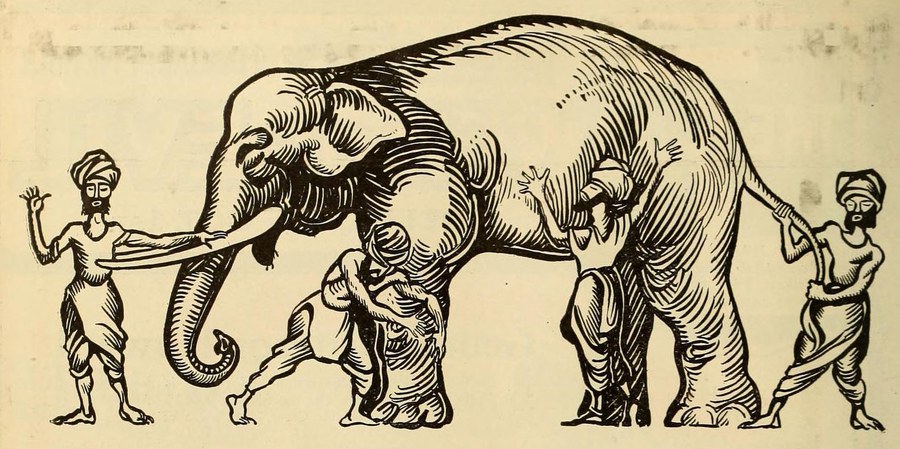
The Blind Men and the Elephant
Maps can be compared to that tale in which three blind men are asked to describe an elephant. One man touches the elephant’s tail and says, “An elephant is like a rope.” Another touches the elephant’s leg and says, “An elephant is like a tree trunk.” The third man touches the elephant’s trunk and says, “An elephant is like a snake.” None of them is entirely wrong, but none is entirely right, because none of them can see the entire animal.
The situation is similar with maps. Maps can never show the whole truth, but that does not make them wrong. Similarly, the viewer may be deliberately reinforced in their perception of only the elephant’s leg, whilst other parts of the body are obscured; the viewer may be intentionally distracted from the elephant’s leg, and so on. This thought experiment served as the starting point for a new course.
The module "Affective and Multi-Perspective Map Communication" was offered for the first time in the 2025/26 winter semester as part of the two master programmes in Cartography and Geoinformation Technologies. The module is highly design-oriented and provides in-depth knowledge of methods and approaches for the targeted use of graphic design and visualisation to address specific target groups or convey a particular message through thematic maps. The following topics are covered:
- Colour
- Psychological Principles in Design
- Emotional Design
- Vivid Cartography
- Persuasive Design
- Persuasive and Manipulative Cartography
- Viral Cartography
- Critical Cartography
A project must be submitted at the end of the semester. The aim is to create two static thematic maps on the same topic showing different perspectives on it and therefore conveying different intentions or messages. Thus, the two maps will be deliberately designed differently. The following section presents six projects, which do not necessarily reflect view of the respective author.
Gabriela Spriestersbach (MSc Cartography)
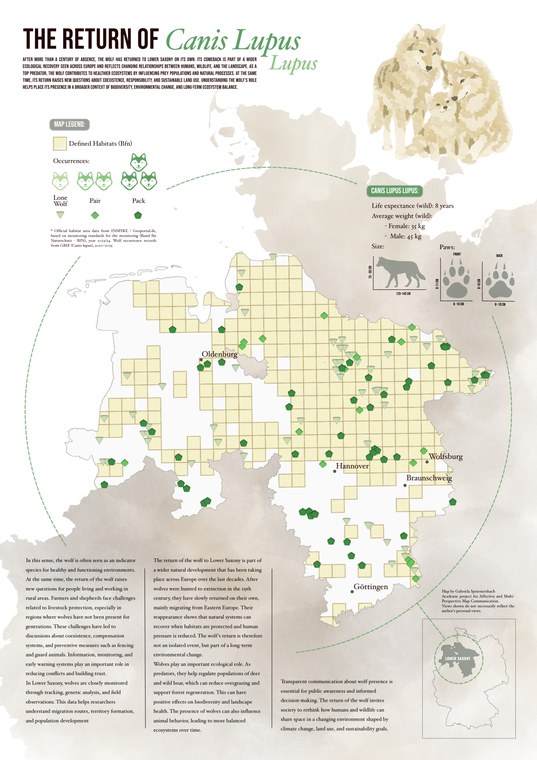
Map 1 made by Gabriela Spriesterbach
This project looks at the return of the wolf (Canis lupus lupus) to Lower Saxony, a topic that has sparked strong and opposing opinions in public debate allowing for exploration of how maps can express different viewpoints instead of a single neutral truth. The first map presents the wolf’s return as a positive ecological development and a sign of environmental recovery aiming at an audience interested in environmental protection. It shows the wolf as a natural part of the ecosystem and highlights coexistence and biodiversity.
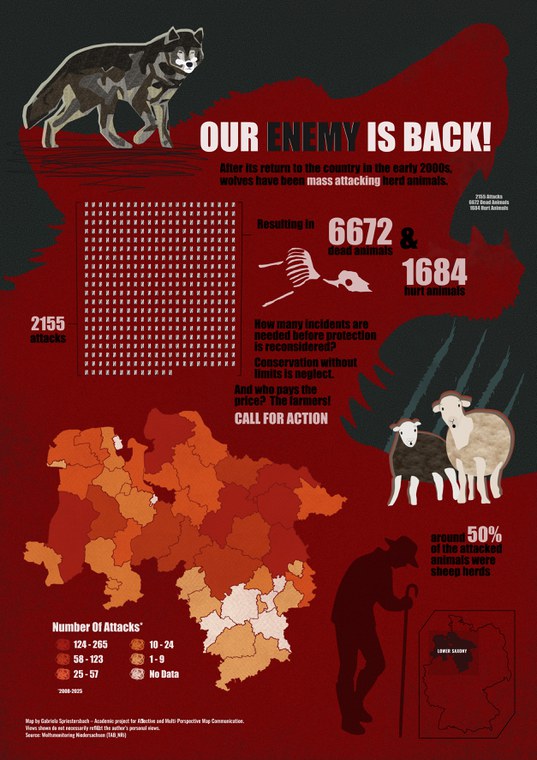
Map 2 made by Gabriela Spriesterbach
The second map portrays the wolf as a threat to agriculture, rural livelihoods, and safety targeting those concerned with farming, rural life, and political decisions. It focuses on loss and urgency, reflecting the concerns of farmers and political figures who are calling for stronger control measures.
Frederica Ballardini (MSc Cartography)
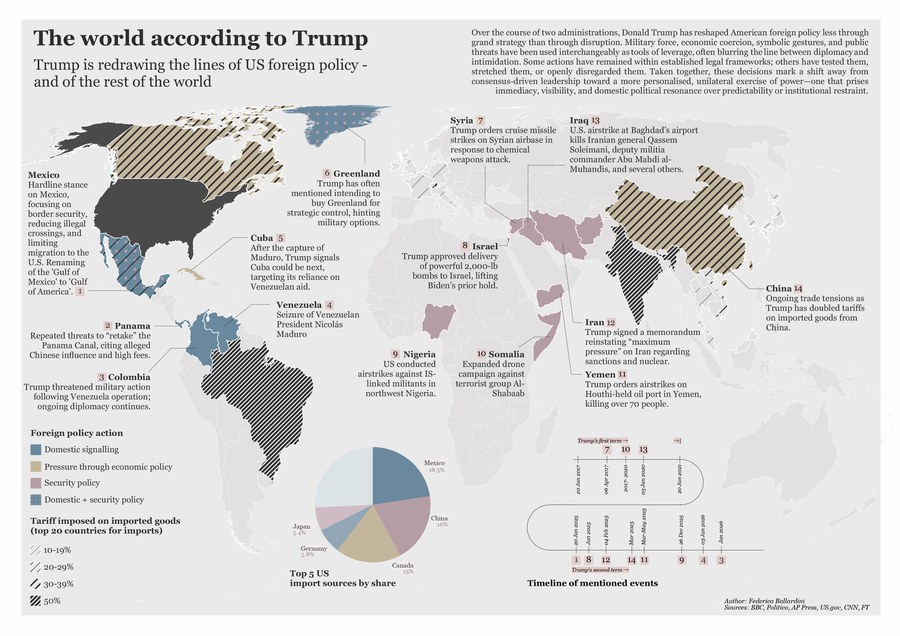
Map 1 made by Frederica Ballardini
These two maps represent the ‘multi-perspectives’ surrounding a president’s foreign policy decisions. US President Trump has often been in the spotlight for his bold actions, and his international legitimacy appears increasingly fragile—an idea reflected in the first map. It could appear in an international politics magazine such as The Economist.
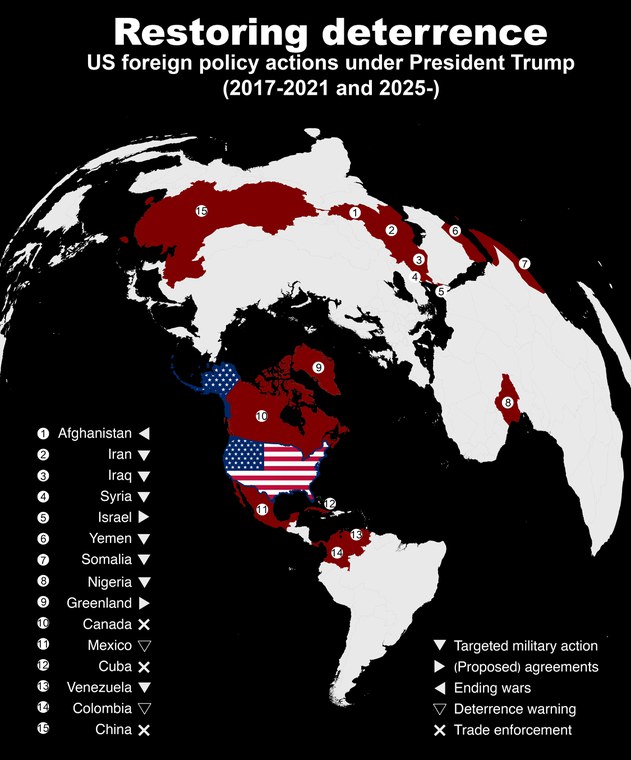
Map 2 made by Frederica Ballardini
Trump’s rhetoric has consistently followed an “America first” approach, often intensified in times of crisis. This perspective is captured in the second map, which could appear on social media or in a press conference led by his PR team.
Lucie Kluwe (MSc Geoinformation Technologies)
Map 1 made by Lucie Kluwe
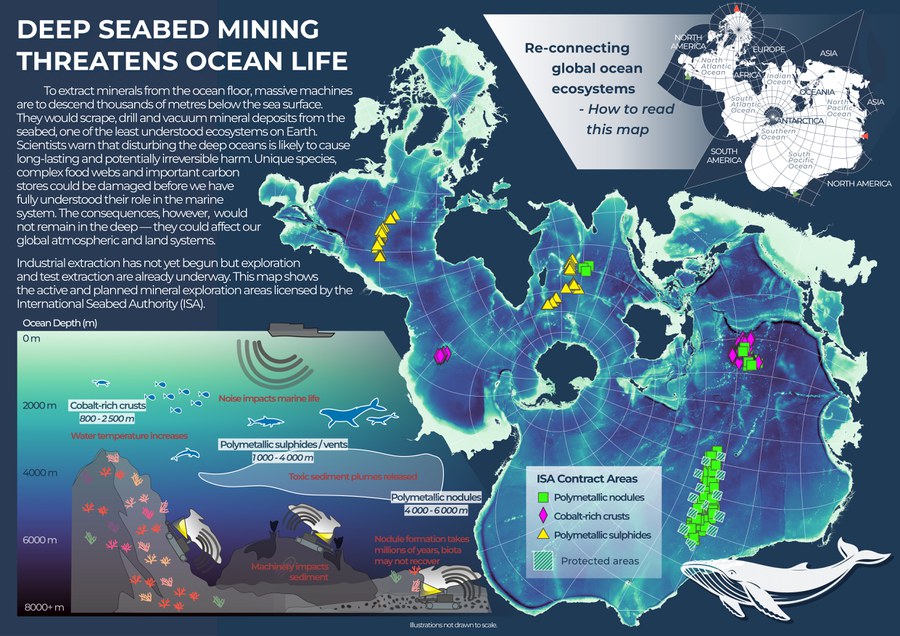
These two maps are on deep-sea mining. The first map is map to be published as a digital poster by an environmental NGO like Greenpeace or WWF. Its target group is a global audience that is environmentally conscious and especially interested in nature and wildlife protection.
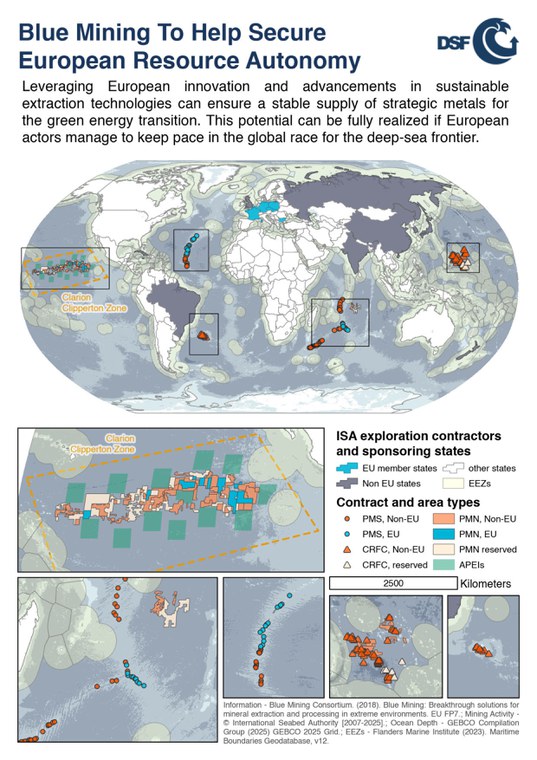
Map 2 made by Lucie Kluwe
The second map is a collection of maps that is to be given out to EU politicians at a conference where further involvement and advancements of EU member states in the area of mineral extraction from the deep seas is discussed. Unlike the left map focusing on oceans in a global sense, this map looks at a country level.
Emiel Verté (MSc Cartography)
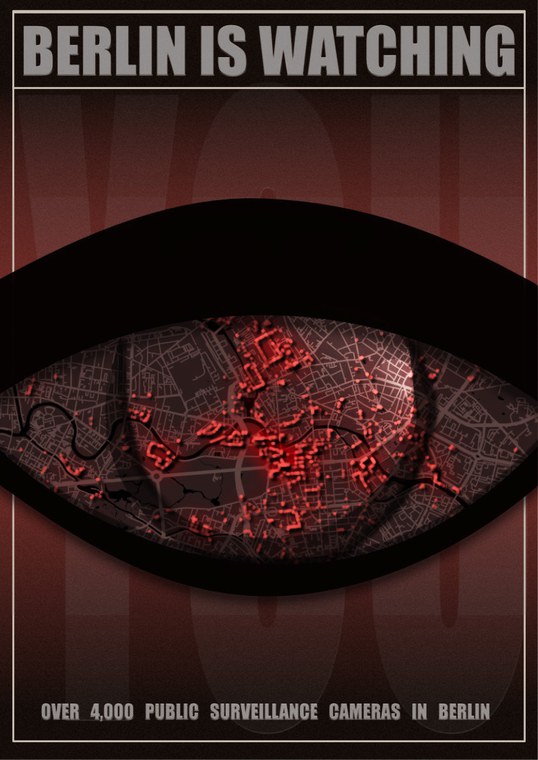
Map 1 made by Emiel Verté
This project examines surveillance cameras in Berlin. The first map is a “1984-style” dystopian poster designed to raise awareness and evoke a sense of being watched. It targets activists, privacy advocates, and civil liberties organisations, aiming to spark debate on surveillance, government overreach, and the normalisation of monitoring in public space. Its goal is not detailed spatial understanding, but immediate comprehension and emotional impact.
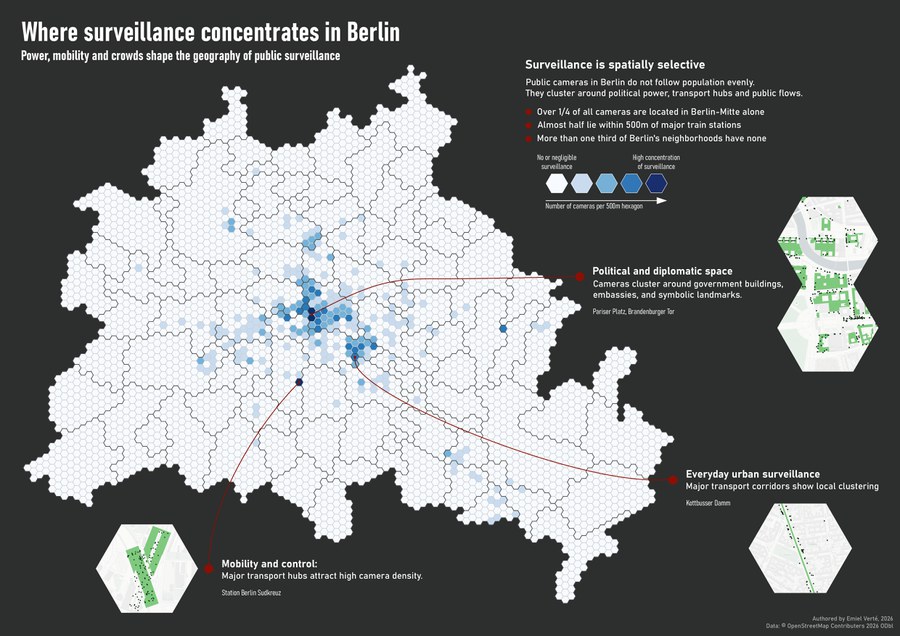
Map 2 made by Emiel Verté
The second map offers a contextual and analytical perspective on the same dataset. It can be seen as a response from city officials, researchers, or journalists, focusing on explaining the “why” and “where” of camera placement. Its audience includes interested residents as well as journalists, researchers, urban planners, and policy-oriented readers seeking to understand surveillance patterns within the city’s spatial structure.
Thijs van Laar (MSc Cartography)
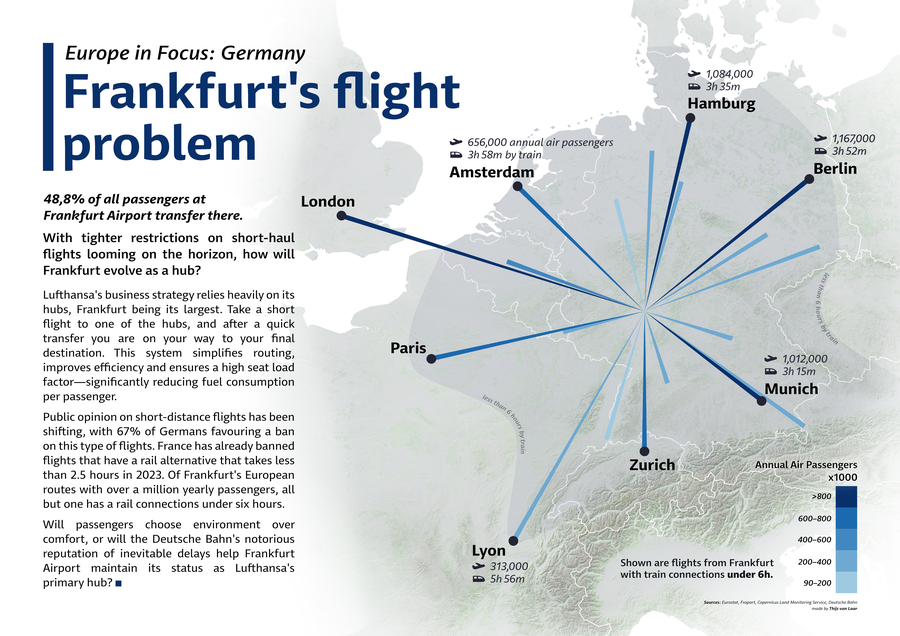
Map 1 made by Thijs van Laar
These two maps are based on a dataset of air passenger routes between partner and major airports in Germany. The first map targets readers of a modern, serious magazine, typically aged mid-twenties to mid-fifties with a more theoretical background. It aims to inform and educate without taking a strong stance, presenting relevant data and ending with a question to encourage d to encourage discussion.
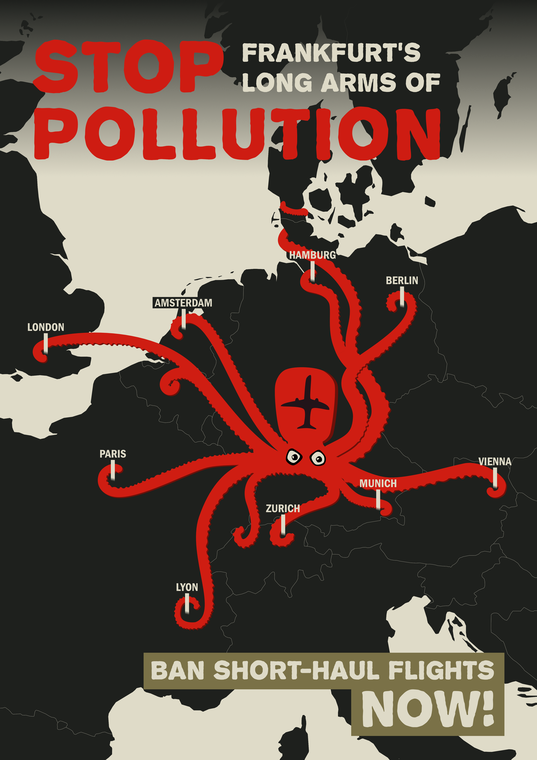
Map 2 made by Thijs van Laar
The second map conveys a clear message about short haul flights, targeting audiences supportive of climate action and receptive to narratives of inequality between frequent flyers and others. It seeks to evoke anger and concern about the consequences of short haul flights, appealing to a sense of injustice.
Devita Remala Sari (MSc Cartography)
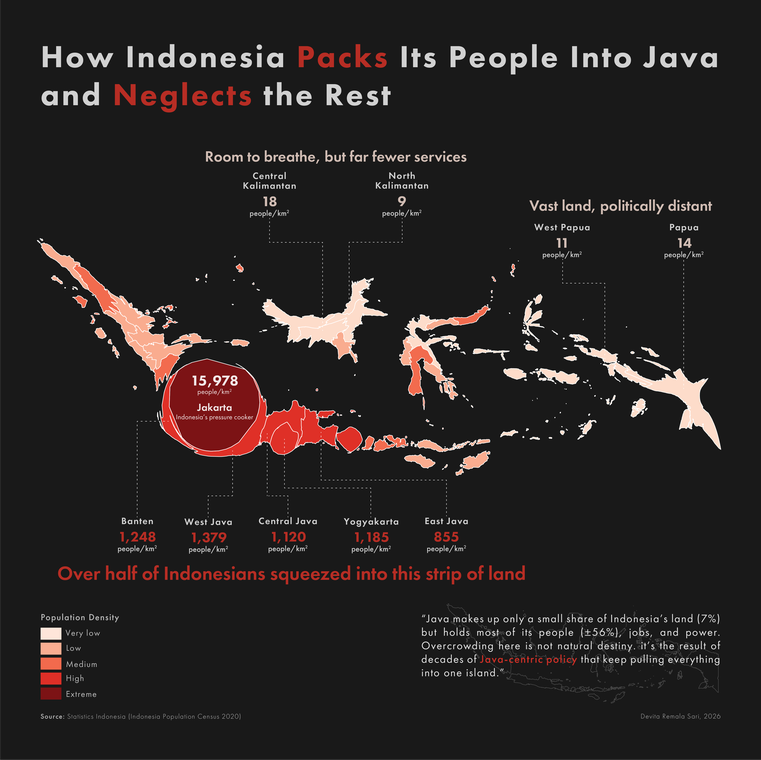
Map 1 made by Devita Remala Sari
This project focuses on population density in Indonesia. The first map targets the general public, especially social media users and non specialists. It frames density as a political and social issue, highlighting the concentration in Java while other regions remain distant. Its goal is to evoke frustration, spark discussion, and question centralisation and uneven development.
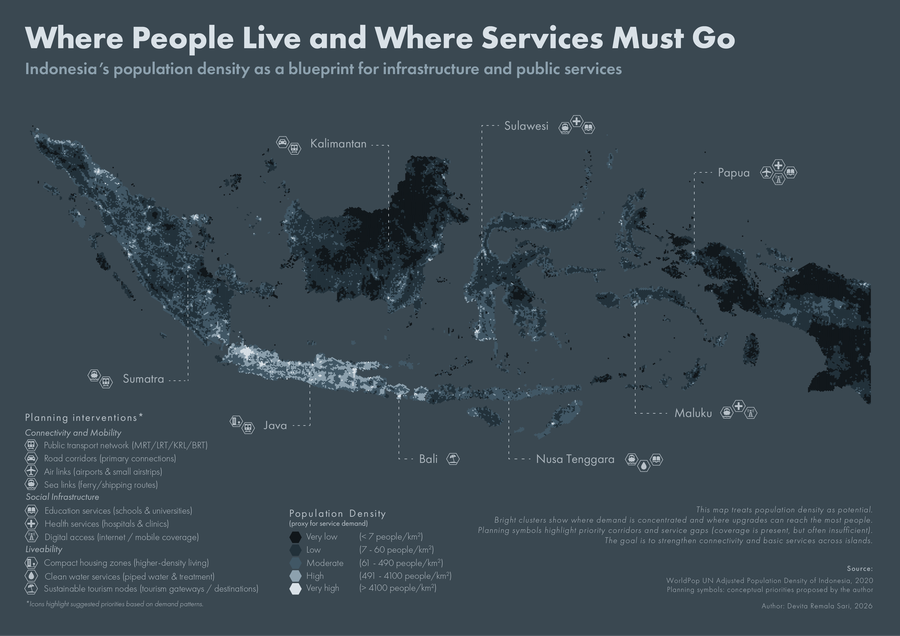
Map 2 made by Devita Remala Sari
The second map addresses public sector decision makers and planners. It presents density not only as a challenge but also as a planning opportunity. Concentrated demand enables efficient upgrades, while sparse areas require different approaches. It frames density as an opportunity for action.