
Research Field 2
Aquatic ecotoxicology - effect analysis and risk assessment of environmental chemicals
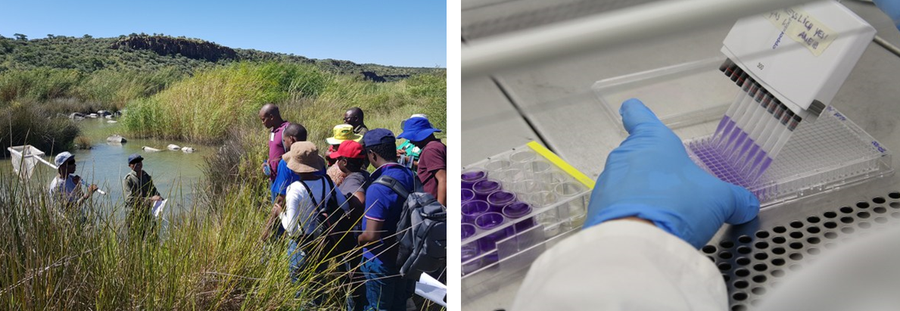
Sampling at Riet River in South Africa (left) and performance of an in vitro bioassay in the laboratory (right).
An increasing multitude of chemicals are being developed, produced, transported and used in many cases in significant amounts which makes interactions between chemicals and living organisms inevitable. The discipline of ecotoxicology emerged from the need for an assessment of these substances regarding their environmental hazard and analyzes adverse changes of ecosystem structures and functions caused by environmental chemicals (Nagel, 1988). It evaluates the hazardous nature of a chemical as well as the probability of it occurring in the environment to allow for a risk assessment.
The research group ecotoxicology within the Chair of Limnology is embedded in international research with a combination of conventional and innovative methods and advises authorities and industry regarding risk assessment and minimization. At the Institute of Hydrobiology both in vitro and in vivo analyses on different trophic levels are performed in the field, in the laboratory or in artificial indoor streams. Individual substances and substance mixtures of chemicals as well as samples from surface waters and municipal or industrial wastewater are tested. Finally, databases can be generated and analyzed.
Methods
- Yeast-based reporter gene assays (YES, YAES, YAS, YAAS, YDS) for the in vitro detection of anti-/estrogenic, anti-/androgenic and dioxin-like potential
- Ames assays (TA98, TA100) for in vitro detection of mutagenic potential
- Mikronucleus assay for in vitro detection of genotoxic potential
- ROS assay (with DCFH-DA) for in vitro detection of oxidative stress
- Daphnia assays for in vivo detection of acute and chronic effects
- Solid-phase extraction
Projects und Publications
Staff / Contact
 © Sara Schubert
research associate
NameMs Dr.phil.des. Sara Schubert
Send encrypted email via the SecureMail portal (for TUD external users only).
Postal address:
TUD Dresden University of Technology
Department Hydrosciences
Institute of Hydrobiology
01062 Dresden
Parcel address:
TUD Dresden University of Technology Institute of Hydrobiology Sekretariat, 1.OG Raum 60/61 Zellescher Weg 40
01217 Dresden
PhD student
NameM.Sc. Annika Schubert
Send encrypted email via the SecureMail portal (for TUD external users only).
Postal address:
TUD Dresden University of Technology
Department Hydrosciences
Institute of Hydrobiology
01062 Dresden
Parcel address:
TUD Dresden University of Technology Institute of Hydrobiology Sekretariat, 1.OG Raum 60/61 Zellescher Weg 40
01217 Dresden
 © Katrin Weise
member of scientific staff
NameMs Dr. Katrin Weise
Send encrypted email via the SecureMail portal (for TUD external users only).
Visiting address:
Drude-Bau, 1. OG, Raum 71 Zellescher Weg 40
01217 Dresden