
research project ReWaRare
Pure Water and Rare Materials: Resource-Efficient Removal and Recovery of Critical Raw Materials from Water and Wastewater Streams Using Membrane Capacitive Deionization
Subproject: Life-cycle assessment of MCDI technology compared to available alternatives and integration of the results into technology development

| Partners: |
TUD Dresden University of Technology: |
|
Funding: |
- ESF Plus STEP Early-Career Research Group (EU) |
| Grant Amount: | 1.4 million euros |
| Duration: | November 2026 – October 2028 |
| Contact Persons: |
Project Description:
The goal of the project is to scale up Membrane Capacitive Deionization (MCDI) for the recovery of critical metals such as lithium, cobalt, and nickel from (waste)water streams from the laboratory scale to practical application.
Lithium, cobalt, nickel, and other metals are key raw materials for high-tech and industrial products, and Europe’s security of supply for these materials is at risk due to dependence on imports. Membrane-capacitive deionization (MCDI) is an innovative electrochemical separation technology that enables the selective separation of metals from black mass extracts derived from battery recycling, geothermal waters, or mining wastewater. Compared to conventional methods, MCDI is characterized by low energy consumption, high selectivity, and a low environmental impact, as demonstrated by laboratory tests.
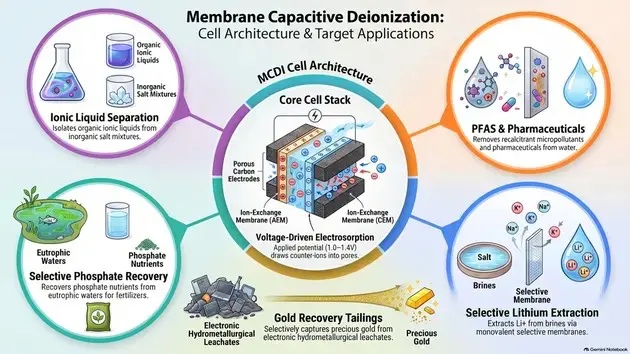
As part of the STEP ReWaRare Early-Career Research Group, the goal is to scale up MCDI technology from the laboratory and pilot plant scale to practical application. To this end, it will be tested on metal-containing wastewater streams to evaluate its practical suitability and industrial applicability. The subgoals of the project are:
- the characterization and selection of three metal-containing wastewater streams based on their potential for resource conservation and environmental relief
- the production of selective electrode materials from biogenic waste materials
- determining the separation selectivity and efficiency in laboratory and pilot-scale facilities
- to scale up the process through simulations of flow and mass transfer
- the use of machine learning to identify complex relationships between material properties, operating parameters, and separation performance
- as well as a comparative life cycle assessment of the MCDI technology.
At the Institute of Waste Management and Circular Economy (IAK), a life cycle assessment (LCA) of the MCDI technology is being conducted throughout the development process, taking into account several LCA impact categories, including global warming potential, energy consumption, and resource consumption over the technology’s entire life cycle. The results of the life cycle assessment are compared with those of alternative, established processes, and potential savings throughout the technology’s life cycle are identified for ecological optimization. The aim is to evaluate concrete contributions to resource efficiency and measurable environmental performance through the recovery of critical raw materials from contaminated wastewater.
Most of this text was taken from the project’s website; this and further information can be found at:
https://tu-dresden.de/bu/umwelt/hydro/ifw/forschung/aktuelle-forschungsprojekte/rewarare-reines-wasser-und-rare-wertstoffe