
Areas of Research
Reasearch Areas
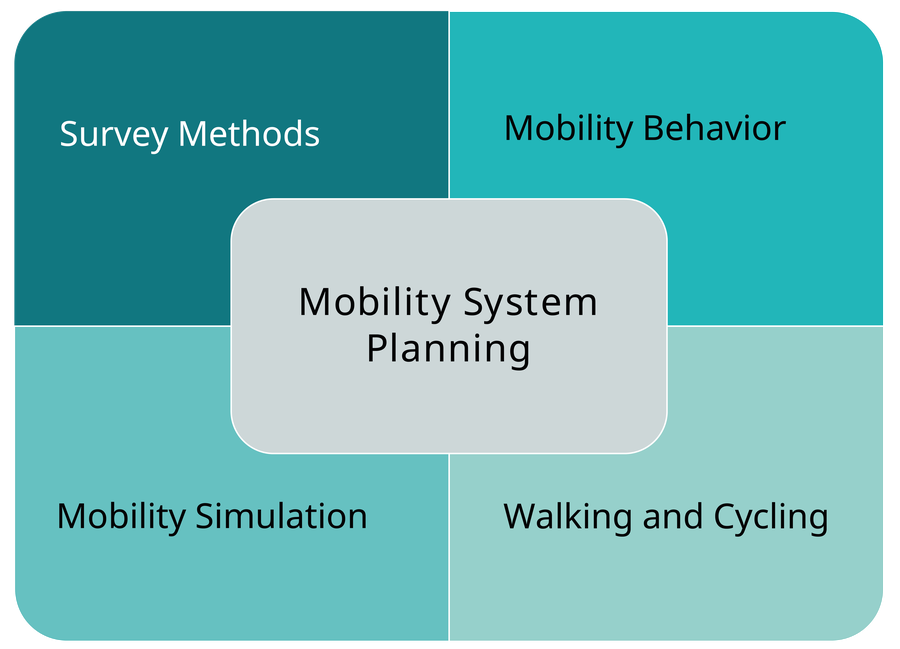
The four research areas of the chair are closely interconnected with diverse dependencies and synergies. Research on mobility behavior and empirical survey methods forms the foundation for mobility simulation. Both contribute to the planning of sustainable mobility systems including safe and attractive street spaces for all modes of transport, and especially for walking and cycling.
Below you can find more information about our areas of research:
|
The research area MV focuses on the analysis, prediction, and influencing of mobility behavior on the basis of empirical data and statistical, model-based methods, providing a foundation for data-driven mobility and transport planning in a social science context. At its core is the understanding and explanation of individual and collective mobility needs and behaviors, including their interactions with transport systems. In addition to an empirically grounded understanding of the causes of travel demand and mobility behavior, the research field also encompasses strategies for shaping the framework conditions that promote sustainable, safe, and socially equitable mobility. In doing so, it combines engineering approaches to transport planning with a social-science-based perspective on mobility behavior and societal developments. By integrating data-driven methods and insights from the sociology of transport, the research field helps develop and implement evidence-based strategies for future-ready mobility systems in planning practice. Accordingly, the research is structured into the following two pillars:
|
The research area EM is dedicated to refining established methods and developing and evaluating new approaches, particularly for measuring people’s everyday mobility. It is closely linked to the existing methodological toolkit for mobility surveys, especially the instruments used in the System of Representative Travel Surveys (SrV) and in the resulting survey series Mobility in Cities – SrV.
This research area plays a central role in consolidating, coordinating, and strategically advancing the chair’s survey expertise over the long term. It is also essential for safeguarding the continuity of the SrV time series: emerging developments in methodological research must be identified early, new survey instruments must be tested, and their practical applicability and scalability must be assessed.
The research is organized into two pillars:
- Survey instruments, particularly for household travel surveys
- Modern application and further development of established methods for the valid measurement of everyday mobility
- Development of methods and tools for quality assurance
- Research on participation willingness, selectivity, nonresponse and method effects, non-reactive participation motivation, and innovative recruitment strategies
- Alignment of survey techniques and indicators with the requirements of SUMP, TEN-T, and national strategies for sustainable mobility
- Integration of self-collected and existing data sources, such as geospatial data, mobile phone data, floating car data, and social media data
- Innovative approaches to measuring mobility behavior
- Particular focus on combining cross-sectional and longitudinal data collection
- Use of GPS-based methods, including smartphone-based surveys
- Assessment of different survey techniques and recording strategies, such as trip-based versus stage-based approaches, the recording of daily routines and activities, and travel diaries versus automated trip detection from movement patterns and trajectories
- Improving the compatibility and integration of different measurement techniques for typical transport planning applications
This research field focuses on developing and applying innovative methods for analyzing mobility systems, with a particular emphasis on pedestrian and cyclist mobility. The aim is to gain a better understanding of the use of road space and traffic safety and, based on this, to develop strategies for safe, attractive, and sustainable mobility.
Our work is divided into the following three areas:
- Data collection
- Use of environmental and usage structures to estimate exposure data, especially for pedestrians and cyclists
- Derivation of information on road space and infrastructure from geodata and aerial images
- Development and application of automated methods for collecting and analyzing data in road space based on video observations – with a special focus on interactions between pedestrian and bicycle traffic
- Design of safe and attractive roads, paths, and squares
- Analysis of crash data, behaviour, and Safety perception to derive targeted measures for pedestrians and cyclists
- International practices in street design
- Vibrant, livable street spaces that promote pedestrian and bicycle traffic
- Development of flexible, sustainable concepts – for urban spaces, new uses, and automated traffic
- Strategic concepts for mobility planning
- Analysis of stakeholders, processes, and target systems in mobility planning with a particular focus on pedestrians and cyclists
- Strategic development of urban street networks to create safe and attractive conditions for pedestrians and cyclists
- Monitoring and evaluation of real-world laboratories and pilot projects for sustainable mobility measures
The research area MS focuses on agent-based transport simulations, paving a path toward a digital twin. Open-source agent-based transport simulation frameworks, such as MATSim, are the main working tools in our research area. With the help of the modern computer, city- and region-wide agent-based mobility simulation can be performed. This provides us with extra insights into the transport system at the individual level. By performing simulations, we can investigate the effectiveness of various transport policies and the project the ridership and impacts of emerging modes of transport.
The work is divided into the following four major parts:
- Integration of empirical findings and agent-based simulation framework
Agent-based mobility simulation works in synergy with empirical approaches. Findings from empirical studies serve as the ground truth and the basis for agent-based models. With the help of additional data, such as mobile-phone-based travel data, representative and realistic agent-based models can be constructed. By performing simulations with these models, we can acquire insights at the individual level, which enrich the outcomes of empirical approaches. - Operation of Innovative Air Mobility (IAM) and its impact on the transportation system
IAM is a popular topic in recent years and may change the way how people and goods move around. As it is fundamentally different from most of the existing modes of transport, the emergence of IAM may also impact travel behavior, such as mode choice, location choice, and potential induced trips. Within the framework of the Research Training Group (RTG) AirMetro, we aim to use agent-based simulation tools, supported by our knowledge and findings from empirical approaches, to investigate the operation of IAM and its impacts on transport systems. -
Policy studies and transport planning with agent-based simulations
In the course of the “Verkehrswende” (i.e., mobility transition) and in pursuit of sustainable mobility, it may be necessary to redesign certain aspects of current mobility systems with the help of new policies and planning strategies. By performing agent-based mobility simulations, we can predict and evaluate the effectiveness of these new approaches and propose potential further improvements based on simulation results. -
On-going development of the MATSim Open Dresden scenario
Created as part of the CRC/TRR AgiMo, the MATSim Open Dresden Scenario is an agent-based model for the city of Dresden and its surrounding area. As a real-world testbed for new modes of transport, innovative policies, and planning approaches, the scenario is continuously being developed and improved. With our expertise and collaborations with partners such as the VSP group at TU Berlin, as well as other partners in and around the region, we strive to enhance the representativeness of the model and build a digital twin of the city of Dresden.