
Jul 23, 2026
Visit by TU Dresden to EUSPA in Prague
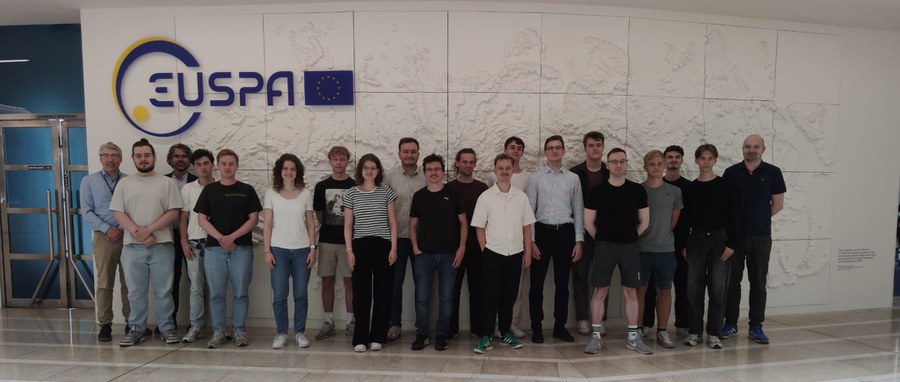
On 7 July 2026, 18 students from TUD Dresden University of Technology travelled to Prague to visit the European Union Agency for the Space Programme (EUSPA) as part of the “Space Economics” module.
The field trip was made possible with substantial support from the Verein zur Förderung des Faches Business Administration and Economics an der TU Dresden e.V. (Association for the Promotion of Business Administration and Economics at TU Dresden).
During a two-hour programme at EUSPA, the students gained valuable insights into the agency’s activities and responsibilities. EUSPA coordinates and supports the use of Galileo and Copernicus, two of Europe’s most important satellite programmes. Galileo, the European global navigation satellite system, provides highly precise positioning and timing services, while Copernicus, the European Union’s Earth observation programme, supplies data for environmental monitoring, climate research, disaster management and security applications.
Hannes Lachmann from the Office of the Executive Director and Christian Markheiser, HR Officer at EUSPA, introduced the students to the agency’s work and institutional structure. Stefan Schneider, Space Downstream Entrepreneurship Officer, presented the support available to young space companies through the EU’s CASSINI initiative. He explained the financial and non-financial funding opportunities offered to founders and start-ups in the space sector, particularly during the early stages of their development.
Christian Markheiser also provided information on career opportunities at EUSPA and encouraged the students to consider internships and other professional entry routes at the agency.
The presentations generated considerable interest and were followed by a lively discussion, during which the students had the opportunity to ask numerous questions.
In the late afternoon, the group returned to Dresden, arriving safely in the evening. The visit to EUSPA provided the students not only with a fascinating insight into European space activities, but also with a deeper understanding of the economic, institutional and technological interrelationships shaping the rapidly developing space sector.
We would like to thank EUSPA, and in particular Stefan Schneider, Hannes Lachmann and Christian Markheiser, for their time and for providing such valuable insights into the agency’s work. Special thanks go to the Verein zur Förderung des Faches Business Administration and Economics an der TU Dresden e.V., whose generous support made the field trip possible.