
Interview with Prof. Dr. Rainer Lasch
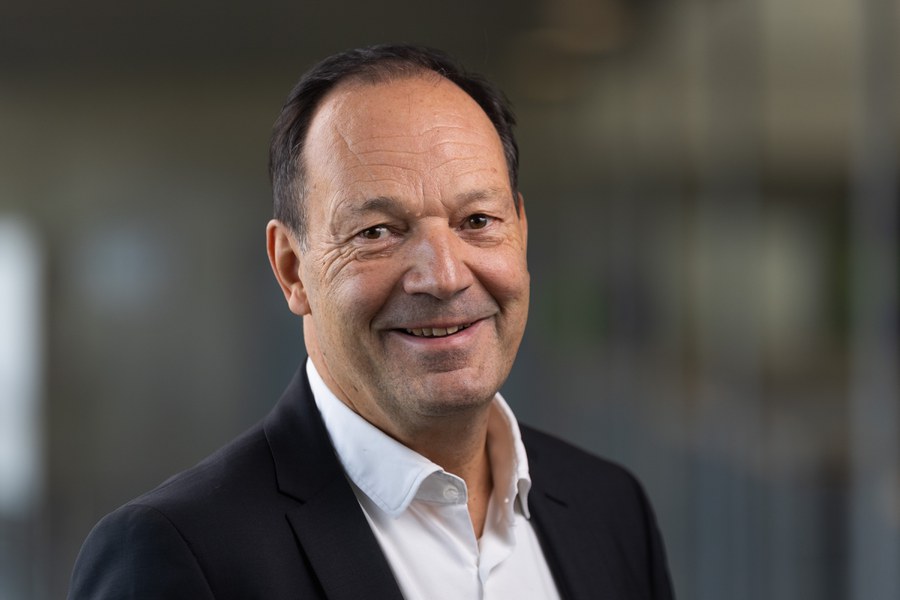
On 25.03.2026, the Faculty Board appointed Prof. Dr. Udo Buscher as the new Dean of Studies for Industrial Engineering and Management. Prof. Buscher takes over from Prof. Dr. Rainer Lasch, who has served as Dean of Studies for Industrial Engineering and Management since 2006. We asked him a few questions about how the degree program has developed over the past 20 years and whether he has any advice he would like to pass on to his successor.
Table of contents
- 1. What did you personally enjoy most about the role of Dean of Studies?
- 2. When you look back on your time as Dean of Studies: What were the most formative developments in the Industrial Engineering and Management degree program for you?
- 3. Which topics or challenges would you particularly like to recommend to your successor, Prof. Buscher?
1. What did you personally enjoy most about the role of Dean of Studies?
As Dean of Studies, I particularly enjoy directly shaping everyday student life. It is particularly fulfilling to further develop degree programs, introduce new focal points and teaching concepts and thus make a concrete contribution to the quality of education. You can see relatively quickly how changes have a positive impact on students - be it through clearer structures, better supervision or more practical content.
Another pleasant aspect is the exchange with different faculties and groups: students, teaching staff and administration each contribute their own perspectives. Bringing these together and finding solutions together can be very enriching.
Last but not least, it's fun to accompany Industrial Engineering and Management students on their journey - for example, when you see how they develop over the course of their studies or successfully graduate. This gives the role a very meaningful component.
2. When you look back on your time as Dean of Studies: What were the most formative developments in the Industrial Engineering and Management degree program for you?
Looking back, there were a number of structural and content-related changes that had a particular impact on the Industrial Engineering and Management degree program:
Change from Bachelor's and Master's degrees back to the Diplom degree
Due to the interdisciplinary nature of the Industrial Engineering and Management degree program, a bachelor's degree is not a practical solution. As the basics are essentially taught up to the fourth semester, there is little room for specialization. A Master's degree is therefore required in practice. With the diploma degree that the Faculty has reintroduced, students can choose their specializations in a goal-oriented manner and deepen these consistently without interruption up to the diploma degree.
Increasing digitalization of content
The integration of topics such as AI, data analysis, digital business models and automation has become increasingly important. Traditional engineering and business administration content has been increasingly supplemented by digital skills, which has made the degree program more modern and connectable.
Greater interdisciplinarity
The core of Industrial Engineering and Management - the combination of technology and business - has been expanded even more consistently. There are more project-based formats in which students can work on complex problems from different perspectives.
Internationalization
English-language modules, exchange programs and international cooperation have increased.
Flexibilization of study structures
Elective options and specializations have been expanded. Students can follow their individual interests more closely, for example in the direction of logistics, production, IT, energy or sustainability.
These developments have made the degree program as a whole more dynamic, practice-oriented and future-proof - and ultimately also reflect the changes in the economy and society.
3. Which topics or challenges would you particularly like to recommend to your successor, Prof. Buscher?
I believe that the following key topics i are crucial for the future of Industrial Engineering and Management:
Balance between breadth and depth
The degree program thrives on its interdisciplinarity - but that is also a challenge. It remains important to find the right balance: sufficient breadth to ensure interface competence, but also sufficient depth so that graduates can hold their own in specific professional fields.
Dealing with the dynamics of digitalization
Technological developments (e.g. Industry 5.0) are rapidly changing the job profile. The challenge is to continuously adapt curricula without getting caught up in short-term trends. The aim is to impart sustainable skills - i.e. an understanding of methods rather than just tool knowledge.
Ensuring and expanding practical relevance
The close connection to industry should definitely be maintained. Practical projects, real-life case studies and collaborations are a key success factor - but at the same time they are organizationally complex. Securing the right structure and reliable partnerships remains an ongoing task.
Sustainability not as an add-on, but as a guiding principle
Sustainability should not just be a single module, but should run through the entire degree program - in both technical and economic issues.
Sharpening the attractiveness and profile of the degree program
Competition between courses is increasing. A clear profile - for example through certain specializations or special teaching formats - is becoming increasingly important in order to attract good students.
If I had to put it in a nutshell: the biggest challenge is to keep the degree program stable and adaptable at the same time. But it is precisely this tension that is its strength.