
Jul 30, 2026
Olga Tcaci’s Successful Dissertation Defense
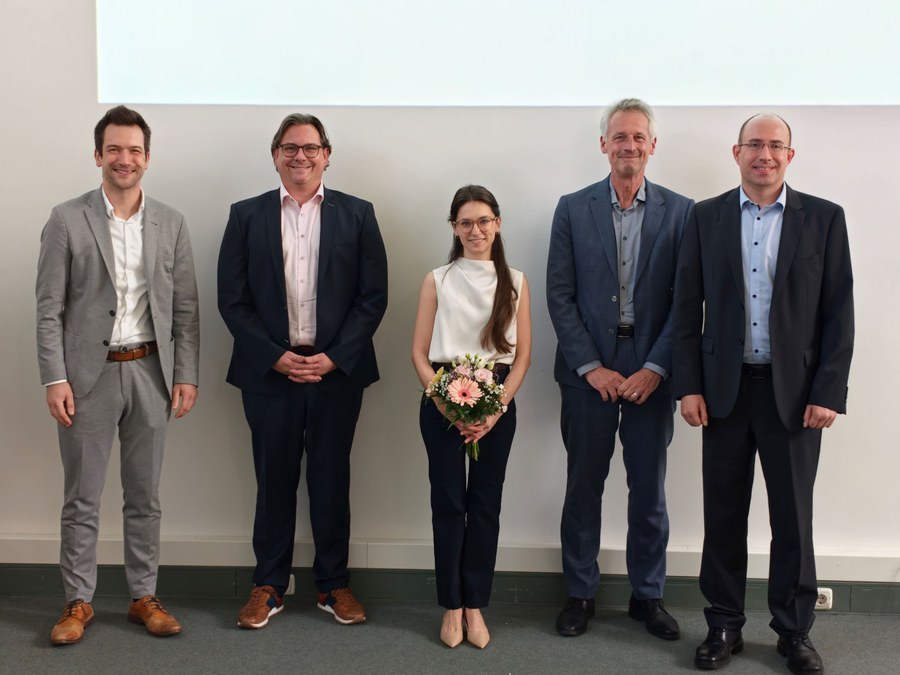
Olga Tcaci with her Doctoral Committe
The team at the Chair of Economic Policy and Economic Research expresses its warmest congratulations to Olga Tcaci on the successful defense of her dissertation, *On the Relations between Institutions, Knowledge, and Innovation*. We are so pleased with her outstanding academic achievement!
In her dissertation, Olga Tcaci examines, across four chapters, how formal and informal institutions influence the creation, dissemination, and use of knowledge and their impact on innovation, as well as the implications this has for innovation:
📌 “Intangible intensity and between-firm wage inequality” (published in *Economica*) uses European industry data to explain that the rise in intangible assets between 2000 and 2020 led to growing wage inequality across firms. 🧷Open Access: https://doi.org/10.1111/ecca.70015.
📌 "Innovation and regional development: The impact of patenting on labor market outcomes” demonstrates a causal link between innovation and economic development by analyzing knowledge complementarities between East and West German patents. In particular, West German districts that benefited from East German knowledge through joint patents after reunification recorded more innovations and higher incomes.
📌 “Loose bricks in the wall: Underground press and political opposition in non-democracies” (published in Public Choice) shows, based on the circulation of underground publications (samizdat), that regions with greater access to political knowledge led to gradual institutional change and, ultimately, the onset of democratization in the former GDR. 🧷Open Access: https://doi.org/10.1007/s11127-026-01401-w.
📌 “Population diversity and entrepreneurial motivation: Evidence from second-generation Americans” attributes the higher entrepreneurial propensity of second-generation U.S. immigrants to the prehistoric migratory distance of their ancestral populations in East Africa as a proxy for intra-ethnic diversity, mediated by greater dispersion and thicker upper tails in the distribution of human capital and skills.
We wish Olga Tcaci all the best and continued success in her future academic and personal endeavors!