
Lasare Samartzidis
Table of contents
- 1. What is the title of your dissertation? How did you come up with the idea of focusing on this topic?
- 2. What are the central research questions of your dissertation and what methods are you using to try and answer these questions?
- 3. You have been working as a research associate at the IOER since 2020 and are doing your doctorate at the Faculty of Business and Economics under Prof. Korzhenevych. Can you tell us why you moved to Dresden for your doctorate and what perhaps also makes the doctorate at the interface between the TUD and the IOER special?
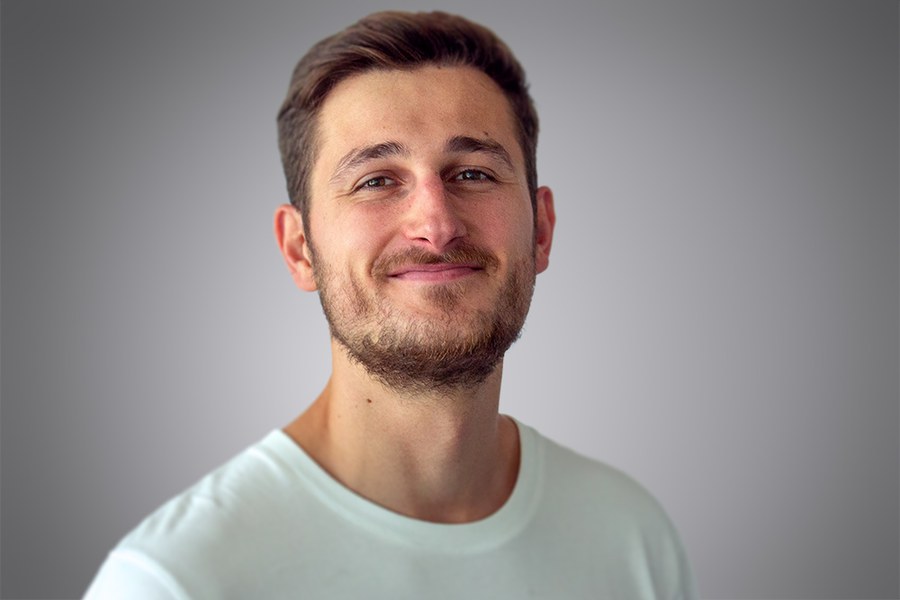
Lasare Samartzidis has been a research associate at the Leibniz Institute of Ecological Urban and Regional Development and a doctoral candidate of Prof. Dr. Artem Korzhenevych since 2020. In this interview, he talks about his doctoral project and presents the most important goals and results of his four research contributions.
1. What is the title of your dissertation? How did you come up with the idea of focusing on this topic?
In the distance you can often see out of focus. "Regional Sustainable Development - A complexity economics analysis" is the title of my dissertation, which initially gave me an outline of four topics that became increasingly clear during my doctorate. Before I came to the IOER, I worked at the Fraunhofer IMW in Leipzig, where I was already working on regional input-output models for the German economy. I was fascinated by the analysis of the highly networked economic processes and their effect on social development, partly because there are still major gaps in research in this area. The regional level is a particularly blind spot due to the poor availability of data. Just think of the existing differences between the federal states of the former GDR and the rest of Germany or the industrial core in Europe and the periphery. Another topic is sustainable transformation. I use the paradigm of complexity economics to approach the highly interconnected economy and its embedding in the planetary system analytically. This paradigm takes up the ideas of complexity research in order to answer economic questions.
2. What are the central research questions of your dissertation and what methods are you using to try and answer these questions?
I have asked myself the following research questions:
1) How do production networks affect regional development and inequality?
2) Can we use machine learning to generate new hypotheses for multidimensional indicators?
3) How well can current macroeconomic agent-based models model policies?
To approach these questions, my co-authors and I used different methods. For the impact of production networks, we used network research methods. In my first article, published in Spatial Economic Analysis, I conducted cluster analyses to qualitatively distinguish trade flows between German regions. In a second article, we used the production network to analyze the degree of specialization of production in European regions and used panel regressions to predict how this degree affects the bargaining power of workers. In the third article, published at Social Indicators Research, I used machine learning. Together with my co-authors, we collected a large number of regional indicators. Using this data, we trained a machine learning model to learn from it which are the most important indicators for predicting subjective well-being in OECD countries. In the fourth article, Rob von Eynde and I used Large-Language Models (LLMs) to provide a systematic model overview of macroeconomic agent-based models. This article also served to explore the possibilities of Large-Language Models for automating repetitive and labor-intensive tasks.
3. You have been working as a research associate at the IOER since 2020 and are doing your doctorate at the Faculty of Business and Economics under Prof. Korzhenevych. Can you tell us why you moved to Dresden for your doctorate and what perhaps also makes the doctorate at the interface between the TUD and the IOER special?
I've been living in Leipzig since 2019 and was delighted to be able to take up a doctoral position in Dresden after working at Fraunhofer. I was born in Dresden and it was nice to be enrolled at TU Dresden, at least for my doctorate, and to get to know the local research environment better. The research environment of universities and non-university research institutions in Germany is very different, so it was extremely exciting for me to gain an insight into both worlds. As research at the IOER is very inter- and transdisciplinary, I was also able to keep the disciplinary context through my doctorate at the Faculty of Business and Economics. I therefore found my doctorate at the interface very enriching.