
Nov 03, 2026
Annual Meeting of the Digital Health Research Group 2026: Exchange on Patient-Centred Care
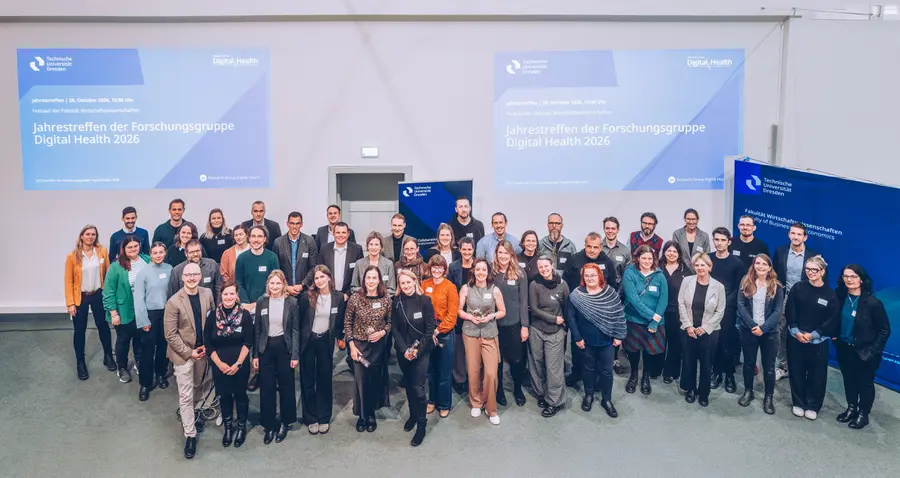
Annual meeting of the Digital Health Research Group on 28 October 2026 in the ceremonial hall of the Faculty of Business and Economics at TU Dresden
On 28 October 2026, the annual meeting of the Research Group Digitel Health took place in the ceremonial hall of the Faculty of Business and Economics at TU Dresden (Hülße-Bau). Following the welcome by apl. Prof. Dr. Hannes Schlieter, around 55 participants from research, teaching, care practice, health insurers and associations joined the afternoon programme.
The meeting opened with the keynote “A Digital Health Ecosystem in the Making” by Prof. Dr. Franziska Bathelt, Julia Backhaus and Philipp Michalke from the Medizinische Universität Lausitz – Carl Thiem (MUL-CT). The speakers showed how a digital health ecosystem is emerging in the Lusatia region that closely links digitalisation and health services research. They also invited the participants to take part in building this ecosystem.
During the coffee break, the research group presented current projects and solution approaches at project stands. Under the title “From the Pathway to the Patient”, Marcel Susky and Rebecca Scheel used the DigiHub MiHUB as an example to illustrate how digital patient support is designed along patient pathways.
The programme concluded with the panel discussion “Patient-Centredness in the Digital Age: Aspiration or Reality?” with Dr. Johanna Kirchberg, PD Dr. med. Jessica Barlinn and Prof. Dr. Franziska Bathelt. Emily Hickmann introduced the topic with an impulse talk and moderated the discussion. The central question was what digitalisation needs to deliver in order to make patient-centred care a reality.
Several key messages emerged from the discussion. Whether and how patients are involved should not depend on individual physicians. Patient involvement needs to be institutionalised more strongly and firmly anchored in medical education and training. Numerous good practices already exist today, for example in stroke aftercare. At the same time, the burden should not be placed on the shoulders of individuals, and language and support need to be tailored to patients’ needs. In addition to short-term feedback, a long-term view of care outcomes is required.
At the closing get-together, participants took the opportunity to deepen contacts and discuss joint initiatives. The research group thanks all speakers and guests for their contributions and looks forward to continuing the collaboration.