
Sep 04, 2026
Unmatched patent strength and exceptional innovative power: TU Dresden ranks among Europe’s top drivers of innovation
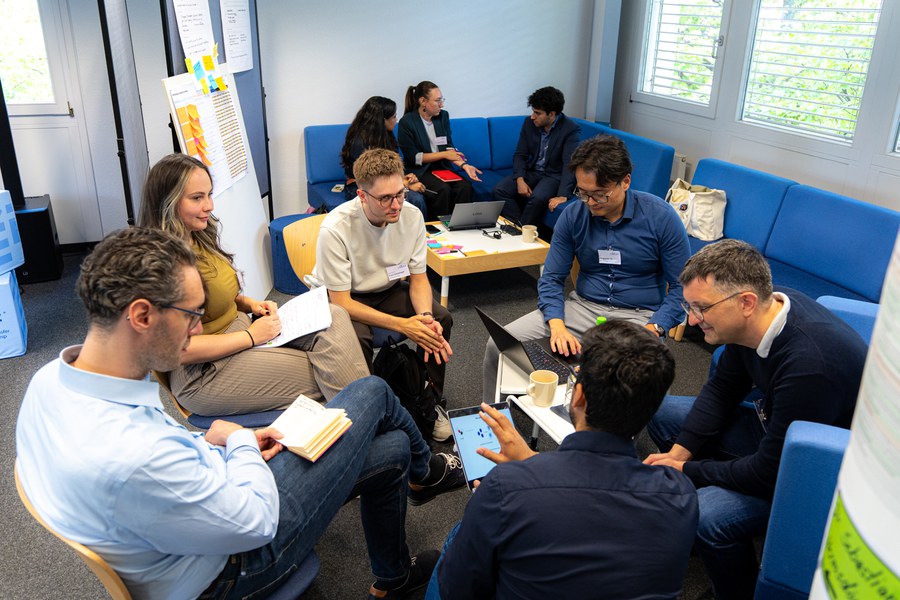
Teilnehmende der International TUD|excite Summer School
Recent Study Highlights TUD’s Strength in Disruptive Innovation
TUD Among Europe’s Top 10: In the study “More Does Not Always Mean Disruptive,” published in the journal Forschung & Lehre (Issue 9/26), Prof. Dr. Jörn Block (University of Trier), Prof. Dr. Hannes Lampe, and Dmitrij Minkin (both from the University of Kassel) examined a total of 82,324 patents from 1,605 European universities dating from 2000 to 2020.
Key finding: In the ranking of the 30 universities with the most disruptive patents, TUD ranks first nationwide and seventh in Europe, with a total of 1,600 patents filed, 62 of which are so-called disruptive patents. Disruptive patents are groundbreaking new inventions and technologies with the potential to set new standards. Noteworthy is the concentration described by the study’s authors: While the 30 universities with the strongest patent portfolios account for only 23.36 percent of all university patents in Europe, they account for 34.66 percent of all disruptive patents.
From Invention to Business Model: The International TUD|excite Summer School as a Practical Example
The fact that TUD not only researches this potential but also actively harnesses it is demonstrated, among other things, by the International TUD|excite Summer School, which took place last week in cooperation with the startup factory boOst and EUTOPIA. During the event, around 30 early-career researchers worked in international, interdisciplinary teams on selected TUD patents. The goal is to develop new product ideas and business models based on real technologies and copyright law—culminating in a final startup pitch. Study author and academic director of the Summer School, Prof. Dr. Jörn Block, sees this as precisely where research and practice intersect: “A format like our Summer School is incredibly helpful in raising researchers’ awareness of entrepreneurship. It brings about a shift in perspective. Researchers are forced to consider what it takes to transform inventions and technologies into marketable products and then, potentially, to found companies. This is anything but trivial. The rules of the game are completely different.”
Background: What makes a patent disruptive?
In the current study, the researchers distinguish between whether an invention merely continues an existing technological development (incremental) or whether it establishes a new technological path (disruptive).
This is measured using the so-called CD Index, which is based on citation patterns: Disruptive patents are cited particularly frequently by subsequent inventions—at the same time, the patents on which they are actually based lose significance because the new invention opens up a new line of development. A patent is considered disruptive if it ranks among the top five percent within its technology field and filing year. Of the more than 82,000 patents examined, only 4,512 ultimately met this criterion.
The authors emphasize: It is precisely these few patents that have a decisive impact on technological progress. Their universities are therefore of particular importance not only academically but also in terms of technology policy—as a starting point for new industries, spin-offs, and value creation that extend far beyond the individual invention.
About TUD|excite
The TUD|Center of Excellence for Innovation, Transfer, and Entrepreneurship (TUD|excite) brings together the central activities of TU Dresden related to knowledge and technology transfer, patent management, and spin-offs under one roof—from securing and commercializing intellectual property rights (excite|PATENTS) to translating research results into practical applications (excite|INNOVATE) and providing startup support (excite|STARTUP).
Study: Block, J.; Lampe, H.; Minkin, D. (2026): “More Doesn’t Always Mean Disruptive—Where Do Groundbreaking Inventions Emerge at Europe’s Universities?”, Forschung & Lehre, Issue 9/26, pp. 40–42.
Press Contact:
TUD Dresden University of Technology
TUD|excite – TUD Center of Excellence for Innovation, Transfer, and Entrepreneurship
Sarah Haaß, Communications Manager