
Apr 29, 2026
Startup Bootcamp MINT: From idea to business model in five weeks
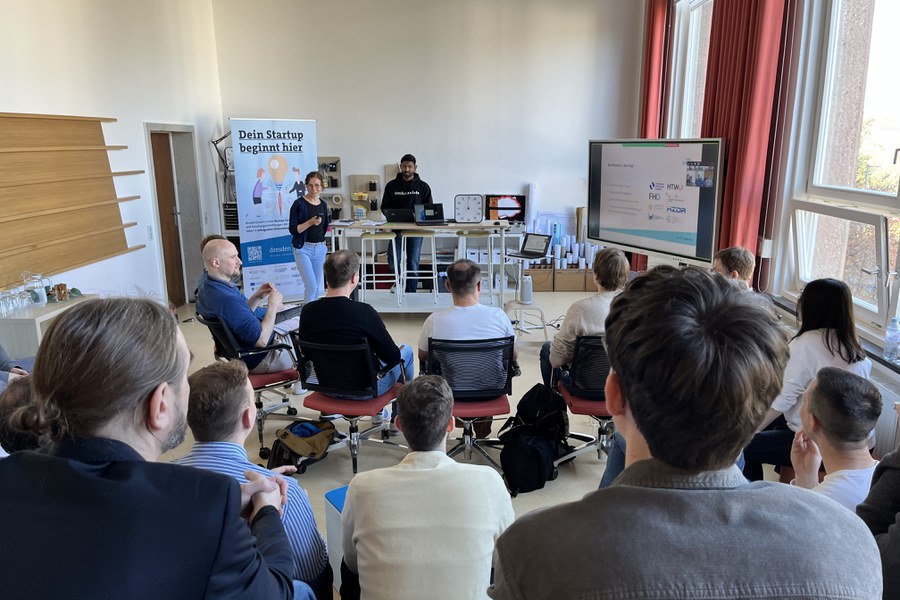
Pitchday - highlight of the Startup Bootcamp MINT
Five weeks are rarely enough to build a startup - but often enough to rethink an idea. This is exactly what the 20th edition of the Startup Bootcamp MINT by TUD|excite and dresden|exists was all about: developing viable and verifiable business models from initial technical or specialist ideas.
On April 15, the participating teams presented their results to an external jury of experienced founders and startup experts at the final pitch day.
Structured program with a practical focus
The bootcamp is designed to be compact and practice-oriented. Within five weeks, the teams go through three full-day workshops: a kick-off with a focus on idea presentation and prototyping, an in-depth part on business models (target groups, value proposition, market analysis) and pitch training to prepare for the final presentations.
The teams continue to work independently between the workshops. Regular feedback loops help them to check their assumptions and further develop their concepts in a targeted manner. In this way, an initial idea gradually evolves into a resilient business model.
Pitchday as a reality check
The pitch day is more than just a final event, but also an initial reality check. The focus here is on the key questions: Is the problem relevant? Does the solution fit the target group? How viable is the business model? And does the team manage to communicate the idea clearly and convincingly? Once again, the jury's feedback was direct, constructive and practical - exactly what is needed in the early start-up phase.
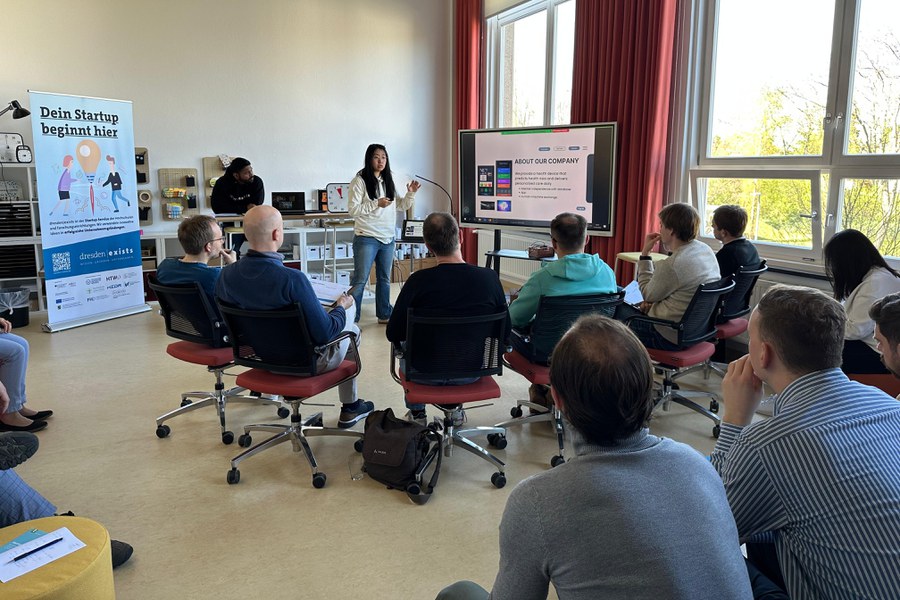
Reality Check fürs Geschäftsmodell: Der erste Pitch vor einer externen Jury.
Diverse project ideas from the STEM sector
The projects presented illustrate the wide range of start-up ideas in the STEM field, this time from TU Dresden and HTW Dresden:
- RobDog is developing a quadruped platform for support and navigation, including for blind people.
- Metis is building an AI-based coaching chatbot that provides individual support for further training and learning processes.
- MOSAI is working on an AI-supported solution for energy storage and transmission using molten salts.
- Spannungsregler is pursuing an approach for more efficient control of voltage converters for energy and data transmission, for example in the automotive sector.
- Tong1000 is developing a hardware-software solution for improved doctor-patient communication.
- ratarmount enables the intelligent integration, indexing and high-performance use of complex data structures.
Despite the different topics, all projects share a common goal: to translate technological innovations into concrete, relevant use cases.
Exchange and networking afterwards
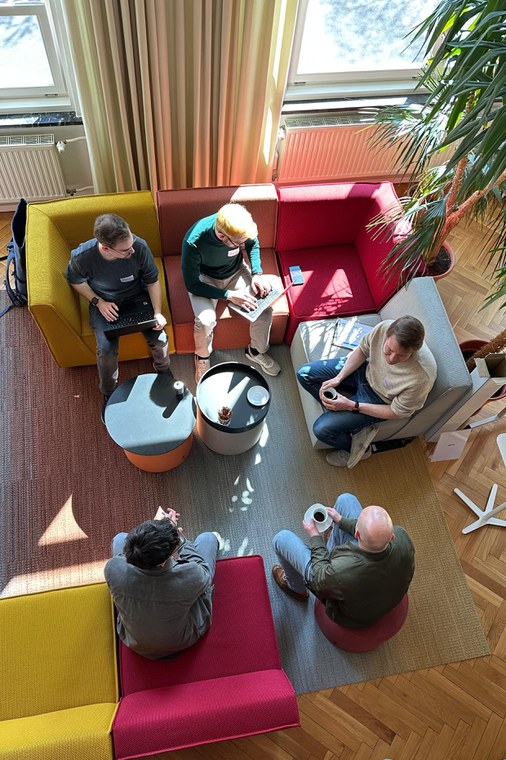
Gelegenheit für vertiefende Gespräche und neue Impulse
The presentations were followed by an informal end to the event with coffee and cake, which provided space for in-depth discussions and networking. This direct exchange enabled ideas to be discussed further and contacts to be made for the next steps.
Special thanks go to the jury members Felix Valentin (enerithm), Ansgar Jonietz (Was hab' ich?), Jan Kubenz (TU Dresden), Maximilian Bäumler (paioneers UG), Alexander Türpe (ExciteLab), Thomas Springer (flow.d) and Frank Peters (Evasive Robotics) for their commitment and valuable feedback.
Outlook
The Startup Bootcamp MINT is not a classic incubation program, but a structured development space for early start-up ideas. The aim is to quickly test and further develop STEM innovations and to integrate feedback from the field at an early stage. The pitch day does not mark the end of the programme, but rather an important intermediate stage. Some of the teams will continue to pursue their projects in the further course - for example as part of EXIST funding applications.
The next edition of the Startup Bootcamp MINT will start in September 2026 and the application deadline is August 31, 2026.
Further information on the program and application:
https://www.dresden-exists.de/startup-bootcamp/