
Jun 10, 2026
Interview with Bruce Brasington
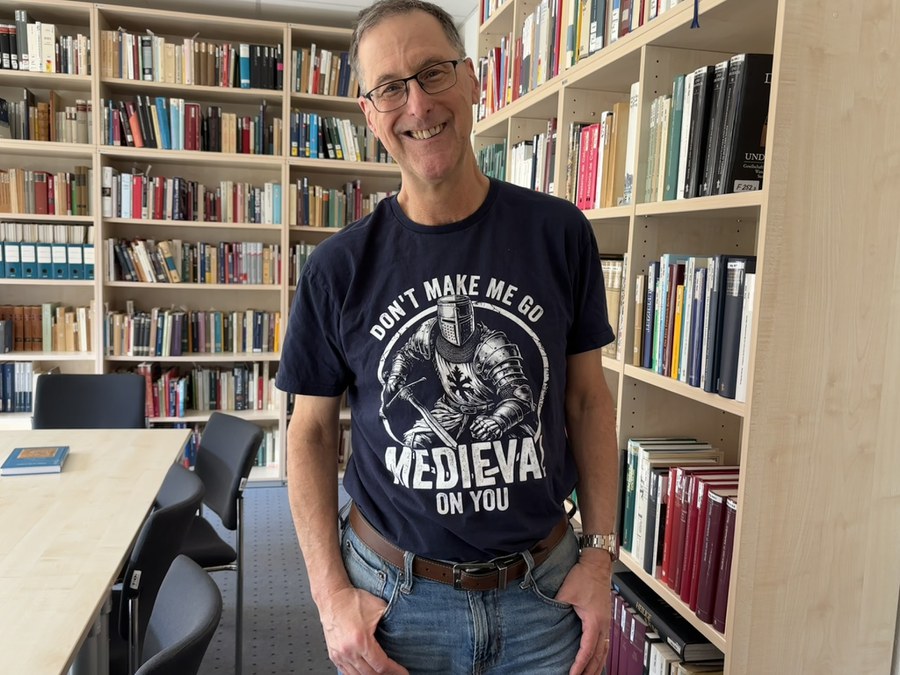
Prof. Dr. Bruce Brasington spent a week in May 2026 as a visiting researcher at the Research Center for Comparative History of Religious Orders (FOVOG) in Dresden. He researches and teaches at West Texas A&M University in the USA. In this interview, he talks about his current research, his connection to FOVOG and his favorite place in Dresden. The interview was conducted by Laura-Marie Lang.
What are you currently working on in your research?
I'm currently working on several projects at the same time. I am currently writing two articles for a handbook on canon law. In the first article, I am investigating the reception of Gratian's "Decretum" between around 1150 and 1215. I am particularly interested in how students and scholars worked with this work in the Middle Ages. I am therefore not only looking at the actual text, but also at marginal notes, commentaries and other traces in the manuscripts. A second project is dedicated to Gratian's influence on late medieval and early modern England. Although the "Decretum" was no longer used as law after the Reformation, it remained an important textbook and reference work at universities for a long time.
I am also working on several essays. I am currently particularly interested in a manuscript from Bamberg that has been little researched to date. It contains an unusual case history on identity, inheritance law and monastery foundations, which reveals interesting connections between canon law and civil law. Such texts show how closely legal theory and narrative motifs could be linked in the Middle Ages.
My biggest project, however, is a book on rare or unusual cases in medieval law. It deals with the question of whether rare events should serve as precedents in legal proceedings at all. During the corona pandemic, I was able to conduct very intensive research on this. Now the main focus is on working out the results.
What is your connection to FOVOG?
My connection to FOVOG and medieval studies in Dresden goes back many years. My first contacts came at the end of the 1980s through the medievalist Gert Melville. At the time, I was studying at UCLA in Los Angeles and got to know him during a visit. A few years later, he invited me to Münster, where I gave lectures and came into contact with medieval studies there.
When Gert Melville moved to Dresden in 1995, I was invited to FOVOG for the first time. Since then, I have been a regular visiting researcher and lecturer here. I have given block seminars and advanced seminars and have also been involved in international summer schools on the history of religious orders, in which students and early-career researchers from various countries took part.
Over the years, this has not only resulted in close academic collaboration, but also a personal connection with Dresden and FOVOG.
At this semester's FOVOG colloquium, you gave a lecture on 'The Summa Aurea' by William of Drogheda. What is special about this text?
The Summa Aurea by William of Drogheda is one of a series of medieval treatises on procedural law. I find it particularly interesting that William uses both canon law and civil law sources to deal with different aspects of legal proceedings, such as evidence, testimony and documents.
What is special about this text, however, is its extraordinarily practical perspective. Many legal treatises of the Middle Ages are aimed primarily at an academic audience and remain highly theoretical. William of Drogheda, on the other hand, takes a very practical approach. It is also striking that he deals with questions that hardly ever appear in other legal texts. As a result, the "Summa Aurea" provides a very direct insight into the legal practice of the 13th century. This is precisely what makes the text so exciting for my research.
Were you able to visit the city of Dresden during your stay? Is there a place in Dresden that you particularly like?
Yes, I know Dresden very well now because I've been here regularly for many years. I particularly enjoy spending time in Hellerau. The district interests me above all because of its cultural and architectural history. Especially in connection with reform movements and architecture around 1900, Hellerau is a very exciting example that I even mention in my lectures in the USA.
There are also some places that I personally associate with many memories. These include the Fischhaus and Café Weinberg, which I visit again and again during my stays in Dresden. Overall, Dresden has become a very familiar place for me over the years, and I always enjoy returning to it.